
A nineteen-year-old behind a high-street counter can lose the first rung of his working life while capital with no address builds the future, and that is the betrayal conservatism has mistaken for progress. There is a buildout going on and a high street going under, and they are the same transaction. Money without an address is being put to work in places that do, while the people who live in those places are asked to be flexible about the bill. The market was punishing the giants who bet on artificial intelligence, while a hedge fund tried to seize the boardroom of a patient investment trust. Around both sat the same mistake: a financial claim being mistaken for legitimate authority.
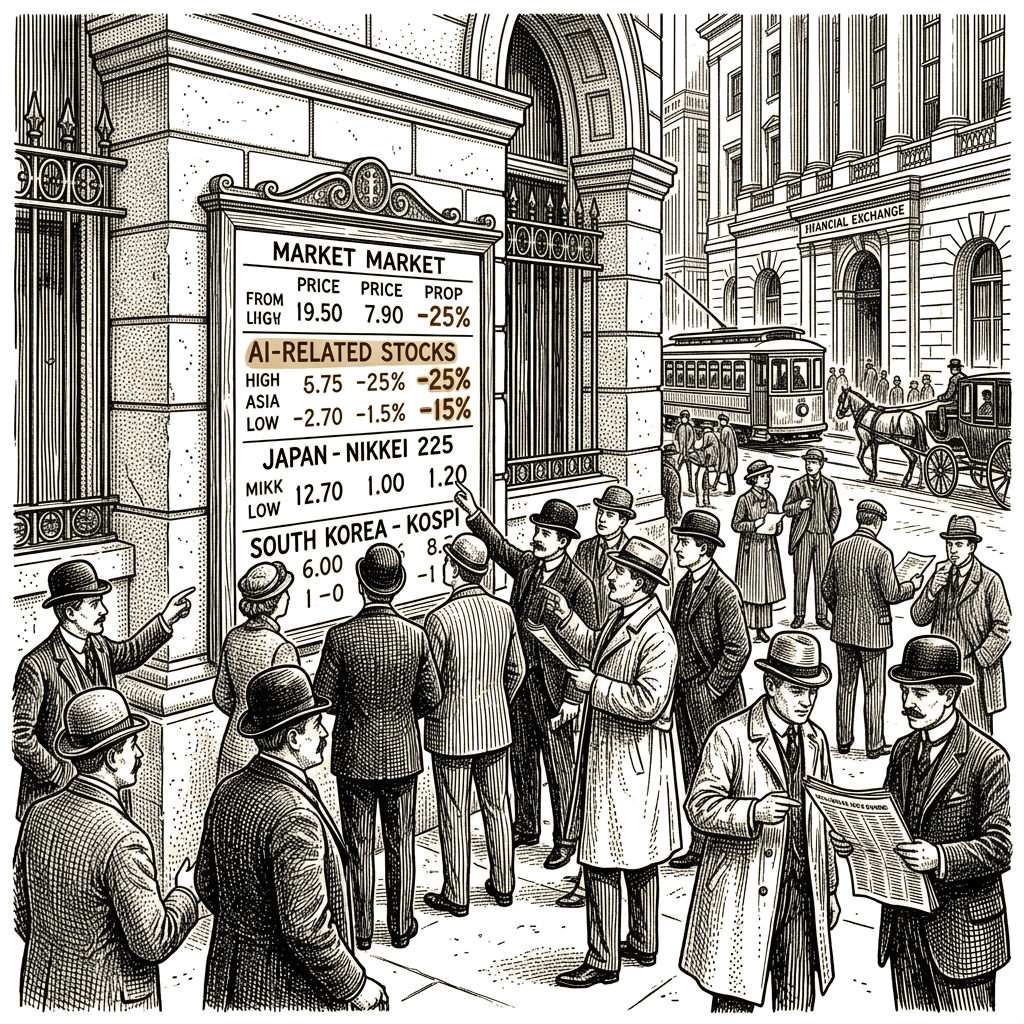
The market record from Thursday put the Philadelphia Semiconductor Index down 6.7%, its worst day since June; the Nasdaq down 2.6%, its biggest drop since June; and the S&P 500 down 1.2%, its worst since July. Friday’s open followed: the Dow down 171.3 points, or 0.32%; the S&P down 26.2, or 0.34%; the Nasdaq down 114.9, or 0.44%. Brent crude reached $113.17. In Britain, retail sales fell 0.4% in September against a consensus decline of 0.1%, while consumer confidence fell eleven points in a month to minus 24—the sharpest fall since the Brexit vote and the sharpest outside the pandemic. This was not two shocks that happened to arrive together. Investors were growing anxious about what the AI buildout would earn. Households, squeezed by fuel and utilities and a budget due on Wednesday, were cutting back. It was the second morning of the same selling.
Britain is not sliding, however, and the honest conservative case must begin there. The preliminary composite PMI rose to 53.1 in October, its strongest since February. Businesses credited AI investment spending and demand for technology services, and for the first time since hiring fell after the autumn 2024 budget, firms were taking on workers. Total retail volumes still rose 0.7% across the quarter. Part of September’s fall was only weather: an unseasonably warm month meant the coats stayed on their hangers, and October may give some of them back.
Capital really does build things. Some of that money is buying transformers, towers and turbines, and no grid was ever built on sentiment. Production is the good life. A country investing in machines, power and people is doing the right thing, and a conservative ought to say so plainly. The case I am making is therefore not against the buildout. It is against the fact that the buildout has no address.
And here is the rate that binds all of it. The buildout is financed with borrowed money; so is the household paying for the power. Rob Wood of Pantheon Macroeconomics judged a November rate rise effectively settled, with another expected in February and a third a close call in May or earlier. Chris Williamson of S&P Global Market Intelligence said price pressures remained dangerously elevated. The 10-year Treasury yield fell 16.6 basis points to 4.95% in the risk-off move, the market clutching safe government debt even as expectations of further rate increases hardened.
A higher policy rate prices a substation, a mortgage and another order for transformers. A cheaper rate flatters all three. The cruel part is that weak consumer signals are already the brake on the third increase: the households being crushed are helping hold off the rate that would tighten the buildout. That rescues nothing. It means the suffering and the investment squeeze are already wired into the same decision.
The fight over the Baillie Gifford US Growth Trust was the most honest struggle of the week, and it was fought in the wrong place. A governance complaint can be genuine without conferring title. Directors can waste money, indulge a fashionable portfolio and mistake their preferences for prudence. A holder of nearly 30% of the shares has standing to demand an answer. Concentrated capital should not receive a veto merely because its owner is loud. But it does not acquire consent merely because its owner is rich.
For the third time, the independent shareholders rejected Saba Capital’s three board nominees, 53 to 47, on an 84% turnout; 99.5% of the independents backed the board. A near-30% holder and a 7.7% ally had been outmanoeuvred. The chairman was jubilant and annoyed. It was a victory, full stop.
Those were not votes for complacency. They were votes for people who had held strategy through the boom and whose capital was not tactical. The vote rejected another raid, not scrutiny. Strategy requires memory, and memory requires people with standing. Big capital can buy a seat at the table. It cannot decide what the future is for.
But voice is not ownership. Saba’s nearly 30% did not buy a farm. It bought a seat on the board of a trust whose assets were companies in cities none of those shareholders would ever set foot in. The shareholders who said no had nothing but their votes to say it with. No milk in the tank. No payroll in the town. No stake in whether the thing survives them. They were members of an institution that could be taken over at nearly 30%.
The buildout’s own capital sits in exactly this sort of vehicle: a place where small holders can vote but cannot say who pays for the wires, who owns the transformer, or which town gets the substation. Voice is not ownership. We have confused the two for a hundred years, and the confusion has a price. The price is always paid by somebody who lives in the place.
Before crops were planted, a futures contract on corn, cattle and beans could be a useful instrument. It let a farmer sleep and a mill plan production. Then finance began trading the expectation of finance trading at a larger scale, with more leverage and fewer people obliged to answer for the result.
I know exactly what those contracts are, because I sold them for years. I traded agricultural futures in Chicago—paper claims on corn, cattle and beans—and I know precisely how little the men in that building thought about the men in the field. The contract was worth more than the corn precisely because it could leave. It could go to a tower in Jersey while the crop it named came up in a field in Wisconsin in weather nobody in Jersey held an opinion about, and the margin settled against a farmer who had to get the rain right and the basis right and the storage right all at once.
That machine has not been retired. It has simply been handed a larger story. The story now is that the capital of the world is going into a future whose electricity, water, steel and roads are somebody else’s county’s problem.
Meanwhile, households spent more than 30% more on filling their cars than they had the previous September, which is how the pump takes a bigger slice of the same household budget. Then came the detail that stayed with me: Tesco, Costa Coffee and the Co-op—the shops themselves, the ones whose names are on the high street—went to the chancellor to ask him to undo a piece of policy his predecessor had made.
The threshold at which an employer starts paying national insurance on a young worker had come down from £9,100 to £5,000 a year, and the retailers argued that the change had helped kill high-street jobs for young and part-time workers. They asked for £6,000. I have no doubt about the mechanism, even where I would not put the whole weight of the high street’s decline on that threshold: a nineteen-year-old used to buy his first wage on a Saturday behind the counter of a shop that taught him how to be a person who works. Take the first rung away and you have not saved money. You have closed a door.
The pub was being told to plan for a thinner custom. Heineken, the world’s second-largest brewer, warned its British pub customers that the boom in weight-loss drugs would mean “fullness and fewer serves”—fewer pints on the night, fewer visits, less money across the counter—and recommended half pints, low- and zero-alcohol drinks, and small plates to go with.
I have no quarrel with the medicine and none with anybody’s body. That is not what concerns me here. A pub was never valued for its throughput. It was valued for what happened in a room where the same forty people came back every week and nobody had to buy anything to stay. That room was the last institution most towns had that nobody had to charter and nobody had to fund, and no balance sheet ever held it—which is precisely why it goes first when the numbers get hard.
The government has promised an unprecedented intervention with the water companies over bills, leaks and sewage overflows, and no one should begrudge the minister that. The question underneath it is older and more conservative than the regulator: who owns the pipes, and who is left holding the dig?
Here is what that looks like at the level of a place, because I live in one. Adams County was a railroad town. The Chicago & North Western’s Adams Cutoff began carrying trains in 1911, made Adams a division point, and for fifty years the place ran on crews, roundhouses and the wages of men with families. The last scheduled passenger train ran on July 23, 1963, and the work went with it, in pieces, for a decade.
In the neighboring paper-mill country of Wood County, the mills went next: Port Edwards in 2008, Whiting in 2010, and the century-old mill at Wisconsin Rapids idled in June 2020 with about a thousand jobs gone. Then came the subtler hollowing. The VFW hall emptied as the veterans died off and the young men who came home had nothing left to give it. Our Catholic parish at St. Leo’s goes back to 1884 in the county’s memory; its little frame building stands on West Street, and the diocese shuttered the rural parishes around it. The old Niebull one-room schoolhouse eventually moved into the county historical society’s museum.
Across Wisconsin, dairy farms went from 16,886 in 2002 to 6,216 in 2022, and the average herd from fifty-six cows in 1997 to two hundred and three in 2022. That is what consolidation looks like on the land: fewer operators, bigger herds, more miles between the barn and the bank. My family’s own ground is now somebody else’s irrigated potato field.
The county’s population fell to 7,566 in 1960 and has climbed back to a little over twenty thousand, which looks like recovery until you learn that roughly half the housing units are vacant and seasonal, roughly a third of the people are over sixty-five, and the labor-force participation rate—48.6% in 2017—was the lowest in the state.
We did not get new work. We got a golf course out on the sand barrens, first opened in 2017, whose builders hoped to become the biggest employer in a county that then employed about 160 people. We got lake subdivisions on Castle Rock and Petenwell. And a good many of our children now serve people who came up for the weekend.
This is not nostalgia. It is what happens when distant capital can treat a community as a location on a spreadsheet while the people who remain are filed as costs outside the calculation. The place itself becomes an input in somebody else’s model.
Conserve what, exactly? A hedge fund’s right to an annual hearing? A price on a screen? The point of conservatism was never to conserve the ownership of the few. It was to preserve the capacities in which ordinary people can live, work and govern the institutions that hold their lives together.
The high street, the pub, the parish, the VFW hall and the family farm were not quaint relics. They were mediating institutions. Each gave ordinary people standing, memory and a practical knowledge that no distant fund could buy. The buildout can produce real things and still consume the civic life in which those things matter. Big capital can buy a stake. It cannot buy the future.
The opposite error would be to answer concentrated capital with a public command: a ministry to plan artificial intelligence, finance, housing and water for us. I know that temptation in my own tradition too. When the market breaks, the state looks like shelter. But a ministry in London or Washington will not know what a county worker needs any better than a fund in New York does; both substitute command for knowledge. Oakeshott’s preference for “the familiar to the unknown, the actual to the possible” is not nostalgia. It is humility about the distance between a planner and the people whose lives the plan will enter.
What gets built must not be a giant masquerading as a community, nor a ministry pretending to be a household. The answer is ownership with a home address: the member-owned electric utility, the credit union, the farm-marketing cooperative, the worker-owned shop, the mutual insurer and the local paper.
In Friendship, the Adams-Columbia Electric Cooperative offers the pattern in hard infrastructure. Member-owners elect the board of a utility whose capital must answer to them. The machinery is useful; the capital is patient; the authority remains close enough to hear the people who use the service and bear the risk. The earth was given for all. A private balance sheet is not a claim upon every useful machine.
A cooperative is not a sentiment. It is a different legal instrument. A share in an ordinary company is a claim on somebody else’s future, priced daily; it goes to whoever bids highest and can be resold to a stranger in a second. A member’s share in a cooperative is a claim on an actual thing—a warehouse, a fleet of trucks, a plant, a herd, a line—that is not resold out from under the people who built it. The people who built it are the owners. They vote one member, one vote. The board is elected and can be dismissed.
At Mondragon, the Basque federation of worker cooperatives, 70,085 people worked for €11.213 billion in sales in 2024, and the highest-to-lowest pay ratio inside the works ran roughly five to one. The workers who live in the town where the factory stands have a reason not to vote for a plan that hollows out their own street. Organic Valley, in La Farge, Wisconsin, an hour and a bit from my own county, unites more than 1,600 family farms and does more than $1 billion in sales. The farmers own it. That is the reason it is still there. Ask what would have become of those farms if ownership sat in a trust in an office somewhere with a ticker and a manager with a bonus, and you have the whole argument.
Do not mistake me for an optimist about cooperatives, because I manage one. The trouble is old and named. Beatrice Potter set it out in 1891, the Webbs said it again in 1914, and the fear is that a cooperative drifts back into a company with a front of collegiality and a managerial oligarchy behind it. A 2022 review of 83 enterprises found that most either resisted that degeneration or regenerated; only a small minority fully degenerated. The danger is real. It is not the greater danger.
REI, which is member-owned and has more than 25 million members, took in about $3.5 billion in 2024 while running a deficit. A cooperative can fail like anything else. It just fails in a different room: the same people who have to live with the failure are the ones who have to go into the meeting.
But the part people forget is the part I want to press on: member ownership is not built out of thin air or out of virtue. It was built with cheap public credit. The Rural Electrification Act went on the books in 1936, and by the end of 1938 roughly 350 cooperative projects in 45 states were serving about one and a half million farms, because the investor-owned utility would not run a line out to a house at the end of a sand road. The difference in that era was not virtue. It was the rate on a loan.
Adams-Columbia Electric is the child of that arrangement. It sits on Lake Street in my own village of Friendship and serves more than 31,000 member-owners across about 2,500 square miles. Its seven-person board is elected by the members and can be dismissed. The state is a very good creditor. It is a very bad owner. Every generation of conservative has said we do not want the government running things, and almost none of us has ever said we do not want the government lending cheaply to people who will own the thing and live in it.
Conserve what, exactly? A market is an engine. Engines do not conserve anything; they consume whatever is put in them, and they do not remember where they were.
It is harder here than it was in 1936, and I will not pretend otherwise. The REA had a country full of farm families who could take a share and sit on a board. We have a county where the labor-force participation rate is 48.6%, the median age is fifty-five, and almost half the homes stand empty until May. Building such things asks people to attend meetings, accept less spectacular returns, discipline management and refuse the convenience of surrendering decisions to somebody richer. It is harder because we have been taught to call centralization efficiency. It is harder because a giant can lobby for the rules while a cooperative cannot buy the same attention. It is harder than waiting for the next rescue.
I have watched storefronts on this street close one after another for the better part of two decades. I have sat at the co-op counter year after year and watched the young ones not come back. So the honest answer to what should be built is not a program. It is a meeting. Seven people elected by the people who live under the lines, deciding together where the next substation goes and what the rate will be, and then having to live with that decision for the next thirty years. That is the entire difference between owning a thing and holding a claim on it.
The load and the asset have to be put on the same table: what new load arrives, what the substation and wires cost, who is permitted to connect, and who pays. If a new industry wants the county’s power, the members can refuse it, ration it, or price it so that its infrastructure is not quietly charged to everyone else.
That is what standing means. It is the power to say no, in public, to the people who want the load. Everything else—the trust, the fund, the ticker, the trading floor where I learned to sell the weather to strangers—is a way of arranging not to have that meeting.
AI can make a fine servant. Make it the master and it will begin by pricing out the places that made us. We do not need one firm to survive. We need a county in which many people can own something.
I sold it for a living. I do not think it was ever a good idea, and I think the county that comes through this will be the one that says no to the traders and yes to the members. There will not be many of them. There never are.