
Trump is preparing to send soldiers back to die in Iran.
At the kitchen table, another Iran war does not arrive as a target list. It arrives as money at the pump, a workplace strained by absences, a military family planning around separation, a community asked to carry another deployment, and taxes paid by people who never chose the fight. The people making the choices can put distance between themselves and those consequences. Working Americans cannot.
Donald Trump is the political power behind the decision. The White House and Pentagon are preparing the options, Secretary of State Marco Rubio is handling the diplomatic side, and the Navy is moving the ships. The corporate power is the defense market dominated by Lockheed Martin, RTX, Boeing, Northrop Grumman and General Dynamics. More fighting means more weapons, maintenance and sustainment contracts.
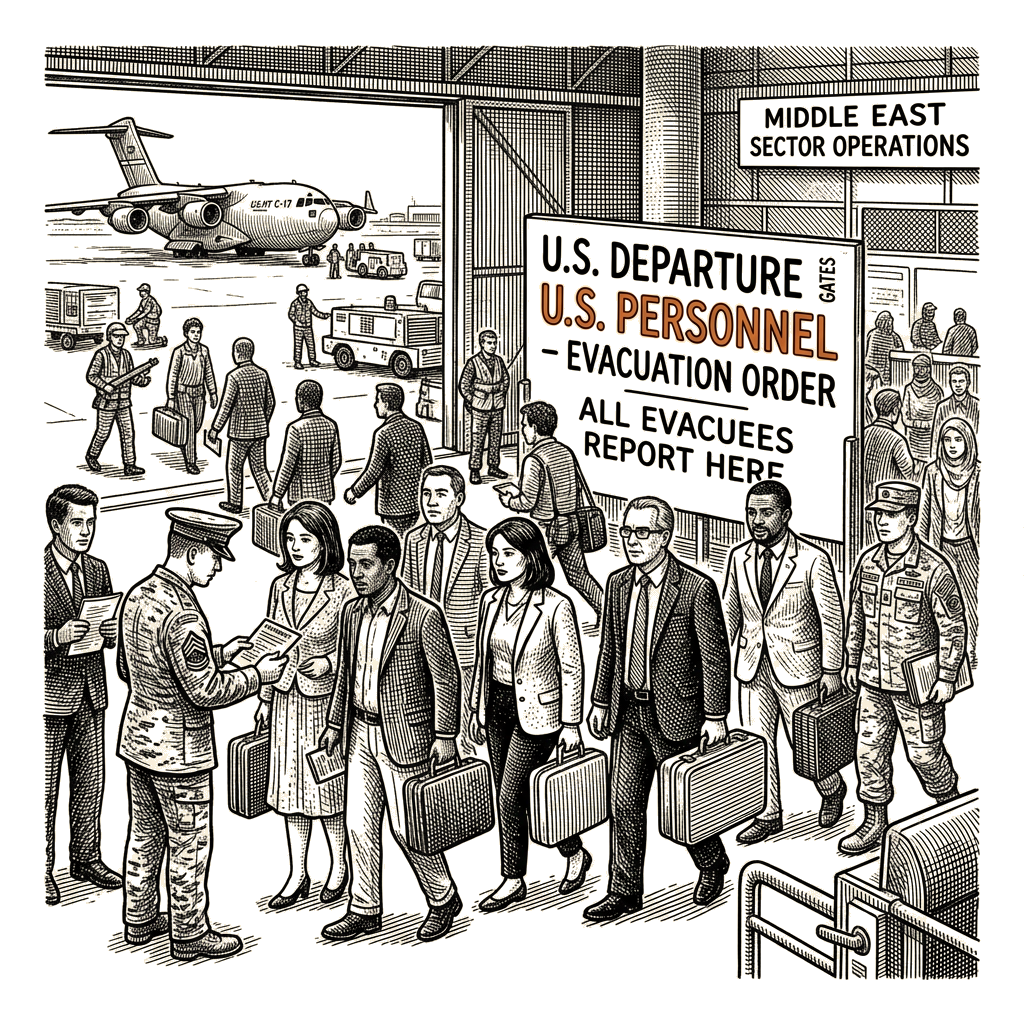
The first sign that Washington expects another Iran war is not a presidential address. It is an evacuation order.
American diplomats and staff have been pulled from embassy posts across the Middle East, including Saudi Arabia, while military personnel have left bases throughout the region. The State Department updated travel advisories for 13 Middle Eastern countries. Earlier this month, the United States evacuated bomber aircraft from a base in Britain after intelligence indicated an Iranian plan to attack the aircraft and their crews.
A Friday memo from Director of National Intelligence Jay Clayton to Rubio said Iran had “substantially increased efforts to target U.S. personnel”. The lethal plotting, Clayton wrote, had reached “advanced stages” in the Middle East and certain other countries. U.S. officials confirmed the memo and the intelligence behind it.
The evacuations were initially attributed publicly to threats from Iran-backed Houthi militants in Yemen. But a U.S. official said suspected Iranian terror plots also informed the decision. Four embassies have cut staff after the Iran threat memo.
These are not scattered embassy housekeeping. They are a regional pullback driven by an assessment that Americans are being prepared for attacks.
Evacuation is not retreat. It is sequencing.
Washington is removing its people from targets before those targets become available. Diplomats and base personnel move away from vulnerable outposts. Aircraft, Marines and strike fleets move toward Iran.
The machinery is already moving. U.S. officials say the Trump administration is preparing to resume strikes on Iran after the Nov. 3 midterms. Trump told a rally in Florida that the United States might conduct “another little ‘Epic Fury,’” using the name of its military campaign against Iran.
The president has been briefed on options prepared by the Pentagon ranging from strikes on Iranian nuclear facilities and infrastructure such as bridges to assaults on islands controlled by Iran. Trump is leaning toward renewed major combat operations, although no final decision has been made.
White House officials had previously said there would be no renewed operations against Iran before the election. Waiting until after the election is not de-escalation. It is campaign scheduling.
Two aircraft-carrier strike groups are already in the Middle East, with a third coming from the Pacific. The USS George Washington has received a large shipment of standoff land-attack missiles and bunker-buster bombs in the Arabian Sea. Another amphibious assault ship loaded with Marines is inbound, expanding Washington’s options to seize territory. Once the additional carrier group and Marine expeditionary unit arrive, the Navy will operate more than two dozen ships in the region.
It is unclear how long all three carriers will stay in the Middle East. That is the signature of a force assembled for a decision, not withdrawn from one. This is not a posture for passive defense. It is the architecture of war.
The contradiction is staggering. Pull people away from vulnerable outposts. Assemble the instruments of a larger campaign. Offer the president a menu of targets. Let the ballots cast.
That is not the posture of a government preparing to end a war. It is the posture of one waiting for a political clock to authorize the next one. Washington is telling Iran that restraint is temporary and force is arriving.
Who benefits when the war menu grows? The contractors. Who pays for the menu? Workers, military families and the public.
Critics of renewed strikes say global energy prices would rise. That is where the war enters the weekly budget. If energy prices rise, families see it at the pump, employers see it in diesel freight and building costs, and workers feel it when businesses pass the cost along or hold wages down to protect margins. A military household carries another cost: a service member’s absence changes work, pay, family plans and care. Communities asked to host another deployment carry the rest.
Congress has to supply the money. It comes from the public, through taxes and the debt those revenues repay. Every new demand for military money is a claim against wages, prices, public services and family budgets.
That does not pencil out as foreign policy. It is a transfer from working households to the Pentagon’s budget and the contractors’ order books.
President Dwight Eisenhower warned in paragraph 24 of his January 17, 1961 farewell address of “unwarranted influence” from the military-industrial complex and called for “an alert and knowledgeable citizenry.” The plain meaning here is not a slogan. In the war Washington is preparing, the contractor market gets the orders, the president gets the option to demonstrate resolve, and the worker gets the fuel price, the tax vote and the military-family absence.
The evacuations themselves are prudent. Iran has planned lethal attacks against Americans, and protecting those Americans is necessary. But a threat assessment is not a blank check.
Before the war began in February, Trump administration officials warned that Iran might strike American targets first and said such a strike would necessitate U.S. pre-emptive attacks on Iran alongside Israel. Now Tehran’s preparations are treated as evidence of danger, while Washington’s preparations are called prudence. That logic can turn every Iranian defensive measure into an American justification for escalation. The war manufactures its own reason.
The proposed answer is strategically empty. Another missile barrage will not compel Tehran to surrender its nuclear program. Iran does not have to surrender politically. It only has to survive long enough for American resolve to weaken, for allies to fracture, or for an American president to discover that another round of bombing costs more than the obedience it purchases.
You can break a bridge. You cannot bomb a government into consent.
Renewed strikes would supply destruction without a new mechanism for compelling surrender. They would also raise global energy prices and hand Tehran a stronger incentive to widen the conflict through proxies and asymmetric attacks. The destruction would be immediate. The political result would remain beyond reach.
Tehran understands the calculation. Iranian Foreign Minister Abbas Araghchi warned that Iran had emerged stronger after the last war. His warning was blunt: “Want to try your luck again? Be our guest. But be careful.” He put it more plainly still: “We have unfinished jobs too.”
That is not the rhetoric of a country preparing to surrender. It is the promise of retaliation. The last war did not settle Tehran’s behavior or eliminate its ability to answer. Both sides rebuilt the machinery for another round.
Congress should refuse to let the president convert a threat assessment into permission for another campaign. Any renewed major operations of this scale should require a new and specific congressional authorization stating the legal basis, military objectives, permitted targets and geography, reporting requirements and limits on duration. Funding should proceed through ordinary appropriations, without open-ended war authority hidden inside an emergency spending measure. A fleet can sail on a vote. It cannot sail on a blank check.
Call it deterrence if you like. The truth is that the last war failed to settle anything, and Washington is preparing the next one under the same logic. Nov. 3 may be the date. The weapons provide the reality.
Trump can empty the outposts and fill the Arabian Sea with bombers. He cannot keep the fuel bill, the tax vote, the workplace strain and military-family grief away from the rest of us. The workers pay the bill.