The Trump administration is trying to erase the debt of slavery.
Joe Martin, 46, a Delta flight attendant, knows that attempt from the receiving end. He is a reparations recipient in Evanston, Illinois, where the government built a legitimate program and then, in his words, “the government’s like, naw.”
America is preparing to celebrate 250 years. The administration is using the anniversary to obstruct the people trying to make the nation confront what it built, profited from and never repaid. Forty acres and a mule was America’s broken promissory note. It was never paid, never formally canceled and, for much of our history, too taboo even to say out loud. Now the word has come loose, and Trump is using it to attack the idea of repair.
In Evanston, N’nanba (Robin Rue Simmons) turned that argument into action. She helped create a $25,000 housing grant for Black residents whose families were harmed by discriminatory housing policies. Now she is taking Evanston’s program—the nation’s first municipal reparations program—to more than 100 communities. One city made the argument concrete. More than a hundred communities could make it a national precedent.
The work is painfully modest beside the wealth extracted through centuries of slavery and Jim Crow. But it is real. A grant reaches a family. A scholarship reaches a descendant. An institution identifies the people whose freedom was stolen and whose unpaid labor helped build American fortunes. The Trump administration’s answer is to obstruct, discourage and erase.
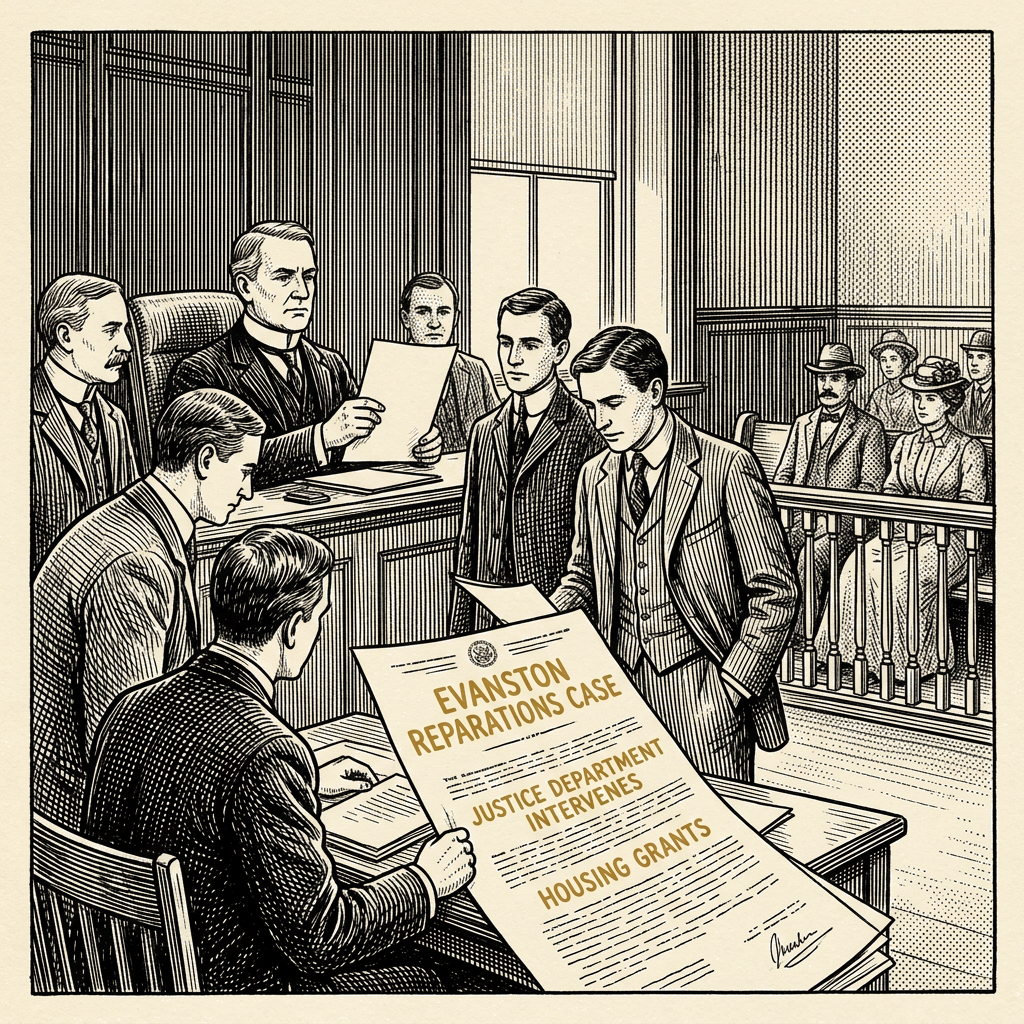
Its answer to Evanston has been a lawsuit. Trump’s administration sued Evanston’s housing reparations program in June 2026, and the Justice Department joined the legal fight in September. A federal judge has allowed the department to intervene. The administration alleges that the program violates the Equal Protection Clause and the Fair Housing Act. Plaintiffs contend that Evanston distributes money on the basis of race without identifying specific harm.
That premise would be easier to accept if the harm had not been racial. Enslavement stripped generations of Black Americans of their freedom and any meaningful share of the fruits of their labor. Jim Crow segregation, housing discrimination and systemic racism then crippled their ability to build wealth on the same terms as white Americans. That wealth remains concentrated among white families. Follow the benefit: the grants reach descendants whose families were harmed, while the lawsuit asks a court to leave inherited advantage untouched. Race neutrality cannot repair a racialized theft. It can only decline to name the people who were robbed and the people who profited.
Trump told supporters in September that reparations seekers wanted to “steal your money,” that the country did not have that kind of money and that reparations were “going nowhere.” They are not going nowhere. They are being tried in court.
The world has moved in the opposite direction. In March, the U.N. General Assembly declared the trafficking of millions of enslaved Africans “the gravest crime against humanity” and called for reparations. More than 120 countries supported the resolution. Fifty-two abstained. The United States voted against it, joining only Argentina and Israel. Washington could not muster enough governments to isolate itself abroad, so it has concentrated its opposition at home—in Evanston, at Harvard and in a sweeping campaign against race-based initiatives.
That makes the administration’s position more revolting, not less. Equality before the law cannot mean preserving the economic consequences of state-backed racial theft. The government cannot invoke colorblindness as a reason to refuse to remedy what racism created. Equal protection is not permission to preserve the loot.
The scale of the unpaid debt is not open to interpretation. The transatlantic slave trade forced an estimated 12.5 million Africans onto ships bound for the Americas; about 1.8 million did not survive the crossing. Roughly 388,000 enslaved people were taken to what is now the United States, where their enslavers maintained a system of chattel slavery, treating the enslaved and their children as property until abolition in 1865. Jim Crow segregation, housing discrimination and systemic racism then compounded the theft by preventing Black families from accumulating wealth on the same terms as white Americans.
The promise of “40 acres and a mule” was broken. And for a long time, calling for repair was treated as taboo.
William Darity, who has written about reparations with A. Kirsten Mullen, put the contradiction plainly: “Now, Trump will speak the word, but with hostility.”
The hostility is already doing damage. Harvard’s researchers identified nearly 500 living descendants of people enslaved by the university’s past leaders. Days after Trump returned to the White House in January 2025 and signed an anti-DEI order targeting universities, Harvard fired the entire team. Outside research has continued. Redress has not.
That is not an isolated retreat. Across higher education, new reparations initiatives have stalled. Some Virginia universities are quietly arranging scholarships to descendants under a 2021 state law, but otherwise there has been no sign of new scholarship programs being started since Trump returned to office. The pressures are unmistakable: no hiring, no new projects, no public commitment that threatens federal research dollars.
The suit makes the race-conscious remedy the constitutional villain while leaving the race-built theft outside the case. The administration’s position is blunt: race-based government benefit programs are unconstitutional and often violate federal civil rights laws. If so, then the government cannot acknowledge that housing policy was discriminatory, that wealth was extracted through slavery or that institutions built fortunes on unpaid Black labor. The United States may name those harms in museums and history books, but when a city tries to repair one, Washington calls it illegal.
That is not neutrality. It is the preservation of the original wrong. Equal protection cannot mean treating the descendants of those who owned human beings as if they stand on equal ground with those who were owned.
Other institutions have refused to be intimidated. Georgetown continues offering admission consideration to descendants of people enslaved by the university. Juan Woolfolk, 36, received a $10,000 scholarship through a foundation and is pursuing museum studies at Southern University at New Orleans. He called it a “tremendous opportunity” at a moment when accurate presentations of American history are under attack.
The Virginia Theological Seminary goes further. It makes annual cash payments to descendants whose family members labored on its campus during slavery and Jim Crow. Its reparations endowment, started in 2019, has grown from $1.7 million to $2.8 million. Payments vary according to the closest family lineage and will continue in perpetuity. The seminary says it is the only educational institution in the country making annual cash reparations payments without strings attached. Its own explanation is right: “The moral repair, the healing aspect is as great as the monetary one.”
Those are not radical fantasies. They are housing grants, scholarships, annual payments and institutional acknowledgments.
Marcus Anthony Hunter, a UCLA sociologist, described what they represent: reparations are about atoning for the crime of chattel slavery, even when they take the form of housing grants or college scholarships rather than direct cash payments. What the money provides is “recognition, the acknowledgment, responsibility and remedy.” Recognition without repair is apology without consequence. Repair without recognition is a number on a check and no change in the national conscience.
For Joe Martin, the contradiction is personal. He knows the history of America ignoring Black contributions and terror. He knows the failure of “40 acres and a mule.” A legitimate program finally came into existence, he said, and then “the government’s like, naw.”
That is the administration’s governing principle in miniature: the money is too much when it goes to descendants, the history is too old when it demands acknowledgment, and equality is too sacred when it requires repair. After generations of refusal, a city acts. Washington responds with a lawsuit. The country that extracted the labor now fights the effort to repair the damage.
Evanston has offered a $25,000 housing grant against a debt the federal government refuses to calculate. The money was never the hard part. The hard part is a city deciding that the people it harmed do not have to wait for Washington to become honest.
Reparations are not a favor. They are the bill for 250 years of stolen labor, broken promises and wealth extracted under color of law. The debt is not too large. It has simply been denied for too long. But denial is not disappearance.
Let the country have its anniversary. But the cake was cut from a loaf stolen by the state, and the people who inherited that theft are not obligated to applaud while the government takes the knife away from the ledger.
The moral arc does not bend because an anniversary gives everyone a speech. It bends where a family receives the check, where a city writes it, where a university names the theft and a seminary pays what it owes. It bends where somebody has the power to stop the work and refuses.
Trump says reparations are going nowhere. In Evanston, they have already arrived.