The White House stole twelve Catholic bishops’ private prayer for its campaign.
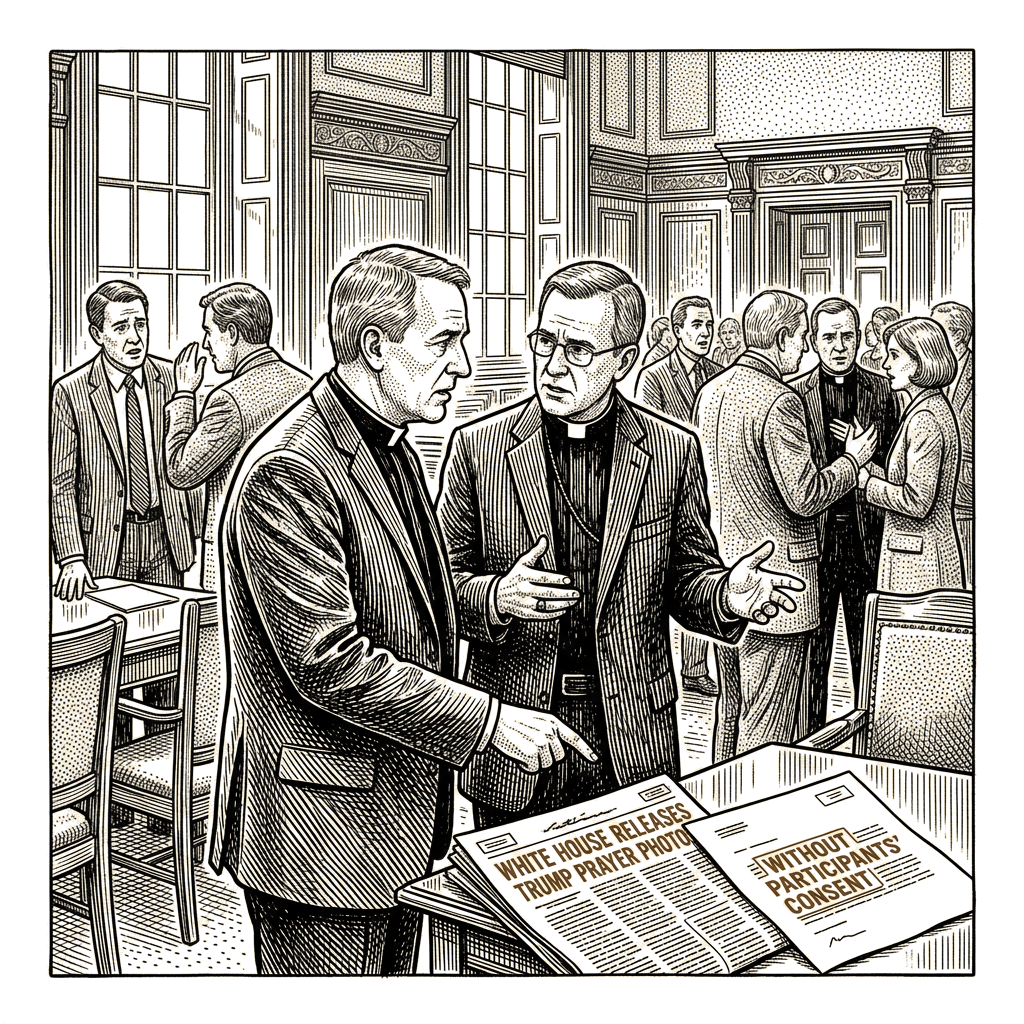
Twelve Catholic bishops entered the White House for a private discussion with Donald Trump and an opportunity to pray privately. They were not told, Archbishop Jeffrey Grob said, that the White House would distribute photographs and a video of the prayer less than two weeks before the midterms. Grob said the White House speedily publicized the event without the participants’ consent.
That betrayal landed immediately inside the church.
Grob, the Milwaukee archbishop, titled his Sunday statement “A Public Apology.” He said he felt “a heavy sadness” because something as sacred as prayer to “our Heavenly Father” had been “manipulated” for political purposes. Bishop William Joensen was blunter. He wished he had been “more shrewd and less simple, like those who exploited our meeting for partisan political purpose.”
Both men made clear that the meeting endorsed neither Trump nor his policies. “The meeting was in no way an endorsement of the president, his policies, or his party,” Grob wrote.
Neither denial was necessary. The photographs had already performed the endorsement for them.
The White House press office declined to say whether the photographs and video were released with consent. Instead, spokeswoman Taylor Rogers offered this nonanswer: “There has never been a greater president for Catholic Americans than President Trump, and his strong record proves it.”
A serious question about consent was met with a boast about greatness. That was not an answer. It was a campaign slogan inserted where the truth should have stood. The administration did not need to resolve the deception when it could turn the bishops’ distress into another occasion for claiming Trump’s political strength.
Consent is what separates a meeting from a publication. Without it, releasing the photographs is not amplification. It is commandeering.
The timing made the political calculation plain. Less than two weeks before the midterms, the White House knew that twelve bishops praying with Trump would be read as Catholic approval. It did not misunderstand the photographs. It published them.
The agenda itself was not trivial. The bishops had come to discuss immigration enforcement, religious worker visas, abortion and federal tax credits for private education. They came to speak about policy, not to applaud a president or bless a campaign.
But “immigration enforcement” is not an abstraction. Federal records count more than 5,500 known family separations between 2017 and 2021. As many as 1,360 separated children had still not been reunited late in 2024. Those children are not background to a photograph. They are children with families and futures. A picture of bishops praying did not answer for them.
Nor could the bishops pretend that the moral ground was hidden from them. In Strangers No Longer in 2003, the bishops of the United States and Mexico affirmed the human dignity of undocumented migrants and called people to recognize the crucified and risen Christ in the stranger. The bishops had named the standard before they entered the White House. Their presence in the room did not absolve the administration; their photograph did not absolve them.
A humane immigration policy must hold two truths together: nations have a right to govern their borders, and migrants’ rights and human dignity must be respected. Family unity, due process and the labor needs of communities cannot become disposable. Federal policy has separated families across administrations, but that history does not make this White House innocent. It makes a consistent standard more necessary, not less.
The meeting itself did not have to be a scandal. Catholic bishops can meet presidents, disagree with them and pray for them. That is politics conducted without pretense. The scandal arose when the conversation became raw material.
The White House did not need the substance of the bishops’ views. It needed their presence, their prayer and their presidential proximity. The image supplied the visual authority. The prayer supplied the emotional fraud. The bishops were invited to give the president a Catholic image, then watched the White House turn that image into an election-season advertisement.
The modern Pharisee operation was plain: keep the appearance of holiness, strip away its obligations and preserve its usefulness. Jesus reserved his hardest words for scribes and Pharisees who “neglected the weightier matters of the law: justice and mercy and faithfulness.” The White House kept the bishops’ prayer and discarded the duty their religious leadership carries.
This was not the first time the White House had placed itself at the intersection of religion and politics. Earlier this year, Trump administration officials joined a Christian prayer service on the National Mall. In April, many U.S. Catholics were dismayed by Trump’s verbal attack on Pope Leo. The White House wants the visual shorthand of Catholic respectability while treating Catholic disagreement as an inconvenience.
This episode was more calculated still. A private devotional act became administration property. Its religious meaning was stripped away; its political usefulness was preserved.
The Catholic hierarchy is not interchangeable campaign scenery. Minnesota-based Bishop Robert Barron served on Trump’s Religious Liberty Commission, while other bishops vigorously condemned aspects of the administration’s immigration policies as contrary to Catholic teaching. That diversity is a sign of a living church, not a defect to be edited out of a photograph.
The White House borrowed the appearance of consensus without requiring consensus. It collected the authority of Catholic leadership without accepting the constraints that leadership entails. Then it placed the burden of explanation on the men whose genuine religious convictions had been converted into political material.
The bishops’ apology is necessary. Their embarrassment is also instructive.
Grob said he received many questions and comments after the meeting, some from distraught people and others who felt wounded by the president’s policies. “I did not go without reservations. I wish I had heeded them,” he wrote.
Joensen was blunter still: “I wish I had been more shrewd and less simple, like those who exploited our meeting for partisan political purpose.”
These were not the words of children who failed to recognize a trap. They were the words of powerful religious leaders who had received warnings, entered the room anyway and watched those warnings become photographs. They had miscalculated the room they entered.
Joensen says he remains open to engaging and praying for political leaders. Openness is a virtue. Blindness is not. Trusting a political operation to honor an assurance of privacy is not openness. It is negligence dressed as pastoral confidence.
Church officials should understand the political uses of sacred things. They should know the difference between a private meeting and a campaign launch, between a conversation and a photo op, between consent and exploitation. If they cannot distinguish those things at the White House, they should not have been in the room.
Before any future meeting, the bishops should require a written media protocol: no photography without consent, no video, and no publication without the express approval of every participant. A prayer that requires publicity to be worth praying is not prayer. It is political material wearing a stole.
The White House may get the picture. It does not get the Catholic mandate. You can still repent. You can answer the question truthfully, acknowledge what you did and refuse to turn another sacred act into propaganda. The door is open. The work is not.
A private prayer remains private only until Washington decides its voters need to see it.