
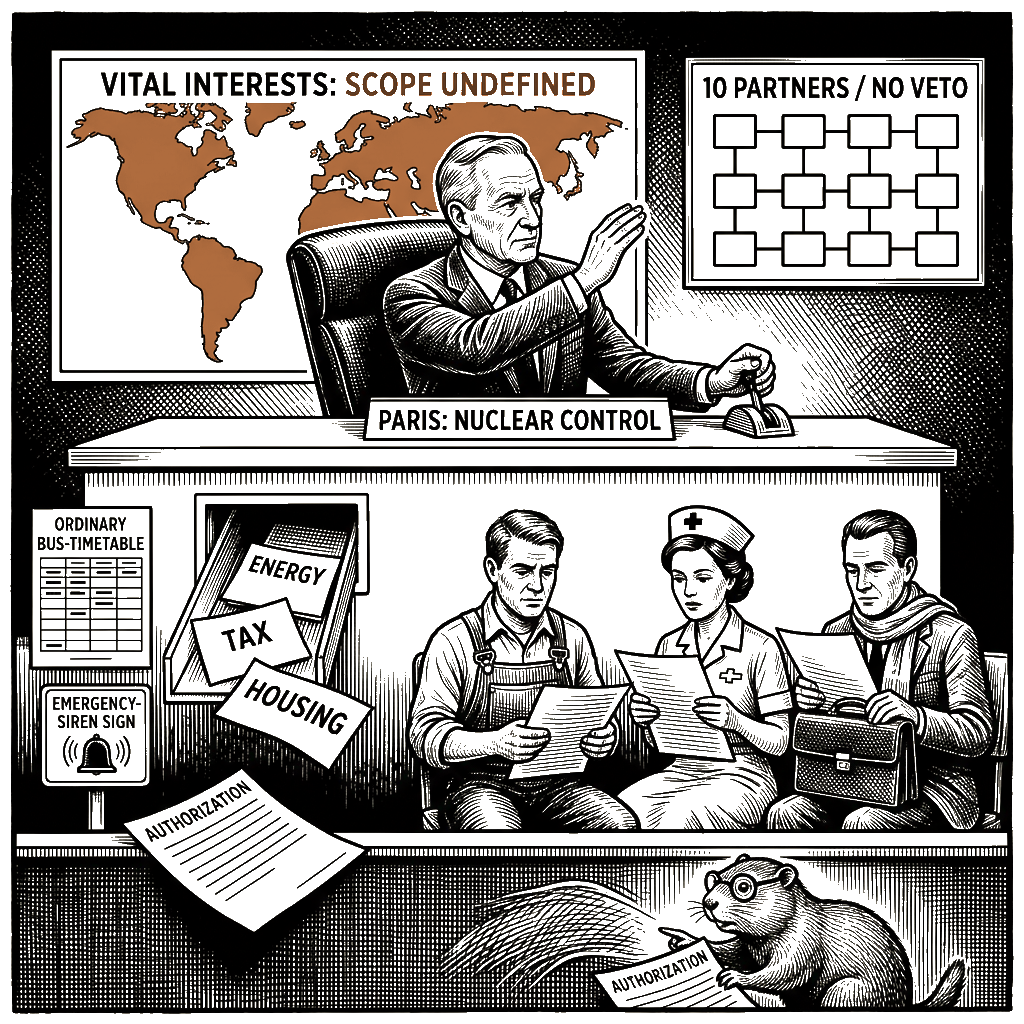
Washington is betting Europe’s workers’ lives on a nuclear guarantee it refuses to define.
Picture a welder in Warsaw, a nurse in Brussels, and a commuter in Helsinki. They do not experience “forward deterrence” as strategy. They experience whether the factory keeps its shift, whether the power stays on, whether heating fuel and electricity remain affordable, whether a bank will lend against the family home, whether the bus keeps running, and whether a siren means a drill or an attack. Those are the practical facts beneath the nuclear map.
Any government asking families to accept that risk owes them a plain answer. Who makes the decision? Who can refuse it? Who pays through taxes, energy bills, housing costs, forgone public investment, and community safety? Who benefits when the deterrent works? The military question and the household question are the same question.
The question behind France’s answer is old. In 1961, Charles de Gaulle asked John F. Kennedy whether the United States would sacrifice New York to save Paris. Kennedy gave no reply. The silence did not settle the matter. It taught the allies to live beneath an American nuclear umbrella while Washington kept the trigger’s meaning deliberately unclear. The unanswered question became policy.
France has now answered with an umbrella of its own. When Emmanuel Macron announced in March 2026 that France would align its nuclear deterrence with European allies and said France would increase its warheads while allowing temporary nuclear deployment, “forward deterrence” stopped being a slogan. The plain meaning is this: France will connect its nuclear force more closely to European warning and intelligence networks, permit temporary nuclear deployment, and give selected partners a place in the deterrent without giving them authority over French weapons.
France is offering participation without sharing the button, consultation without surrendering the decision, and nuclear weight without creating a French nuclear club.
The architecture has a hub and ten spokes. Paris is the hub. The spokes are London, Warsaw, Helsinki, Oslo, Berlin, Brussels, Amsterdam, Athens, Stockholm, and Copenhagen. Italy declined. The three Baltic states, described as among the most vulnerable to Russia, are out. This is not a Europe-wide guarantee. It is a French umbrella with ten partners, which is enough because the network is wide even where involvement is not uniform.
France has created ten separate steering groups and is holding bilateral talks rather than summoning its partners into a joint nuclear council. Defense officials compare notes on what Paris has told them. Macron’s strategic-affairs adviser, Xavier Chatel, called the purpose plain: “a new complication for the adversary, because it brings another layer that the Russians will have to read.”
France retains full control of its nuclear decisions. Partners enter the communications and intelligence network, but they receive no veto over the weapons. One European minister described the bargain bluntly: “The French will let us participate in their nuclear deterrence as much as the Americans.” France built its sovereign force outside NATO’s nuclear planning group in the 1960s. The British deterrent remains tied to American-made platforms and NATO’s integrated command structure. Paris is offering something Britain cannot: a European nuclear role without surrendering the French button.
Now strip away the diplomatic vocabulary and look at what the weapons can do.
Under NATO’s nuclear-sharing arrangement, tactical B61 gravity bombs require permission from both Washington and the host nation. They were designed in the 1960s to stop Soviet tank divisions racing out of East Germany. Military officials and analysts describe them as increasingly obsolete in modern war and as a limited threat to the Russian homeland because of advances in Russian air defenses.
France’s ASMP-A nuclear-tipped cruise missiles carried by Rafales were designed for Russia’s main cities. French military officials and analysts say they have a high likelihood of reaching their targets. Nicole Grajewski, an expert on Russian and nuclear affairs at Sciences Po, puts the distinction bluntly. The B61s are “pretty much instruments of political assurance,” while “the French nuclear arsenal, by contrast, can reach Russia.”
One is principally a promise that the American umbrella may open. The other can put Russian cities at risk. That is the difference between reassurance and a capability Moscow must take seriously.
Moscow is not a passive backdrop. Its leaders control one of the world’s largest nuclear arsenals, have invested in air defenses, and repeatedly threaten escalation. Ambiguity helps them test how far Western leaders will go without having to face the consequences. Doubt about American policy has intensified under President Donald Trump, who has struck energy deals with Russia and put pressure on Ukraine.
For an ordinary European household, this is not a diplomatic detail. Energy contracts, shipping insurance, transport costs, construction lending, and the price of keeping warm or keeping the lights on are where a foreign-policy crisis enters private life. If those costs rise, the rise belongs to the strategic ledger. It is not an unfortunate side episode.
The same is true of fear. War risk can chill insurance, construction, and mortgages before a shot is fired. Communities must prepare for disruption that may never come while still answering the needs of families already there. The people who make the decisions operate from offices far from blast zones. The people who staff the emergency rooms, run the buses, repair the substations, and keep the food moving live with the consequences. That is the class question beneath the nuclear map.
None of this is free. Rafales, warhead production, secure communications, early-warning systems, exercises, maintenance, and security cost money. Public money is finite. Every dollar or euro spent on one thing is unavailable for another.
If a cabinet says additional defense billions are free, it is lying to the public. The money comes from taxes, borrowing, or spending not done elsewhere. The honest choices are more defense and fewer other services, higher taxes, or more debt. Families can argue with those choices when officials state them. If the public cannot inspect the bill, the choice has already been made for it.
That does not pencil out as democracy merely because the weapon has a technical name.
Dwight Eisenhower, in his farewell address of January 17, 1961, paragraphs 24 and 25, warned of “the acquisition of unwarranted influence, whether sought or unsought, by the military-industrial complex.” He also said that only “an alert and knowledgeable citizenry” could properly mesh the “huge industrial and military machinery of defense” with the nation’s peaceful aims. Eisenhower was asking citizens to know who was building the machinery, who was steering it, and who was paying. Europe cannot outsource that knowledge to a secretariat, a contractor, or a president.
France’s plan raises the same democratic question at home. Macron said France would resume manufacturing nuclear devices for the first time in decades and would stop disclosing the size of its stockpile. France is believed to possess around 290 operational warheads, a fraction of the American and Russian arsenals. Its deterrence is not a token.
Paris reserves nuclear use for its “vital interests” but leaves their geography open. Macron asked in March: “Could we consider that the survival of our closest partners may be put at risk without it affecting our vital interests?” France has never offered its allies an explicit guarantee. The ambiguity is deliberate. Moscow should not know exactly how far Paris may go, while partners enter the network without authority over the force.
Full French control is the shield. It is also the liability. Every French government must answer for what its vital interests mean, and allies carrying shared risk must have a way to ask questions without being handed weapons and told to mind their own business.
Finland shows what that shared risk can look like. President Alexander Stubb says Finland has no plans to host nuclear weapons during peacetime but intends to create “a strategic dilemma for Russia.” He describes the undertaking as a 10- to 15-year process. Some of the new communications and warning network could also support conventional defense if Washington failed to protect a NATO ally. This is not a press conference. It is a decade of construction, maintenance, exercises, security, procurement, and public money.
The gravest danger is Parisian, not Moscow. Macron retained full control partly to keep forward deterrence acceptable across France’s political spectrum. The Rassemblement National of Marine Le Pen has implicitly endorsed the initiative, and opinion polling places Le Pen ahead in the race for the presidency next spring. Her past warmth toward Moscow would give the Kremlin a propaganda instrument more valuable than another nuclear warhead. Bruno Tertrais, deputy director of the Foundation for Strategic Research in Paris, warns of “a loss of credibility on both branches,” deterrence of Russia and reassurance of allies. A senior European defense official said the intent, focus, and scope of the partnership would come under renewed scrutiny in Paris and among allies if Le Pen came to power.
That is the price of sovereign control. The Gaullist inheritance can endure a hostile American president. Whether it can survive a French president hostile to Russia is the central test. Macron has told allies there is no going back. Paris must now decide whether that promise includes the democratic authority to make it credible.
None of this makes France a substitute for the United States, and Paris is careful not to claim one. Norwegian Foreign Minister Espen Barth Eide said the French plan “doesn’t replace anything. It supplements the nuclear guarantees that were already there” beneath the American umbrella. Vipin Narang, an MIT professor of nuclear security and political science who oversaw Pentagon nuclear policy under the Biden administration, was blunter: “Is it better than nothing? Probably. But it is not, and should not be viewed as, a substitute to U.S. extended deterrence.” That necessity pains him as a former American official, he said. It is also the point. France is not replacing America. It is hedging against a guarantee America deliberately keeps ambiguous.
Any American effort to renew or extend nuclear commitments should face explicit congressional authorization, with the authority’s limits written down. Congress cannot choose every target, but it cannot be asked to fund and bless an undefined guarantee in ignorance. Europe should require the same plain accounting from Paris. The more allies share sensitive warning and intelligence links, the more explicit their democratic oversight must become.
France’s new deterrent does not cancel the American umbrella. It punctures the illusion that Europe possesses only one. That is the nuclear guarantee Washington never defined.
The weapon being built is not a bomb. It is credibility: the belief that Paris would risk Paris for Warsaw. That is the pillar no B-61 can supply and no communiqué can replace. It is also the thing Europe’s workers need when they judge the risk of nuclear war. France is betting that Russia will take that belief seriously.
But the families carrying the risk must be able to name the person holding the switch, read the bill, and question the war before it becomes their emergency. Europe’s new nuclear umbrella has only one real switch, and Paris intends to keep it.