
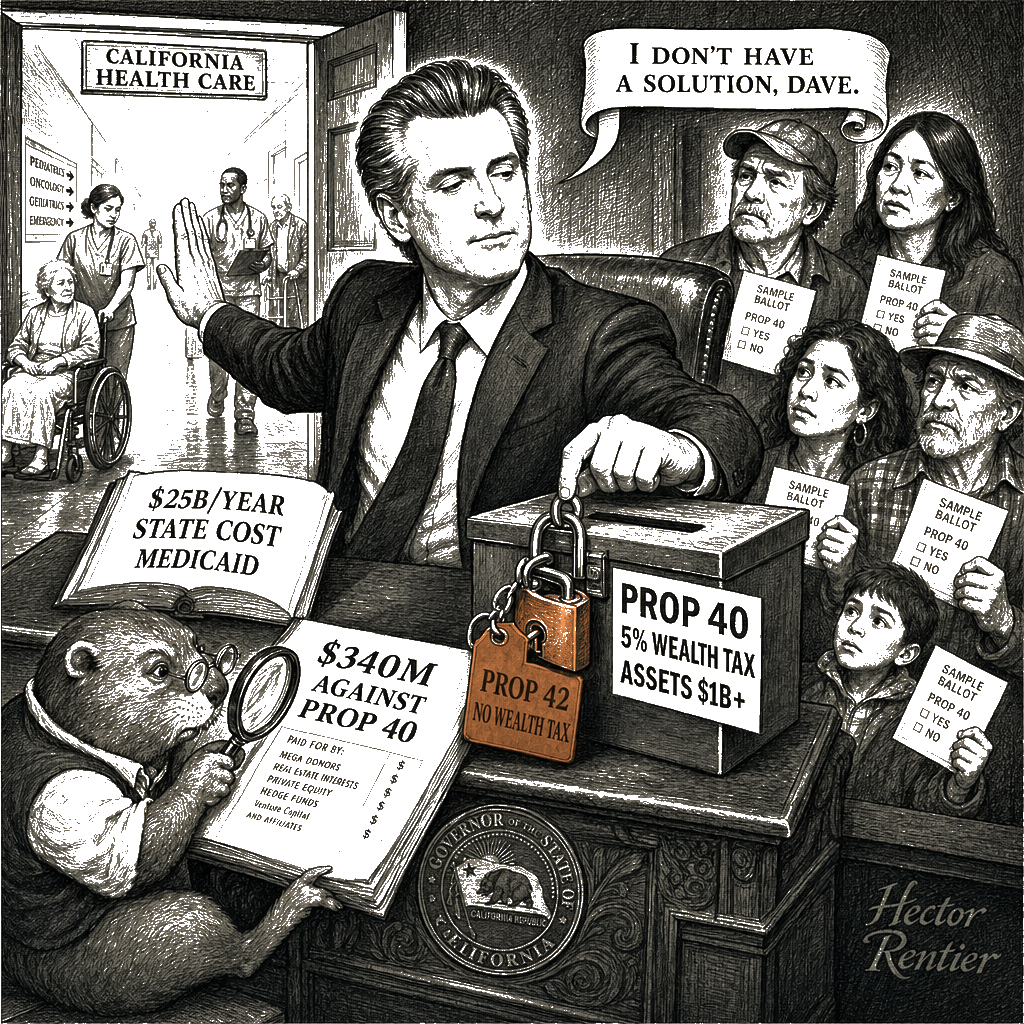
Dave Regan put a $100 billion health-care tax before California voters; Gavin Newsom, after acknowledging that federal Medicaid cuts could cost the state $25 billion a year, told the union president, “I don’t have a solution, Dave,” and then asked him to withdraw the measure. The governor had no answer for the hole and an answer for the tax: kill the tax.
On Nov. 3, voters will decide Proposition 40, a one-time 5% tax on California residents with net assets of at least $1 billion at the end of 2026. It would apply to stocks, bonds, business interests, intellectual property and art—not merely income or real estate—and to people who were California residents on Jan. 1, 2026, blunting the familiar promise to flee before the bill arrives. Proponents estimate the measure would raise about $100 billion from between 200 and 300 Californians. A resident with $10 billion in assets would owe $500 million.
It is not a tax on everybody’s savings. It is a check from a few hundred people whose fortunes are large enough to make the rest of us squint. Teachers’ unions say 90% of the revenue would go into a dedicated health-care account rather than the general fund. The measure would create the nation’s first billionaire wealth tax.
The timing is where the tax stops being theory. The One Big Beautiful Bill Act will cut national health spending by more than $1 trillion over a decade, largely through Medicaid. Medicaid covers more than one-third of Californians and anchors the state’s health-care system. Hospitals and clinics face the loss before lost coverage, hospital closures and higher insurance bills arrive at the door.
Frank Wilhoit’s law supplies the mechanism: an in-group protected but not bound, and an out-group bound but not protected. Here the in-group owns the ballot money. The out-group owns the hospital halls. Old Mammon has learned the ballot.
Newsom calls the tax a threat to California’s competitiveness and prefers a national wealth tax instead. His Competitiveness has one doctrine: solve California’s hospital crisis in Washington, where the rich may leave California and the bill may leave with them. California cannot outsource its fiscal decisions to a national alternative that cannot fund California’s hospitals now.
According to Regan, Newsom called him before Christmas and discussed the possible $25 billion annual cost of the Medicaid cuts in Newsom’s Sacramento office. The governor acknowledged the hole, told Regan, “I don’t have a solution, Dave,” and asked him to withdraw the measure. The union later offered a 2% alternative. Newsom rejected it. A representative did not respond to requests for comment.
Regan also alleged that “Gavin wants to raise money for his presidential campaign,” saying Newsom was protecting wealthy donors ahead of a possible 2028 presidential run. That allegation remains Regan’s account. The money does not.
California Democrats have discovered a tax they can oppose without offending the people who write their biggest checks.
The California Democratic Party endorsed Proposition 40 in August. Newsom opposed it. His Democratic successor in the governor’s race, Xavier Becerra, opposed it. Rep. Katie Porter opposed it and called the measure “already a hot mess, no matter what happens.” Rep. Ro Khanna supported it. Bernie Sanders campaigned for it in Los Angeles and San Francisco. Democratic voters supported it more strongly than the party hierarchy did.
Independent polling shows support slightly ahead of opposition, with a large undecided bloc still available. The money behind the opposition makes the campaign impossible to mistake for ordinary disagreement.
More than $300 million has gone into the three ballot initiatives involved, roughly 90% aimed at defeating the wealth tax. Reporting puts the tech-billionaire opposition spending at $340 million. Google co-founder Sergey Brin spearheaded two countermeasure initiatives.
One countermeasure, Proposition 42, would prohibit California from taxing wealth altogether. Newsom supports it. This is not another measure competing for attention. It is a lock on the door before voters decide whether the door should ever open.
The opposition’s television ads warn that taxing billionaires today could mean taxing everyone tomorrow. Tech and political figures have discussed leaving the state. Meta’s board reportedly negotiated a share split that could help Mark Zuckerberg cover a potential tax bill.
Flood the airwaves. Offer rival ballot measures. Make the signature process expensive. Then complain that the tax is too radical for a public debate whose terms the money has already purchased.
Money answered before voters spoke.
One side has money. The other has voters. The Service Employees International Union–United Healthcare Workers collected the 875,000 signatures needed to place Proposition 40 on the ballot. California’s ballot process was built to settle disputes between money and votes. That is precisely why Proposition 40 must go to the public.
California’s labor movement does not line up neatly either. The California Federation of Labor Unions supports the tax. So does the California Federation of Teachers, and the San Diego Building Trades Council supports it. The statewide construction union, ironworkers and pipefitters oppose it, warning that wealthy departures would reduce the revenue available for major projects. Their members rallied against the measure in 100-degree heat beneath signs reading “Protect Our Jobs.”
Teachers’ unions objected that 90% of the proceeds would enter a special health-care account rather than the general fund and worried the measure could compromise a separate proposal making a tax on high earners permanent for education. Julie Van Winkle, a senior United Teachers Los Angeles officer, broke with her parent organization to support Proposition 40 and brought the smaller California Federation of Teachers with her.
“I don’t want my students to not have healthcare,” Van Winkle said. “I felt like it was my responsibility.”
Lorena Gonzalez, president of the California Federation of Labor Unions, told Newsom’s chief of staff: “With all due respect to Gavin, he doesn’t speak for unions.”
The union movement’s own ledger has fresh ink.
SEIU California, the statewide coordinating organization that includes Regan’s 120,000-member health-care union, comprises 17 unions representing more than one million workers. Its executive committee voted in both August and October 2025 against seeking new revenue through a 2026 ballot measure. Regan did not stop. Two outside law firms investigated harassment and extortion complaints.
One report substantiated the complaint of David Huerta, then president of SEIU California: Regan raised the prospect of a U.S. Department of Labor investigation if the executive committee did not back the tax. Regan said his comment was not a threat.
Another complaint, from former executive director Courtni Pugh, alleged that Regan kicked in her office door during a 2009 argument, backed her against a bookcase and yelled in her face. A colleague recalled hearing the argument and Pugh sobbing. Regan denied the allegation and said it was intended to distract from the wealth-tax debate.
A separate complaint from Jess Bartholow, who leads SEIU California’s lobbying team, described a March altercation in which Regan yelled “F— you.” Regan said Bartholow approached him and that they had a brief, “honest and frank exchange.” According to one person familiar with the matter, he has since been barred from SEIU California’s offices, though he remains eligible to participate in union meetings by Zoom. Regan and other union leaders filed a countercomplaint alleging character assassination.
Investigators substantiated one complaint. Regan disputes the others.
He is also fighting a federal lawsuit brought by the California Primary Care Association and several health clinics. The association, which had raised about $30 million to oppose Proposition 40, alleges that Regan offered through an intermediary to withdraw a separate ballot proposal governing how clinics spend their budgets if the association dropped its opposition and used its campaign money to support the union. The association called it a shakedown. A union spokesman called the allegations “categorically false.”
Do not change the subject, dear. The donor campaign and Regan’s conduct are separate exhibits. The opposition will try to make the misconduct swallow the $340 million. It will not. The donors spent money to bend the ballot. Regan burned credibility to bend his own union. Each belongs in the ledger.
A tax championed by labor cannot spend credibility the way the opposition spent money.
California is not choosing between economic sanity and economic radicalism. It is choosing between two versions of its governing class. On one side stand Newsom, the super-rich, medical groups and large donors determined to block the tax. On the other stands a coalition of health-care workers, teachers and public unions trying to use a once-in-a-generation tax to protect the state’s social infrastructure. And at the center of that coalition stands a union president whose conduct has made labor pay in currency the opposition does not have to borrow.
If Proposition 40 fails, California will have shown that the richest people in the state can block even a tax aimed only at the richest people in the state. If it passes, California Democrats will have shown a rare willingness to stand with labor over their own governor.
Either way, the damage inside organized labor will outlast the campaign. The men and women who put the measure on the ballot cannot spend credibility the way the opposition spent money. They gathered 875,000 signatures. The opposition gathered $340 million.
Nov. 3 will settle the tax. It will not settle who California’s labor movement became in the fight to save it.