Trapped people in Oleshky gained a lifeline while Russia kept bombing Ukraine.
At 3 a.m. Tuesday, a localized ceasefire began in the Russian-occupied town. Minutes later, ballistic-missile explosions shook Kyiv, and air alerts sounded across multiple parts of Ukraine. The two facts were not contradictory. They were the whole story: a war allowed to stop for a humanitarian mission, and nowhere else.
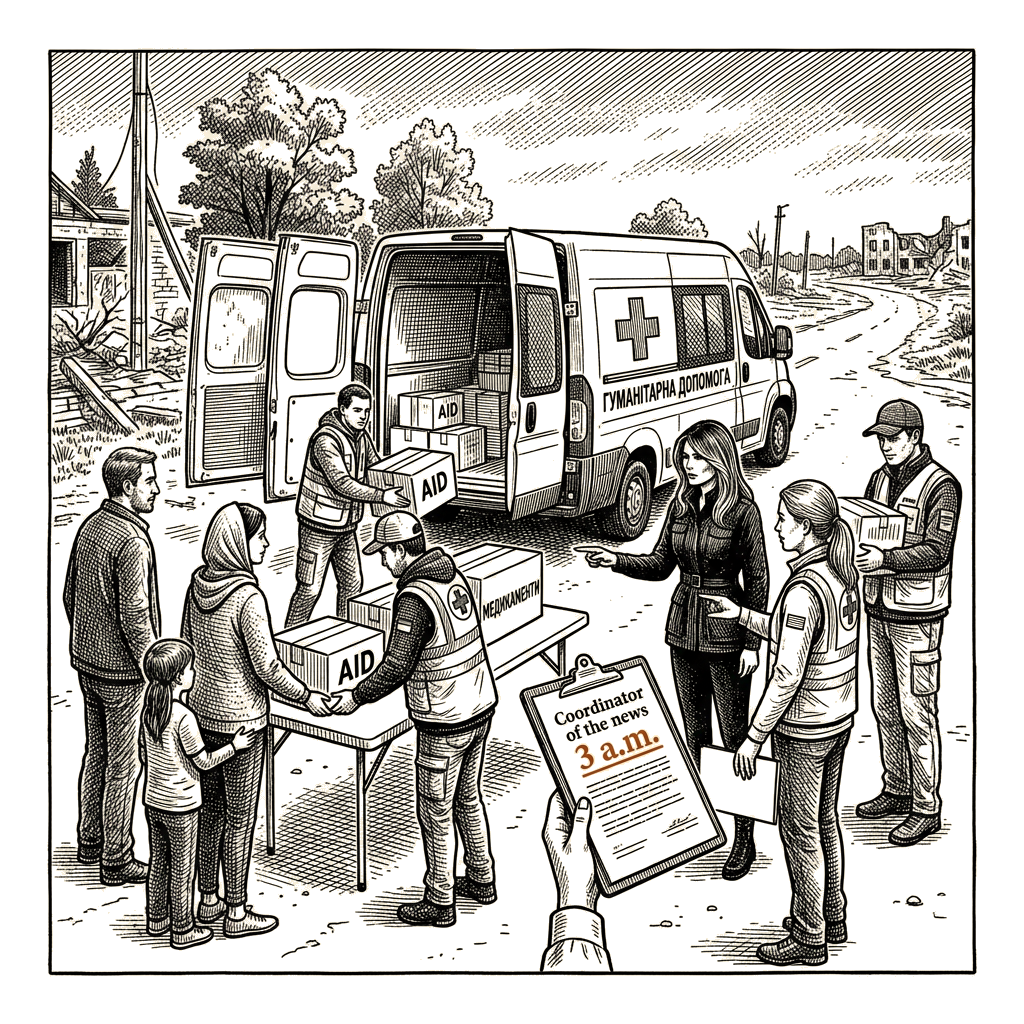
The arrangement had been announced on Oct. 23. Russian and Ukrainian negotiators, along with the militaries of both countries, confirmed its start in separate statements. It was due to last through Saturday, or longer. Doctors, medicines, food, and water would reach the town before evacuation corridors opened. The humanitarian operation was planned for later in the week.
As many as 2,000 people are stranded in Oleshky, according to the United Nations. Their food and medicine are dwindling. Explosive mines and drone attacks have prevented them from leaving. The corridor has to open through the same mines and drone attacks that sealed the town in. Every hour matters.
This was not a minor diplomatic achievement. Deep mistrust has thwarted previous attempts at ceasefires. This one survived because it asked for less: a place, several days, a mission. It asked for them on ground Russia had held since the first day of the full-scale invasion, across the Dnipro from Kherson. Russian forces captured Oleshky in 2022. Russia had taken Kherson in the early stages before withdrawing across the river several months later. Floodwaters then inundated Oleshky in June 2023 following a dam collapse, leaving its population exposed to danger long before this mission.
Melania Trump’s office said she led talks with civilian negotiators from Russia and Ukraine after meeting with United Nations officials who briefed her about conditions in the town. The first lady’s participation should not obscure the larger point: in this war, ceasefires are being made to perform tasks, not end them. The task here is mercy. The fact that it is a task at all tells you where the war stands. Melania Trump helped open a window. Washington has yet to show it can open a way out.
The pause was geographically narrow, not fleeting. The war outside Oleshky did not stop. Missile attacks resumed while the localized halt remained in effect. The strikes outside Oleshky did not violate the agreement; they revealed its boundary. Mercy had been rationed by geography: quiet where aid could move, war everywhere else.
The violence outside supplied a grim measure of what the mission was up against. On Monday, Russian ballistic missiles damaged the grounds of a university in Kyiv, killing one person and leaving 10 injured. In Kharkiv, Ukraine’s second-largest city, authorities said attacks killed two people and injured four.
Ukrainian President Volodymyr Zelenskyy described the pattern plainly: “It is important that the world sees that Russia is showing nothing but a desire to kill and continue waging war.” The weapons continued doing what diplomacy had not stopped. This was a rescue operation, not a peace process.
Micah asked, “What does the Lord require of you but to do justice, and to love kindness, and to walk humbly with your God?” Justice now means protecting the corridor. Kindness means making sure the aid arrives. Humility means admitting that a town-sized exception is not a strategy for ending the war.
I will not stand outside that accounting. We who invoke humanitarian law while civilians remain trapped inside its geometry have helped build the machinery that makes Oleshky necessary. A pause that saves lives is right. A recurring pause is not yet peace.
The moral arithmetic is the same for every party and every mediator. Russia and Ukraine must honor the corridor. Washington must make the next step mean more than another protected town. No negotiator may call civilian harm an acceptable price while asking others to carry it.
Negotiators, you have shown that a mission can survive mistrust. Use that proof to build a peace process. Honor the corridor now; interrupt the barrage next. The door out is not hidden. It begins where the mission begins and runs wider than the mission.
A new round of U.S.-brokered Russia-Ukraine talks is expected next month, with ending more than 4½ years of fighting as its aim. Russia’s agreement to a trilateral meeting gives that round a broader table. Now Washington must turn the mission into a strategy.
That means an interruption of strikes substantial enough to matter, terms clear enough to enforce and serious enough to survive the first dispute between the parties. The instrument already exists: negotiators and both militaries confirming separately, civilian talks, a United Nations briefing, aid delivered before the corridors open. Repeating that town by town is what turns a task into a strategy. Otherwise this is not diplomacy moving toward peace. It is an ingenious system for delivering medicine between barrages.
Which is not nothing. For the people trapped in Oleshky, it is everything. A corridor is the difference between medicine and no medicine. It is the difference between evacuation and remaining trapped. For them, the distinction is measured in meals, medicine, and a route out. Honoring that ceasefire is a moral imperative, not a diplomatic ornament to be treated casually while claiming broader progress.
The mission remains ahead; the war does not. Until Washington can turn relief into strategy, relief is indispensable, but it is not peace.
For everyone else, the distinction will be measured by whether this week becomes next month—and whether next month becomes the end.
Oleshky deserves the medicine. Ukraine deserves the silence.