Secretary of State Steve Hobbs got the central point right: “The timing of this request — one week before the general election — is no doubt intended to cast unfounded suspicion on the results.” The Justice Department wants Washington to set aside ballots from 405 people it alleges registered without U.S. citizenship. That timing makes this more than a routine voter-integrity inquiry. It is an attempt to place federal suspicion over Washington’s vote before the votes are counted, using an unverified list built from records stretching back decades.
The department says it has identified 1,500 votes cast by more than 400 people in prior elections. Acting U.S. Attorney Charles Neil Floyd calls the 405 people identified so far “the tip of the iceberg.” That phrase would be frightening if the evidence beneath it were solid. It is not. The iceberg is a spreadsheet of leads, not a collection of adjudicated cases.
Federal officers compiled much of the list from recent contacts with suspected noncitizens. Because investigators lack access to state records, Floyd acknowledged, proving that anyone voted illegally is difficult. The information supplied to Washington included when each person last voted. One person on the list last voted in 1994. Some may have become naturalized citizens since appearing in federal records. Their citizenship questions require verification before the government can call their votes illegal.
Routine checks can generate leads. They cannot establish ineligibility. The Justice Department’s own lack of access to state records shows that this list has not been checked against the facts. What the Justice Department has is a fishing expedition. What it wants Washington to provide is the apparatus for turning suspicion into exclusion.
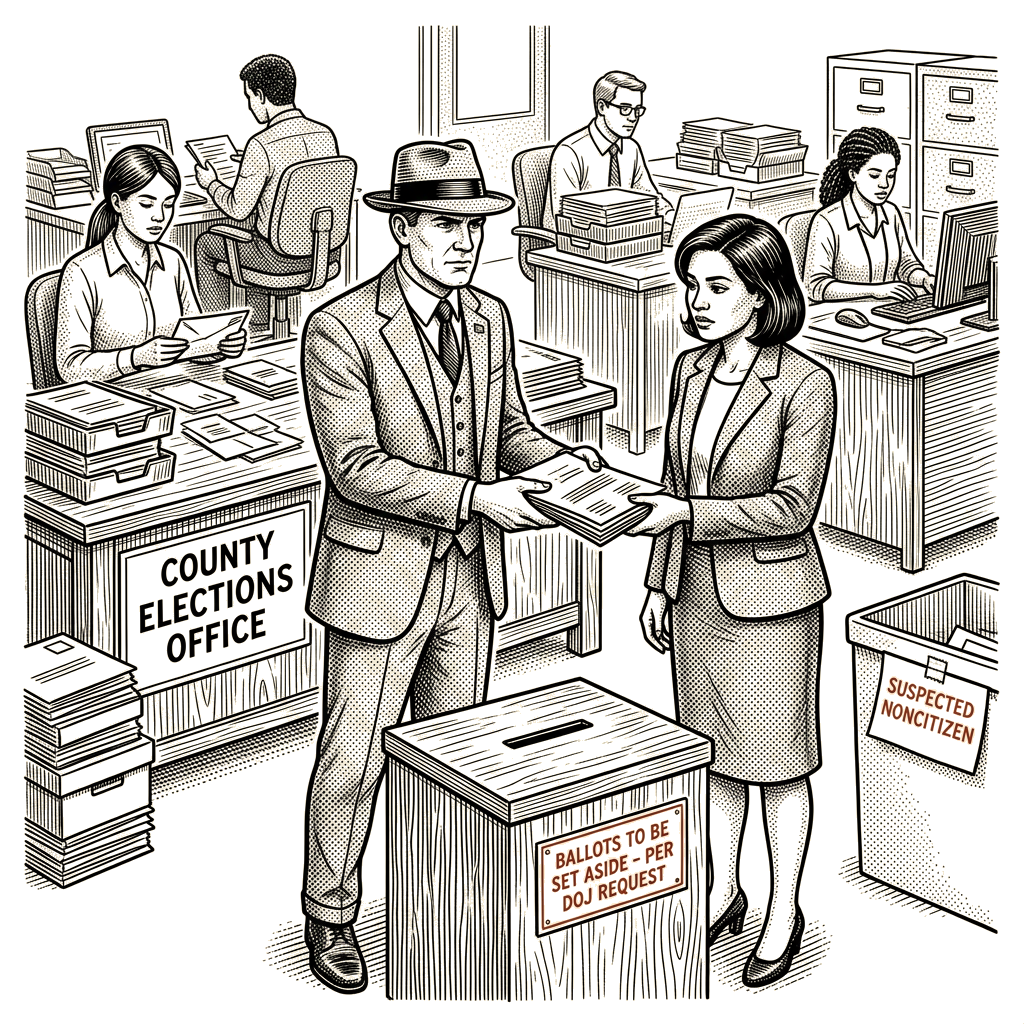
The demand itself reveals how far the government is running ahead of the evidence. It seeks addresses, dates of birth, driver’s license numbers and partial Social Security numbers. It expects to deliver another list before Election Day. This is not a request to investigate individual cases and punish proven wrongdoing. It is a request that state officials segregate ballots preemptively while federal prosecutors continue assembling allegations. The ballot purge is being designed to make the accusation operational before the facts arrive.
Washington has more than 5 million registered voters and mails ballots to all of them. The 405 people on the federal list are fewer than one in every 1,000 registered voters. Even if every name on the list were valid—which the record does not establish—state officials cannot convert an untested accusation into a blanket reason to hold ballots aside.
The cost of that leap would fall on the wrong people. A voter whose registration record was mishandled, whose citizenship information was confused or whose naturalization simply postdated the list would bear the cost of the government’s failure to verify the facts before the election. No federal spreadsheet is a verdict. No suspicion is a substitute for identity confirmation, an eligibility determination, notice and an opportunity to cure.
The measurable civic harm in Washington is not the hypothetical fraud floating inside a federal spreadsheet. It is the disenfranchisement of legitimate voters caused by changes in U.S. Postal Service operations, an issue state officials say has affected thousands of people. One problem has identifiable voters and known consequences. The other begins with 405 names attached to an incomplete investigation.
That demand is also part of a pattern. It came less than two weeks after a similar challenge in California and was the Justice Department’s third direct challenge to a state that month, following action in Alaska. In California, the Justice Department sued over mail ballots from as many as 20,000 suspected noncitizens, prompting an emergency dispute that reached the Ninth Circuit. Judges there questioned the timing, constitutionality and asserted authority behind the effort to isolate those ballots. The appeals panel declined to rule on the Justice Department’s expedited timeline and sent the case back to a lower court. The administration’s appetite for confrontation needs no judicial blessing.
A sample of 200 names from the California list included canceled registrations, inactive voters, people with no voting history and people who appeared to have been born in the United States. That is what an unreliable list looks like in practice. It produces false positives. And the Justice Department wants election officials to act on every one of them before the cases are resolved.
The sequence matters: litigation, then pressure on another state just before its election. Washington is not an incidental backdrop. Its third congressional district is among the country’s most competitive House races. Democrats are counting on Rep. Marie Gluesenkamp Perez to win reelection as part of their effort to retake the House majority. The Alaska dispute goes further, with a lawsuit seeking to delay certification if the Republican incumbent does not win. These are not housekeeping complaints made after an election. They are interventions aimed at the legitimacy of unfinished votes in battlegrounds.
The constitutional alarm is equally difficult to ignore. The Elections Clause gives state legislatures the power to set the time, place and manner of congressional elections. The Justice Department may investigate suspected violations and request records; it does not get to decide which ballots Washington withholds. It can litigate its claim. What it cannot do is use an election-eve deadline to pressure state officials into making the decision for it.
The courts have not resolved the question. That is precisely why the administration should not obtain practical power through a pre-election demand while the law remains unsettled. Legal uncertainty is a reason to proceed carefully, not a license to manufacture a fait accompli in the seven days before ballots are counted.
Hobbs’s review should end in refusal of the blanket set-aside request. If federal prosecutors have credible, individualized evidence that a specific person is ineligible to vote, they can present that evidence and seek lawful relief. No ballot should be set aside without identity confirmation, an eligibility determination, notice and an opportunity to cure before exclusion. What the Justice Department cannot do is convert suspicion into procedure.
The names deserve scrutiny. The evidence does not justify a blanket purge.
The mail ballots are already out. Washington’s job is to count them—not to turn an unresolved federal list into an election-day emergency. Let the attorneys litigate their claim in court. Let the state count its ballots. And let the Justice Department explain why an election-eve fishing expedition deserves to be treated as neutral administration rather than what it plainly is: an attempt to put the federal thumb on the scale before Washington’s ballots are counted and its result resolved.