
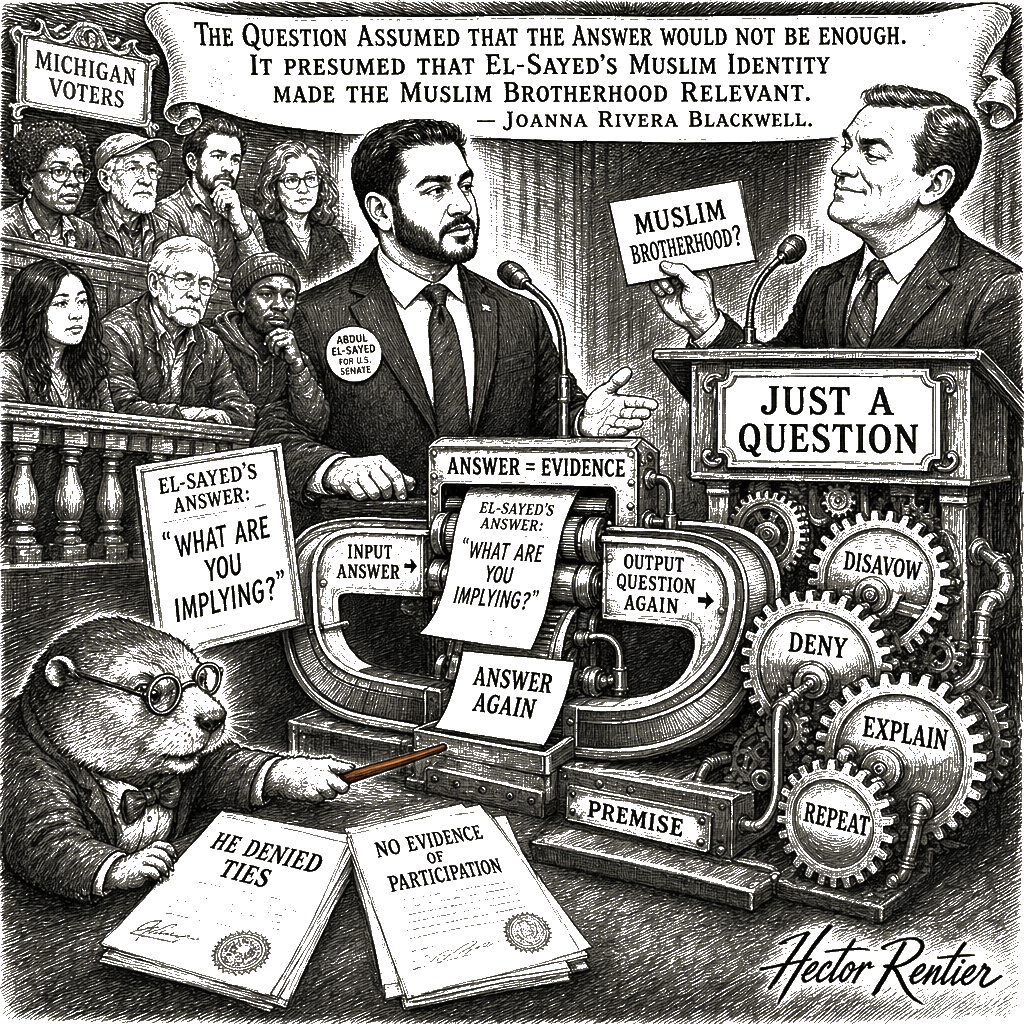
The most revealing five minutes of Abdul El-Sayed’s Senate campaign did not begin with policy. They began with a man demanding that the Michigan Democratic candidate disavow the Muslim Brotherhood in front of a crowded room. It was, in effect, a demand for a religious loyalty oath.
“Sure, yeah, absolutely,” El-Sayed replied.
Then he reversed the examination.
“What are you implying? Do you assume that I wouldn’t?”
The exchange became a viral campaign moment, viewed more than 50 million times. But its significance reaches beyond virality. El-Sayed did something American political culture rarely permits a Muslim candidate to do: instead of pleading innocence, he made the questioner defend the premise.
That was not an evasion. It was an indictment. And that is why the attacks are intensifying.
For five minutes, El-Sayed would not let the question hide inside its grammar. He compared the man’s insinuation to the suspicions once directed at John F. Kennedy’s Catholicism. He asked whether the questioner would disavow reading religious doctrine into American law. The man said he would not. El-Sayed told him that he was the one who needed to understand the constitution. The room cheered.
The question assumed that the answer would not be enough. It presumed that El-Sayed’s Muslim identity made the Muslim Brotherhood relevant to his fitness for office, regardless of his answer. By asking the questioner to explain the premise, El-Sayed put the assumptions of his interrogator on trial.
The questioner was Thomas Teepell, a former aide to Republican senator Josh Hawley. Teepell’s father’s firm was paid $250,000 by a nonprofit for “canvassing and influencer marketing” against El-Sayed, according to an FEC filing. Nothing shows that Teepell was paid, and the connection does not prove that the question was coordinated. Those distinctions matter.
But no conspiracy is required for the question to do its work. The insinuation arrives preloaded: if you are Muslim, you must be capable of sympathy for the Muslim Brotherhood; if you reject that association, prove it again; if you resist the question, that resistance becomes further evidence.
Who governs this pressure? Not one backroom. Teepell supplied the question. His father’s firm, which received $250,000 from a nonprofit for anti-El-Sayed canvassing and influencer marketing, supplied part of the campaign ground game. AIPAC and other pro-Israel donors supplied most of the more than $60 million in outside spending; Whitmer and Peters supplied party backing; Crawford and, reportedly, Weiss supplied media amplification; Tuberville and Trump supplied the national labels; and Michigan’s Democratic primary voters supplied the reward. Those actors had different roles and powers, and the record does not make them a single conspiracy. The governing legal baseline is equal citizenship under the Constitution; the governing political logic is simpler: make the accusation, demand a disclaimer, and treat resistance as further proof. Their choices converged on one governing demand: a Muslim candidate had to prove his loyalty before voters could judge his record.
Does El-Sayed have ties to the Muslim Brotherhood? He has twice denied that he or his family has ties to it, and there is no evidence that he took part. But the guilt-by-association test does not seek an answer. It demands renunciation of people, organizations, and history, then invites continued dissatisfaction with the answer until the accuser is satisfied. El-Sayed refuses to perform that ritual.
Questions about a candidate’s record, associations, and policy positions are fair. The presumption of radicalization is not. Treating Muslim identity as grounds for suspicion is something else. It is Islamophobia wearing the respectable mask of a question.
The same dynamic appeared during the primary. During a CNN interview, Kasie Hunt asked three times whether Israel has a right to exist. “I’m not going to play this gotcha game,” El-Sayed said, adding: “Nobody’s ever asked me whether or not I believe Palestine has a right to exist.”
That was the decisive question. El-Sayed was not required to deny Israel’s right to exist before he could discuss American policy. He was being asked to reject one country’s existence while a sympathetic question about another country’s was treated as settled in advance. The apparent debate over foreign policy was, in reality, a test of political legitimacy.
His answer was to narrow the question to democratic power: not whether Israel has a right to exist, but whether it has a right to “our tax dollars.” That is the question voters can adjudicate.
El-Sayed has forced that distinction into the open throughout his campaign. His direct approach has yielded the nickname “Mean Mamdani,” or “Meandami.” Zohran Mamdani has built a political identity around warmth and reassurance; El-Sayed has built one around friction. But both have made resistance to establishment power central to their appeal. El-Sayed’s confrontation is not merely a personal temperament. It is a method for exposing who controls the terms of debate.
The Democratic establishment has not quite known what to do with it. When Mamdani-backed challengers won primaries in New York, Hakeem Jeffries tried to play their victories down. In Michigan, party leaders lined up against El-Sayed and money poured in. Voters responded by refusing the script.
Michigan governor Gretchen Whitmer and senator Gary Peters backed his rival, Haley Stevens. More than $60 million in outside money, mostly from pro-Israel groups, went her way. El-Sayed dared the American Israel Public Affairs Committee to “come for me” and won by about a point and a half.
That result matters because it broke an old assumption. A Democratic candidate who challenges major donors over Israel could lose prohibitively for it. El-Sayed did not. His primary victory proved that Michigan Democrats were tired of an arrangement in which major donors and party leaders tried to dictate the terms.
The media accelerated the frame. CBS News legal correspondent Jan Crawford praised the questioner and called El-Sayed’s response a “self-own” before deleting the post and apologizing. CBS editor-in-chief Bari Weiss reportedly encouraged journalists to pursue angles concerning El-Sayed’s supposed sympathy for the Muslim Brotherhood. The pattern was revealing: when a Muslim candidate rejects the premise of the accusation, his rejection is immediately converted into further evidence for the accusation.
When El-Sayed challenges the bad premise, it is treated as evidence of a guilty conscience. When others insinuate, it is treated as journalism.
The hostility became still more overt. According to the Center for the Study of Organized Hate, Islamophobic posts naming El-Sayed jumped almost 1,900% in the week after his primary victory. Republican senator Tommy Tuberville called him a terrorist within hours. Donald Trump called him a “jihadist,” and the assault continued with an invocation of 9/11 and allegations of Muslim Brotherhood ties. A Rutgers report examining more than 30 cases since 2001 found the same playbook repeatedly deployed against Muslim candidates.
Read in sequence, those cases expose a repeated pattern: raise an accusation, attach it to the candidate’s identity, then punish the candidate for answering.
El-Sayed’s confrontational style has a liability. When he answers an insinuation with a counterattack, he can create noise that obscures the answer beneath it. After being asked on Meet the Press whether he or his family had ties to the Muslim Brotherhood, he said no twice. The Washington Free Beacon then surfaced his half-sister’s 2012 posts describing their mother’s activism in the group during the 1970s. There is no evidence that El-Sayed participated; he told NBC: “I wasn’t raised by my mother.” He called the questions “not serious” and asked whether the host was “insinuating that somehow I was lying.”
The answer to the narrow question was clear. The rhetorical posture reopened the trap. His instinct to strike back can magnify the very insinuation he is trying to defeat.
That is the price of refusing the assigned role. His counterpunch sometimes gives opponents the visual they want: the evasive Muslim candidate rather than the interrogator whose assumption has been exposed. Yet the distinction between scrutiny and suspicion does not become less important because El-Sayed can be abrasive.
After his primary victory, Fox’s Jesse Watters spent 25 minutes with El-Sayed asking about Ice, sharia, and transgender issues. El-Sayed repeatedly steered the conversation back to prices. The strategy was not cosmetic. It was an attempt to prevent his opponents from turning his identity into the election and to keep the contest where working-class voters wanted it: the economy and healthcare.
The confrontation over the Muslim Brotherhood had the same purpose. It forced his opponents to show what they really wanted to discuss. If the answer was his religious identity, they could keep asking. If the answer was policy, they would have to answer for it.
His voters wanted a candidate prepared to confront donors and party leaders who assumed they could dictate the terms. He has given them one.
But confrontation is not a complete campaign strategy, and El-Sayed sometimes allows his detractors to choose the terrain. In a general election, his confrontation cannot become an endless tour of traps laid by interviewers. It has to remain a means of redirecting voters toward the economy and healthcare, not an end in itself.
El-Sayed still has a coalition problem. His universalist campaign has lagged among Black voters, and his primary result should not be mistaken for a mandate he has already converted into a statewide coalition. Republicans will try to make his identity the election. His task is to show that his candidacy is about more than tolerating a Muslim name on the ballot.
He is not asking Michigan to ignore his record or suspend legitimate scrutiny. He is asking voters to reject the right to demand endless disclaimers before a Muslim American can be judged on his merits. His primary victory answered that demand with a margin of roughly a point and a half.
The primary was a referendum on defiance. The general election is a test of whether that defiance can become a governing majority.
Now all of Michigan gets a say.
The prosecution rests. The question is whether Michigan will acquit the political order that produced it.
Michigan can answer the heckler too. It has a candidate who asked the only question that mattered: What are you implying?
Because the premise was never innocent.
It was the attack.