
At a free food distribution at Rancho Cienega Park in Los Angeles on 29 August, a volunteer handed milk to a line of people who had come for it (Justin Sullivan/Getty Images). That is the visible cost of a program the government says has just lost 5 million participants.
The Trump administration’s changes to the Supplemental Nutrition Assistance Program have taken enrollment from 41.6 million in July 2025, before the One Big Beautiful Bill Act took effect, to 36.5 million in June 2026. That is a 13% decrease, according to the Department of Agriculture. The Congressional Budget Office projects the changes will cut SNAP spending by about $187bn over 10 years.
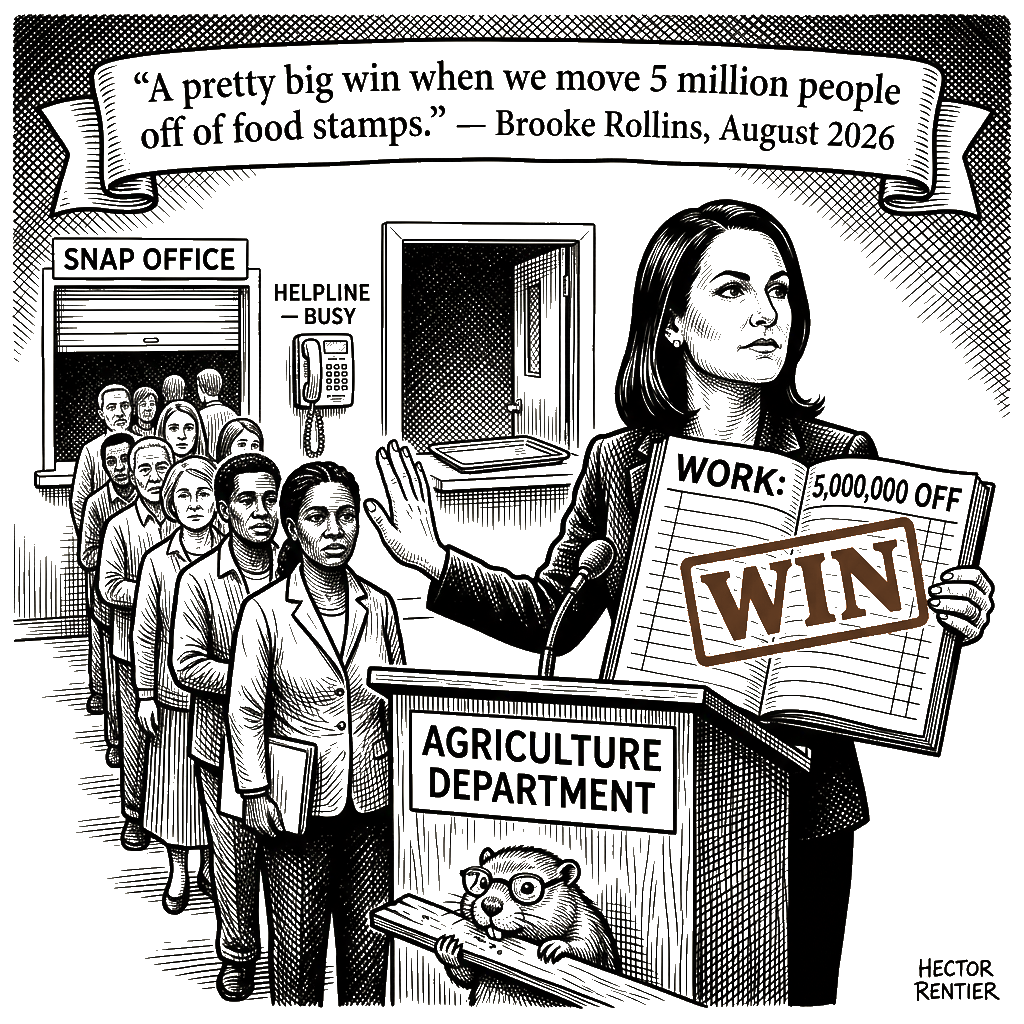
At a farming festival in Minnesota in August, Agriculture Secretary Brooke Rollins said: “Democrats don’t love the decrease. But for those of us that love work and celebrate work and want people to work and not be on food stamps, it’s a pretty big win when we move 5 million people off of food stamps.”
That is the entire case for the policy.
Read the sentence as it was built. It does not say anyone found a job. It does not say anyone got richer, better fed, or more secure. It says five million people were moved off. The verb is administrative. The unit of account is a human being, and the human being is a subtraction.
The trouble is where the administration files the number. It files the drop under work, as though five million people clocked in somewhere. They did not. It belongs under hunger. Five million Americans are no longer receiving food assistance. Where they went is the only question worth asking, and the answer is not a paycheck.
They turn up somewhere else.
It is a queue.
The rewrite of the rules made the queue grow. Under the old system, only able-bodied adults between 18 and 54 with no dependent under 18 had to work a minimum of 20 hours a week. Even then, the requirement reached them for no more than three months out of every three years. Under the new rules, able-bodied people from 18 to 64 with no dependent under 14 must put in at least 20 hours a week of paid or volunteer work.
A parent with a 16-year-old used to be exempt. A 60-year-old with no children at home now owes 20 hours a week. The old three-month cushion is gone. As written, the demand is twenty hours every week, with no stated cap and no grace period in it.
Read the requirement closely, because one word does all the work: or volunteer. Unpaid hours can satisfy it. That is how a work requirement can be enforced at scale without producing a single payroll entry. The rule can record compliance without replacing the SNAP dollars a household has lost. It can turn a question about food into a question about boxes, hours, and paperwork.
The new rule counts paid work and volunteer hours alike, which is generous, and beside the point.
The employment data refuses to flatter the story. According to figures compiled by FactCheck.org, the United States added 776,000 non-farm jobs between January 2025 and September 2026, about 37,000 a month. During the final 20 months of Joe Biden’s presidency, the country added 2.6 million, about 130,000 a month. Across nearly identical 20- and 21-month windows, the country was hiring at less than a third of the earlier pace.
The months when the work requirement was enforced and five million people came off the food-assistance rolls were not a period of an employment boom.
The requirement did not chase a hot labor market. It dropped people out of a cold one.
A USDA spokesperson said: “The number of individuals receiving benefits is constantly changing and is not representative of any one policy.” The spokesperson did not answer whether the changes had forced some Americans to go hungry.
It is an odd position for an administration that calls the decline a victory. The department administering the statute will not attribute the decline to the statute.
What happens to five million people is that they turn up somewhere else.
In Michigan, the Food Bank Council of Michigan’s helpline began taking more than three times as many calls a day after the changes took effect. This week, the organization had to suspend the line temporarily because of the volume. Not because the questions stopped. Because there were too many to answer.
Sheril Kirshenbaum, the council’s chief external relations officer, said: “We don’t have the data to suggest that there are more jobs suddenly out there. We just know fewer people are getting benefits.”
In Kentucky, enrollment fell 6%. Governor Andy Beshear wrote to Rollins this month: “I am concerned more people are going hungry in my state because of changes to Snap, impacting children and the elderly.”
In Arizona, enrollment dropped 50% between July 2025 and June 2026.
In Louisville, Rhona Kamar of Feed Louisville said: “We have always had enough food around. But now what we are seeing is every day the shelves are empty at the end of the day, so every bit of food that comes into our kitchen every day goes right back out to the community at the end of the day.”
The hunger does not stop at the recipient’s table. It reaches the school cafeteria.
Under the Community Eligibility Provision, a school whose student body is at least 25% enrolled in SNAP or another public benefit can use federal funds to serve free breakfast and lunch to every student without household applications. Fewer SNAP enrollees means fewer qualifying students. Fewer qualifying students means fewer universal meal programs.
The Washington Post reported this week that in the Houston Independent School District, 26 schools that had been feeding every student free meals are no longer eligible for the program.
A system built to reach the children who are hardest to reach is now rationed by the size of the paperwork failure in the neighborhood. The same policy that pushed families and individuals off the food-assistance rolls is taking universal school meals away from students who still need them. No hearing. No signature. No parent in the room.
Related coverage reports show the same machinery at work. The USDA has proposed requiring chip-enabled SNAP cards and tap-to-pay terminals in all 50 states. Millions of Medicaid recipients face new work requirements from 1 January 2027.
The program is narrowed at the front and rebuilt at the back. Fewer people are eligible. More apparatus is built to pay the ones who remain.
And the bill for all of it is landing on the states. Starting in October, states must cover 75% of SNAP’s administrative costs, up from half. From October 2027, states must pay a share of benefit costs when their payment error rate runs above 6%. The USDA says that measure is not a measure of fraud. The only states granted relief were those with error rates above 13%.
Joseph Llobrera of the Center on Budget and Policy Priorities put it plainly: “States have been really set up to fail.”
More money for the same paperwork. Longer waits at the other end of it.
The savings are real, too. The Congressional Budget Office’s $187bn projection is enormous money, and the administration wants the country to focus on the saving. The cost lands elsewhere. It lands in food-distribution kitchens running out of food, school cafeterias losing universal meals, county offices facing heavier administrative demands, and households waiting longer for help.
Meanwhile, the administration’s theory runs straight into the arithmetic of wages. “If people were getting paid enough, they would not be on the Snap program,” said Gina Plata-Nino, who directs SNAP at the Food Research and Action Center.
That is the whole contradiction in one line. A work requirement does not fix a wage. It moves the shortfall from the federal government to the household.
Grocery and gas prices have increased during Trump’s second term. For a worker relying on SNAP, the arithmetic is brutal. A bigger basket. Less purchasing power. No bigger paycheck.
Which brings us to the person at the end of the line.
Sandra Scott is 58 and lives in Louisville. She has been homeless for most of her life. Six back surgeries. A long fight with mental illness. A methamphetamine addiction she has been sober from for two years. A subsidized apartment. An emergency responder certificate she is working toward. Volunteer work with The Table, a nonprofit restaurant where the price is whatever you can pay.
Before she started receiving SNAP four years ago, she ate at “soup kitchens or wherever I could, but for the most part, like on the weekends, there really was not anywhere to go.”
Asked what she would say to the Trump administration about the SNAP changes, Scott said: “Why don’t you walk in one of our shoes, somebody in the community that doesn’t have anything, that wasn’t born into money or doesn’t have a job because it’s so hard to find or [who] can’t find affordable housing because it’s too high?”
She has already put in the volunteer hours. The rule can see her checkbox. Her back, her housing, and her missing wage remain outside it.
Donald, you are a small man with a large hand on the lever. Your stomach turns when the Michigan helpline suspends its line. A hard weight settles behind your sternum when the Houston cafeteria takes the free tray from a child’s hand. Your jaw locks when Andy Beshear writes that more people are going hungry.
You do not have to feel any of it. You arranged the distance.
You are not offering work. You are removing dinner and putting the invoice on the people least able to pay it. That is not leadership. That is hunger dressed as arithmetic.
Brooke, your throat closes when you say “a pretty big win.” A metallic taste gathers under your tongue. The muscle beneath your ribs catches. Your hands turn cold around the microphone when you say “move 5 million people off of food stamps.”
You are not speaking about work. You are speaking about the disappearance of dinner. Five million human beings became five million fewer lines on a report, and you called the subtraction victory.
You do not get to call this work. You do not get to call hunger administrative. You made hunger disappear from the ledger while the hunger moved into kitchens, cafeterias, stomachs, and the long wait for a helpline that had to stop answering.
There is no innocence in the arithmetic.
Roll the ledger the right way. Five million people off the rolls. 776,000 jobs added in 21 months. More than triple the daily calls to the Michigan helpline. 26 Houston schools out of universal meals. States set up to fail. $187bn in savings booked as a victory while the burden lands on food banks, school cafeterias, county SNAP offices, and households that need assistance.
That is not a work program. It is a hunger program with a job requirement stapled to the front, and the people least able to navigate the paperwork are the ones who fall off.
The work requirement asks whether you put in 20 hours. It never asks whether there was a job to put them in.
Main Street didn’t ask for a smaller safety net. Main Street asked for a paycheck that covers the cart. You delivered a quota instead, and the bill is coming due, paid by people who never applied for it.
“Truly I tell you, whatever you did not do for one of the least of these, you did not do to me.” — Matthew 25:45