
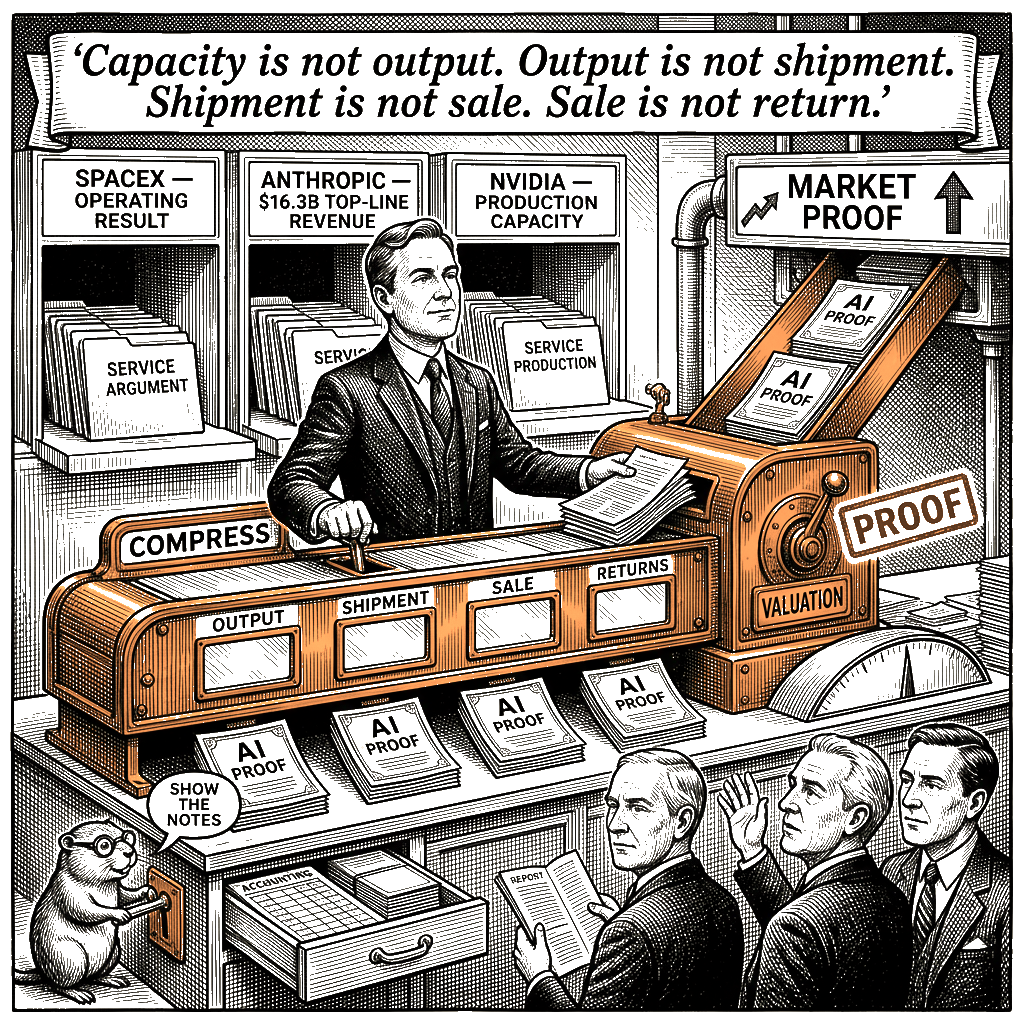
Nvidia and Musk are selling investors forecasts in place of measured engineering proof.
The market did not need another promise from artificial intelligence. It needed three, and Wednesday supplied versions of all three.
SpaceX had an operating result. Anthropic had $16.3 billion in first-half revenue. Nvidia had next-generation computing systems sampling at Microsoft and a supply chain said to be capable of manufacturing thousands of them per week. The Nasdaq Composite rose 1.1%, nearly recovering Friday’s brutal selloff; the S&P 500 rose 0.6%; the Dow climbed 0.7%, or 360.21 points.
The figures were real. So was the confusion.
Look again at the lineup. These are no longer interchangeable versions of the same speculative promise, though they are not interchangeable evidence either. SpaceX supplied an operating result. Anthropic supplied a top line. Nvidia supplied production readiness and an early deployment. The market compressed three different propositions into one AI story and called the result proof.
SpaceX was the day’s explosive centre, and the explosion was easy to misunderstand.
Its operating disclosure was concrete: $14.6 billion in quarterly revenue, Musk’s statement that SpaceX was profitable and, according to MSI’s report on the company’s earnings, a return to the profit expectations investors had learned to doubt.
Starlink is a connectivity business: subscribers and service customers pay for access to a deployed satellite network. AI infrastructure is a different operating system, with different customers, capital requirements and margins. The $14.6 billion figure was real, but the earnings disclosure did not provide segment revenue or segment profit. It therefore did not say how much came from each engine, which carried the capital costs or whether either could finance its own expansion.
Reported profitability mattered. It was stronger than a forecast. It was still an accounting result, not a synonym for free cash flow, which is what remains after capital spending and working-capital needs are paid. Musk did not provide the latter in the quoted record. Calling SpaceX a “cash engine” therefore outran the evidence.
The forecast was a separate instrument again. Musk projected more than $500 billion in annual recurring revenue by the end of 2027. Annual recurring revenue is a run-rate measure: it takes current revenue and projects it forward over twelve months. It is not contracted backlog, and it becomes less informative as the period being forecast grows longer. A forecast can be useful. It cannot arrive wearing the clothes of revenue already earned.
Then there was the merger.
Musk said a combination of SpaceX and Tesla could become the largest merger ever, joining companies valued at roughly $2 trillion and $1.5 trillion respectively. The companies formed special committees of independent directors to examine the idea, and Musk said he would not participate. There were no terms and no guarantee of an agreement.
Optionality has value. That is precisely what makes merger talk useful to a share price. Tesla rose 3.4 per cent Wednesday and continued higher after hours after reporting flat third-quarter revenue but positive free cash flow while continuing its heavy investment in AI and robotics. The operating result and the merger proposition were separate trades that happened to travel through the same stock.
Anthropic supplied the cleanest top-line print of the week. It was not the cleanest proof of demand.
A draft IPO prospectus showed $16.3 billion in revenue during the first half of 2026. That is commercial scale, not a slide-deck aspiration. It is also why the draft prospectus cannot be allowed to stop at the top line.
To turn that number into evidence of durable technical demand, the disclosure must answer several separate questions. What is the product mix among API inference, Claude Code, paid Claude subscriptions and enterprise contracts? How concentrated is revenue among customers, and how much is sold directly rather than through a cloud partner? Are API token volumes, context lengths, retention and expansion rising? What compute obligations has the company contracted, and what happens to them if demand slows? What remains as gross margin after inference costs? How much capital spending or cash burn was required to produce the revenue?
Those are not ornamental accounting distinctions. They determine whether $16.3 billion represents a widening customer base or a concentration risk; recurring software demand or a temporary burst of consumption; an efficient service or revenue that arrives with larger obligations attached.
Revenue is money recognised for services delivered. It is stronger evidence than a forecast, but revenue is not the same thing as healthy unit economics. A prospectus is where hard numbers are supposed to become legible. The headline figure cannot substitute for the notes.
Nvidia then supplied the physical claim, and here the distinction between a production line and a product market matters most.
Vera Rubin is not an AI model, nor is it a single chip. Rubin is the accelerator architecture; Vera is the CPU; together they form a rack-scale computing platform combining processors, memory, high-speed interconnects, networking and system software. Its job is to train and serve large models. The unit matters: a thousands-per-week production claim concerns complete systems containing many processors and substantial supporting hardware, not thousands of loose accelerators waiting for an enthusiast with a screwdriver.
At its GTC conference in Berlin, Chief Executive Jensen Huang said sampling of the Vera Rubin systems was going “incredibly well.” He said the systems were already in use at Microsoft’s cloud-computing arm and that Nvidia had established a supply chain capable of manufacturing thousands of systems per week.
In this context, sampling means early production-intent systems moving into customer evaluation. It is a stage between engineering and volume production, not a synonym for shipment. “Thousands per week” describes what the manufacturing line is prepared to assemble. It does not establish that thousands left the factory, reached paying customers, were accepted, produced revenue or avoided being returned.
Nor did “incredibly well” constitute a measured performance result. A useful benchmark must name the model, precision, context length, batch size, concurrency and power envelope. Token throughput without those conditions is not a performance claim so much as an attractive adjective with a decimal point attached. Energy per token, time to first token, utilization, uptime, failure rates, software compatibility and cost per completed task are the numbers that tell whether a new platform is merely present or useful.
At the bench, the rule is simple: capacity is not output; output is not shipment; shipment is not sale; sale is not return. Nvidia rose 2.5 per cent Wednesday. Advanced Micro Devices gained 3.4 per cent, Texas Instruments rose 2.5 per cent and Teradyne added 2.6 per cent. Those were market prices, not laboratory measurements. The Microsoft deployment mattered because it put the systems somewhere they could be tested; it did not establish broad commercial demand by itself.
The other prices were no more self-explaining. CoreWeave fell 0.5 per cent Wednesday and remained down nearly 30 per cent for the month. South Korean data-centre startup Elice’s market debut also fell flat. The ten-year Treasury yield rose to 5.145 per cent, and Brent crude settled at $108.82 a barrel.
None of those figures permits the sentence that investors were “punishing promises.” One session cannot isolate motives among operating results, financing conditions, positioning, interest rates, contracts and expectations. Nor does CoreWeave’s monthly decline establish technical failure. Calling it and Elice “expensive scenery” would not be analysis; it would be a way of disguising ignorance as a verdict.
What the tape did establish was a hierarchy of prices. SpaceX had reported an operating result. Anthropic had reported top-line scale. Nvidia had reported production readiness and customer evaluation. The names with less equivalent disclosure were collateral in the session, but they were not convicted as engineering failures because their share prices moved differently.
The AI trade is no longer indiscriminate. It is a hierarchy—but Wednesday priced the hierarchy of disclosures, not a hierarchy of proven businesses. SpaceX was supposed to be the cash engine; it was a profitable company with a forecast and a merger proposition attached. Anthropic was supposed to be proof of demand; it was proof of revenue with several material questions still attached. Nvidia was production capacity, which was closer to the word, but capacity remains one stop before shipment and several stops before return.
The risk has changed shape. The question is no longer whether the current generation of large language models and the machines built to run them are real. It is which companies own the revenue, infrastructure and capacity—and whether the economics survive the bill.
The remedy is less romantic than the prospectuses. Anthropic should disclose product mix, customer concentration, API usage and retention, contracted compute obligations, gross margin after inference, and capital spending. Nvidia should distinguish sampled systems from shipped, accepted and revenue-producing systems, while reporting workload benchmarks and return rates. SpaceX should separate Starlink and AI infrastructure revenue, operating profit and capital spending from Musk’s $500 billion forecast, and should treat a possible merger as optionality until an agreement exists.
These are not requests for more storytelling. They are the accounting categories required to distinguish demand from capacity, capacity from shipment, and shipment from return. Public markets now assign extraordinary values to infrastructure whose operating details remain selectively visible. An AI summit would not repair that. Public filings can.
The tape can print a verdict overnight. The machines still have to ship, run, benchmark and earn their keep. Wednesday put the names at the top of the wall; it did not build the wall.