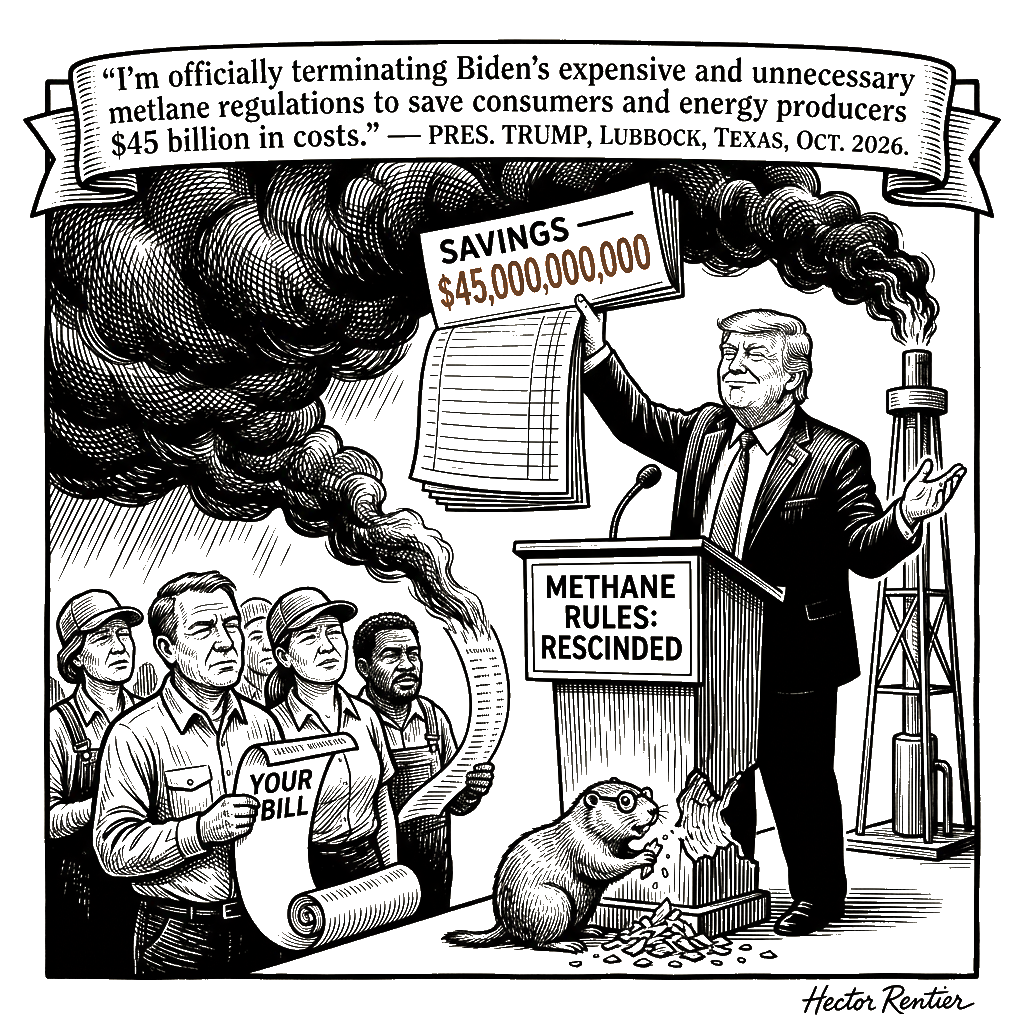
President Trump on Tuesday reminded Americans exactly what they were promised — and why so many of them fear him. “I’m officially terminating Biden’s expensive and unnecessary methane regulations to save consumers and energy producers $45 billion in costs,” he announced at a rally in Lubbock, Texas. The $45 billion is written on one book only: the savings are tallied, the costs are pushed into the air everyone breathes. That isn’t a savings; it’s a transfer from the public to polluters — producers’ avoided compliance costs become everyone else’s cleanup, health, and climate bills. More pollution, fewer rules, please.
The Trump Environmental Protection Agency is moving to rescind a suite of Biden rules that would have forced oil and gas producers to stop treating the atmosphere as an open sewer. The rules were modest: capture the natural gas that comes up incidentally with oil production rather than flaring it into CO2 — transport it to market or put it to productive use on-site, by, say, generating electricity, anything except treating the open air as a free waste pit.
Large producers already capture and sell incidental natural gas because it is profitable, and they have a strong financial incentive to do so. For smaller producers in the fracking fields it is often not economic — an argument about their books, not about the air. It is the smaller producers the administration is rescuing.
And who are those marginal wells? The EPA estimates that roughly 77% of oil wells in the country are “marginal,” meaning they produce 15 barrels a day or less over a year. They account for just 5.6% of U.S. oil production. Their main product, in other words, is not energy — it is the pollution that comes with it. Most owners of marginal wells are indeed small, with 65% owning 10 or fewer. Many are located on family-owned property with royalties from production helping pay the bills. But smallness does not make emissions harmless, and none of that explains why what comes out of them should be free. Royalties on family land pay some bills; they do not pay everyone else’s.
The Biden rules would have forced many marginal wells to close — if the rules would close some marginal wells, that is a feature, not a bug; the public shouldn’t subsidize unprofitable pollution forever. If the real concern is those families, the honest answer is transition help, not a blanket license to flare.
The Trump EPA estimates that its deregulation will add 210 million barrels of oil and 1.41 trillion cubic feet of natural gas supply through 2050. Note what is being added — supply — and what is being subtracted: the obligation to stop flaring. That isn’t a savings; it’s a liability. More supply means more methane and more CO2, paid for by everyone. Economic benefits could be significant in places like Lubbock and Kansas, where about 45% of wells are classified as marginal — and so are the costs, which land on everyone who breathes.
Permitting delays make it hard to build or connect to a gas pipeline and move captured gas to market, and Mr. Trump’s answer is to let producers flare it into the air for free. The Trump rollback was, ironically, engineered by the same crowd that is trying to lay more pipelines and keep natural gas power plants running flat out. Their overarching goal: keep more oil and gas in the air.
Officials such as EPA Administrator Lee Zeldin are doing the devil’s work dismantling rules that would have made producers pay for what they emit — doing the industry’s bidding and calling it public service. Alas, many Americans don’t know about it because the President prefers to talk about his border taxes that raise costs and are unpopular. He is quietly raising the other kind: costs that never show up on a receipt — only in the air. Go figure: the self-described populist priced the public’s sky at $45 billion, called it savings, and handed the public the bill.