
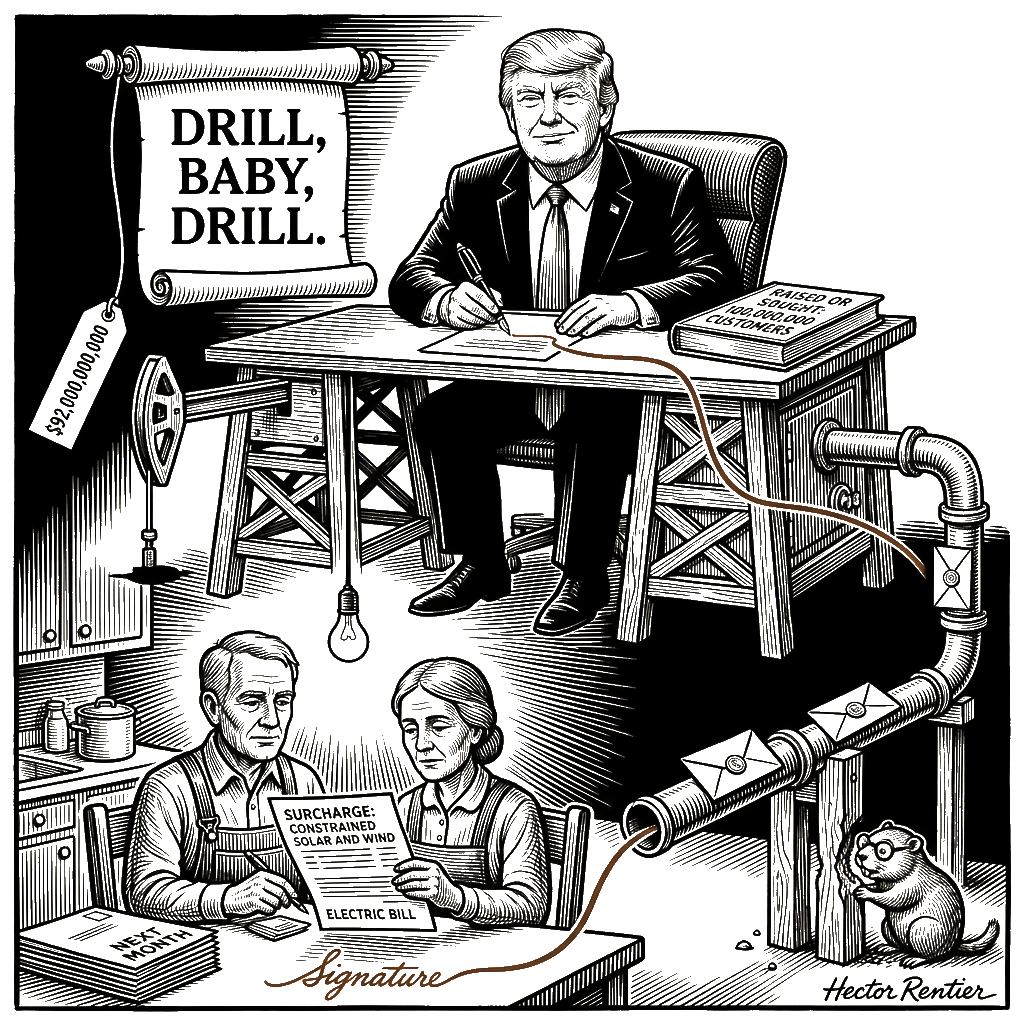
Trump’s energy agenda is on every Adams County electric bill. I picked up the statement off the bench Tuesday next to a carburetor, and the number on it is not an abstraction some economist modeled in Washington — it is what it cost to keep the shop and the house running through a September that would not break. Out in Houston a gas meter sits outside an apartment building, and since Trump took office gas and electric utilities have raised or sought to raise bills by more than $92bn, touching more than 100 million customers. I have never seen that Houston meter. I have got my own, out here on the section-line road, and it is reading the same policy. That $92bn is the entire election in one number, and four days out it is remarkable how few candidates anywhere want to say so out loud.
The constraints on solar and wind are not a phase of the news cycle. A Nera study projects economy-wide household energy costs rising an average of $11.6bn annually between 2027 and 2033 because deployment is being constrained — with Texas, the hardest-hit region, facing increases of as much as 22%. Lean on gas instead and you inherit gas: greater reliance on natural gas capacity raises reliability risks and leaves households more exposed to price volatility. Around here that lands as a rate case at the Public Service Commission in Madison and as a winter supply schedule from the co-op, because on the sand plain a household runs propane for heat, electricity for everything else, and a farm runs both plus the diesel to dry a crop that came out of the ground wet. The clean energy workforce shed nearly 37,000 jobs last year — the first annual loss since the pandemic, per an E2 analysis of Department of Energy data — and Climate Power puts the tally at 173,000 jobs cut or delayed since Trump took office, with Texas losing the most. I do not need the national number to believe that one. The kid who was putting panels on barn roofs north of here two summers ago is back to swinging a hammer for a contractor out of the Dells. “Drill, baby, drill” has a retail price, and it is printed on the monthly statement.
Which is why the affordability frame is not a rebrand — it is the honest one. Researchers at the University of Michigan’s School for Environment and Sustainability found three distinct groups of Democratic candidates and officeholders talking about the climate crisis: energy populists like Sherrod Brown in Ohio, who reach for datacenters and utility bills; climate champions like Arizona’s JoAnna Mendoza, promising bold clean-energy investment; and “all-of-the-above” candidates like Amy Acton in the Ohio governor’s race. Josh Turek in Iowa is making the insurance argument — extreme weather driving premiums up. Different pitches, one common denominator: affordability. As Geoffrey Henderson put it, the climate message has been brought into alignment with the affordability question, and this election tests whether that combination resonates. None of them sound like an IPCC report, and they do not have to. The one-in-three-Americans-directly-hit-by-extreme-weather figure is not a statistic I have to import from a national survey: it is the drought that came across this county’s sand plain and took a cutting off the hay, it is the adjuster’s letter that reset a neighbor’s premium, it is a syrup season that starts three weeks early and finishes before the tourists arrive. I have kept the dates in a notebook for twelve years. The notebook and the poll are saying the same thing.
The alternative — the quiet version — is a choice to lose on purpose. “Climate hushing” persists election after election even as Environment Voter Project polling of likely US midterm voters shows Democrats and Republicans in battleground states want candidates to talk more about the crisis. Candidates are betting that voters cannot do the subtraction. The subtraction is trivial: every constraint bolted onto clean energy is a surcharge bolted onto the household. Wendell Berry has been saying for fifty years that a community’s economy is its membership — that extraction takes the people before it takes the payroll — and a utility bill is where that stops being philosophy. This is not a niche environmental story. This is the affordability crisis wearing a hard hat and holding a meter reading.
We made the case three weeks ago from this same bench that this is the decade’s last window to reshape Congress, and Trump’s approval is sitting at a historic 37% with a genuine opening to retake it — as we noted earlier this month. What that opening means is decided on our own ballot: the congressional seat that carries Adams County, the governor’s race in Madison, and the statehouse seats that appoint the people who sit across from the utilities. What they do with it depends on whether voters hear themselves in the conversation.
A Democratic House forces the White House into budget fights, which is where climate provisions can ride through on appropriations — as Michael Gerrard of the Sabin Center notes, presidents sign spending bills carrying provisions they dislike because the government must stay open. For a rural district that means the difference between a Rural Utilities Service loan that reaches a co-op like ours and one that does not. It also restores subpoena power: oversight of, say, the administration’s intervention in a federal lawsuit to keep Elon Musk’s Mississippi datacenter running portable gas generators in alleged violation of the Clean Air Act — and I have had three generators in this shop this month, so I can tell you exactly what a portable gas generator burns and who breathes it. A Democratic Senate gains leverage over confirmations, which means fewer anti-regulatory judges lifetime-tenured onto the bench and more vacancies left for the next president to fill. Dan Farber’s point is the durable one: those seats outlast the vote that blocks them, and the judge who hears the next fight over a well-water standard or a rate increase is going to be one of them. And a permit bill that would gut the National Environmental Policy Act — leaving no court able to halt a project over a NEPA violation — would be rewritten rather than waved through if Democrats hold both chambers, Gerrard says, which is the difference between whether the people down the road get heard before a project gets built over their water. None of this is flashy. All of it lands here.
The downside branch is worse: if Republicans buck the polls and hold both chambers, they get a mandate for “drill baby drill” on steroids — more favoritism toward polluting companies, more of what Farber calls repealing the Inflation Reduction Act’s clean energy wins and overturning specific regulations by Congress, more packing of the lower courts with anti-regulatory judges — and it comes courtesy of the same lawmakers who voted to repeal clean energy tax credits that created jobs in their own districts. The repeal is not abstract in a county where a farm or a pole barn with panels penciled out partly on a credit. Trump faces no subpoena and no confirmation fight. Farber has watched this movie. “I keep thinking, how much worse could they do? But they always find something.”
The states are on the same ballot. The Cook Political Report has Democrats picking up two-to-four governor’s seats this cycle, and in Gerrard’s words a flipped governor’s office could yield a profound change in state climate policy. In Wisconsin that governor signs the energy agenda and stands up the Public Service Commission that hears our rate cases — which is as close as energy politics ever gets to a kitchen table in Friendship.
Then there are the courts, which no election result fully controls. “Every significant environmental regulation is challenged in court by one side or the other,” Gerrard says, and two cases will decide how much of the regulatory state is left to fight over: the DC Circuit’s review of Trump’s revocation of the endangerment finding — the ruling that lets the EPA limit greenhouse gas pollution — and the supreme court’s Suncor v Boulder case, which will decide whether local officials can force fossil fuel companies to pay their share of climate damages. Rule against Boulder and future damages suits are blocked, removing a vital method of accountability no Congress can restore.
Which is the point. “Climate hushing” sounds like a failure of nerve. In truth it is the most honest political translation available: the climate crisis was never a separate issue from the cost of living. It was always the same bill, arriving in the mail a few years early. And that bill must name its author — the relief has to point back at the fossil fuel interests who caused it, or “affordability” becomes another mandate for drilling.
That gas meter in Houston does not know which party controls the House, and neither does mine. Mine knows only what the constraints cost: $92bn in raised and requested bills, 100 million customers deep, with more scheduled to load on in 2027 — and a propane gauge on my own property that will be checked the first hard week of November. On Nov. 3 that is the ballot question, whether or not the candidates say it out loud, and whether the people out here decide to keep paying it or start making the interests who caused it pay it for them.