
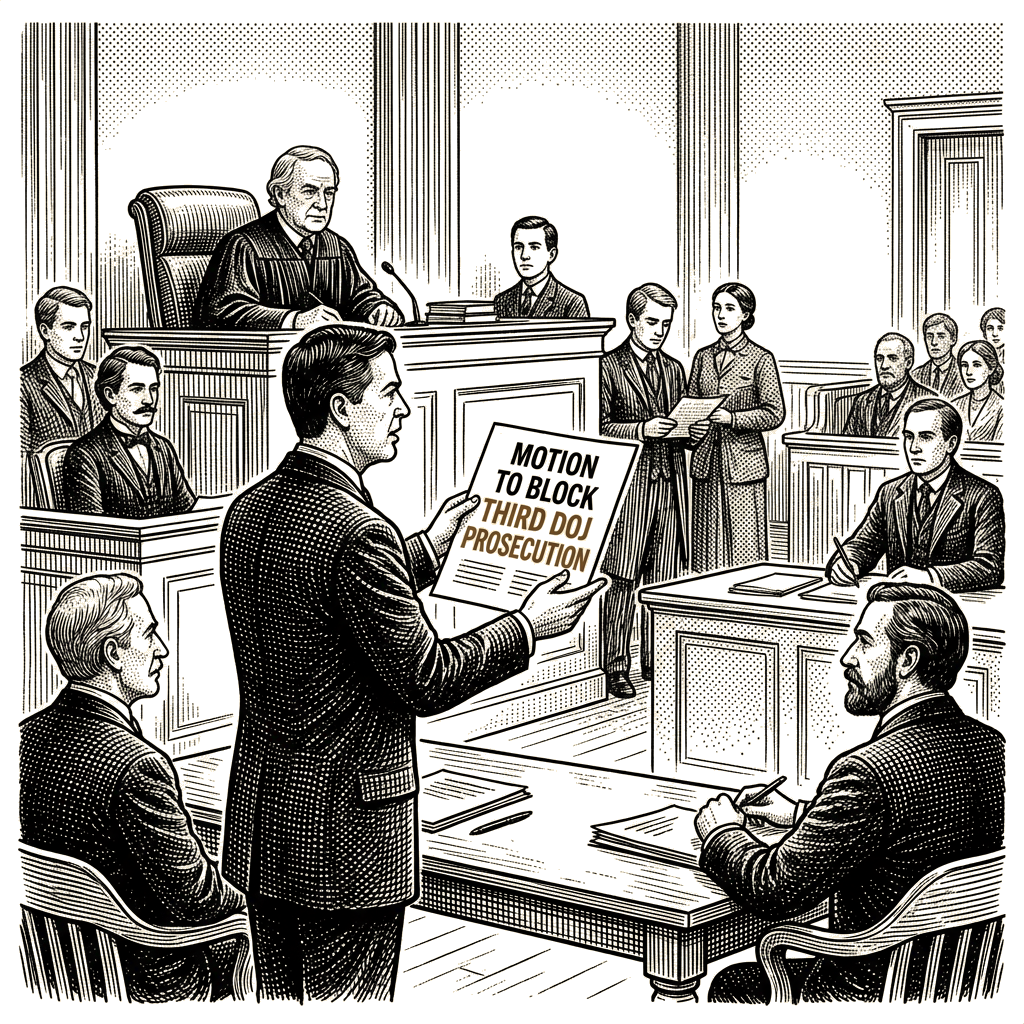
On Friday, James Comey will walk into a Washington courtroom as a three-time defendant, and U.S. District Judge Trevor McFadden — a Trump appointee — will decide whether the Justice Department gets to keep its third case against the man it already cleared. It is a hearing that should not exist. The case should not exist. The only reason it does is that the department had to bend its own rules to dodge its own legal time limit, and that tells you everything you need to know about what this is.
It is not justice. It is a vendetta wearing a prosecutor’s suit.
Start with the record the government itself built. The underlying allegation is a decade old: an October 2016 New York Times story about a secret Foreign Intelligence Surveillance Court order directing Yahoo to scan emails for messages potentially linked to a foreign terrorist organization — an order Yahoo was barred from disclosing and that two anonymous government officials described to the Times. It is the kind of story leaks are made of, and it is the kind of leak that gets investigated and, when nothing turns up, closed.
That is exactly what happened — twice. Federal authorities opened an investigation in early 2017. Among the prosecutors was John Durham, the man the right would later canonize for hunting the FBI’s investigators. In December 2018, Durham wrote a classified memo recommending no criminal charges against anyone — not one person — in connection with the disclosure. The U.S. attorney’s office for the District of Columbia then opened a second probe of the same matter in 2019, code-named “Tropical Vortex,” and it closed in early 2020 with the same result: nothing. No charges. No case. Twice over.
The government may call it a national-security breach. Its own prosecutor read the file and recommended charges against no one, and the second probe closed without a single charge. Two investigations. Zero charges. And it’s the same Yahoo email-scan order that links this revived case to that 2016 disclosure. Nothing about the underlying facts changed between early 2020 and this month — at least, the department’s stated rationale for this new filing was a deadline maneuver, not a new fact. The clock just got short.
So the department, rather than let the decade-old time limit run out, did something it rarely does: it bypassed the grand jury entirely and filed a charging document called a “criminal information,” defending the maneuver as a way to extend the legal time limit for an indictment. The department’s own spokeswoman has confirmed that the waiverless filing stretched the 10-year deadline — an admission that the deadline had otherwise run. Be plain about what that is: the government looked at a deadline, decided it didn’t like it, and invented a procedural end-run to keep chasing a man it had failed to charge twice. Comey’s lawyers call the case legally invalid. That is what a decade-old charge looks like when you resurrect it: a procedural workaround dressed up as accountability. A rerun with the serial numbers filed off, and the timing is the tell.
This was never about the leak. It’s about the man, and the calendar — the charges, unsealed Monday, land in the final stretch before next week’s midterms, part of a series of politically charged investigative actions in the run-up to Election Day. The president who fired Comey in May 2017 as he oversaw the Russia investigation, who has accused him of treason and called for his imprisonment, now commands a Justice Department that files criminal informations against his enemies like a clerk stamping invoices.
If you doubt it’s personal, look at the scoreboard. Case one: filed in federal court in Virginia, accused Comey of lying to Congress, dismissed by a judge who concluded the prosecutor who brought it was illegally appointed. Case two: a pending indictment alleging Comey threatened the President of the United States with an Instagram photo of seashells arranged to read “86 47” — 86 being diner slang for “to throw out,” “to get rid of,” or “to refuse service to,” and 47 being Trump’s number in the presidential line.
Seashells. An Instagram photo. That is what the might of the federal government has been reduced to: chasing a man over seashells and a leak that two separate investigations declined to touch. Three cases, one target, one coincidence too many to be one — all landing in the run-up to next week’s midterm elections.
Comey’s own words, in his video statement Monday after the documents came unsealed, are the sanest thing said on any of this: “Well, they’re back — again. It would almost be funny if it weren’t such an appalling abuse of the Department of Justice — one that we cannot become numb to. Nothing’s changed with me; I’m still innocent, I’m still not afraid of these people — and I still believe in the independent federal judiciary.”
Still not afraid of these people. Let that sit. Here is a man the most powerful government on earth has now charged three separate times — a man branded a traitor by the president, a man who likened that president to a corrupt mafia don in a book and has been paying for it ever since. And he stands in front of a camera and says he is not afraid. The government has the grand juries, the marble buildings, the criminal informations. He has the one thing they cannot manufacture: the record, which twice concluded there was nothing there.
Comey says he still believes in the independent federal judiciary. The judge on Friday is a Trump nominee, which cuts both ways only if you pretend the case is ordinary. It is not ordinary — a charge twice abandoned, revived without a grand jury, aimed at the president’s most prominent former foe days before the midterms. If it survives before a judge the president nominated, survival will not have been the law’s doing. Whether the rest of us have gone numb to a Department of Justice that prosecutes men it has already cleared is the harder question.
Two investigations. Zero charges. One clock they had to cheat. And still they came back for him, a third time.
Friday is where that belief gets tested. Comey’s not afraid. The country should be.