
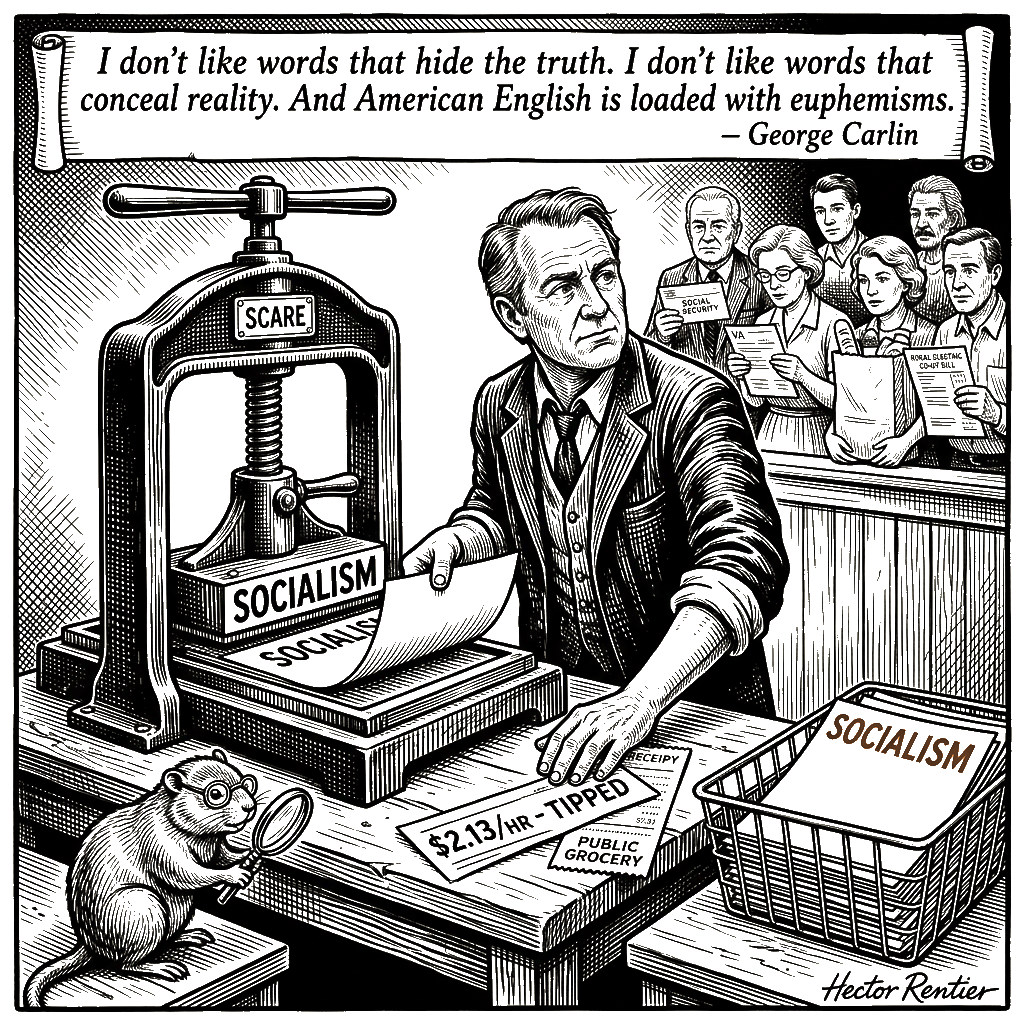
The most feared word in American politics spent this election season as a warning label, and the candidates wearing it kept winning anyway. As the Associated Press tells it, five democratic socialists are positioned to enter the House after Nov. 3 — Darializa Avila Chevalier and Claire Valdez in New York, Melat Kiros in Colorado, Donavan McKinney in Michigan, Chris Rabb in Pennsylvania — expected to win safe seats and join the two already serving. The most radical thing about any of them is the paperwork: they won primaries. Republicans rang the socialism bell all year. The bell didn’t ring the way it used to — least of all among Democratic voters. That is what happens to a scare after enough reruns.
Several of them did not inherit open seats; they took occupied ones. Chevalier, a community organizer who did field work for Mamdani’s mayoral campaign and has organized for a living, toppled longtime Rep. Adriano Espaillat in upper Manhattan and the Bronx — the other half of July’s double ouster. Kiros, a 29-year-old attorney, ended Diana DeGette’s thirty-year run in Denver — an upset we wrote up when it happened. McKinney beat Shri Thanedar in Detroit despite being badly outspent, campaigning on utility bills and Medicare for All. Rabb, ten years in the Pennsylvania state House, topped a four-way field in Philadelphia. Valdez, running on the Mamdani-backed slate that swept New York’s primaries in June, dispatched retiring Rep. Nydia Velázquez’s handpicked successor. These were not walkovers.
Now. The menace. The AP files these five under the far left of the Democratic Party, so let’s read the far-left program. Abolish ICE, for the record — a real fight, not a rerun of something America already runs. Medicare for All. Less donor money steering the party, which Rabb summarized better than I will: the party listens to “the people closest to the pain,” as he puts it, instead of “the people closest to the purse.” And here is the part the alarms are actually aimed at: Rabb wants to retire the $2.13-an-hour federal tipped minimum — an American peculiarity the rest of the rich world never bothered to copy — so the wage floor covers the delivery driver as well as the diner waitress, and open government-run grocery stores in the food-desert neighborhoods the supermarkets wrote off, which I’d want costed before I cheer. McKinney ran on Detroit’s utility bills. That is the ideology the sirens are about. A raise for waitresses. A place to buy eggs. I’m not going to pretend the whole menu comes pre-tested. My side doesn’t get a discount.
Let me say the thing I’m always assumed to be dodging. Communism as it was actually built in the twentieth century — Russia, China, Cambodia — was a catastrophe. It killed tens of millions and crushed the workers it claimed to free. That verdict is in, and I’m not relitigating it. What the verdict does not settle is whether the word “socialist” attaches to a 29-year-old lawyer from Colorado. The dividing line in that history was never the label. It was whether the people in charge could lose. Lenin’s crowd abolished the counting. Eugene Debs drew about 900,000 votes for president in 1912 and nearly a million more from a federal prison cell in 1920, and the republic held both times. Michael Harrington built his version of this inside the Democratic Party, and the label that stuck was the left wing of the possible. These five are heirs to the second fork — the one that runs, loses, and runs again, the one that has already put Mamdani in City Hall and Ocasio-Cortez and Sanders in Congress. A politician who can be voted out is not a menace. A politician who cannot be voted out is.
And note the method, because the method is the whole difference. Nobody seized anything here. These five won nominations by asking their own party’s voters, in a country with a free press that can print their mistakes and courts that are still open — the exact machinery the century’s disasters dismantled first. The word shares a history with the catastrophe. The method is the opposite of it. Which raises the only question worth asking: are the gulag and the strip-mine really the only two items on the menu?
That discount applies to Scandinavia too. The Nordic countries everybody reaches for are not socialist, and I wish people would stop saying it. They are high-tax market economies — everyone pays the standard rate at the register, a full quarter of the price in Sweden, Denmark and Norway, the middle class included — that chose to put a floor under the market and then spent ninety years building the plumbing to hold it. Sweden’s grand school-voucher experiment has been, at best, a wash on the averages: flat mean results, enormous spread between schools. What these five campaigned on looks less like a seizure of the economy and more like social democracy plus a grocery store. Judge the word’s history separately from the platform. The platform is a paycheck and a checkout line.
Here is why the bell has gone quiet. A scare word does its work in the abstract. It needs a voter who has never met the thing it’s attached to. Medicare for All has a pilot program. It’s called Medicare — single-payer healthcare for everyone over sixty-five, every disabled worker, everyone on dialysis — run by a government that has never once been accused of loving efficiency, and that nobody serious campaigns to abolish. Even the seniors who take the private-brand detour, Medicare Advantage, get their care paid for from the same government counter. Social Security is universal social insurance and the most popular program in the country. The VA is fully socialized medicine — government hospitals, salaried government doctors — and politicians trip over each other to defend it; the member who tried to close one would be carried out of his district on a rail by his own voters. Rural electric cooperatives serve some 42 million Americans across most of the landmass of this country. North Dakota has run a state-owned bank, profitably, since 1919, and nobody ever put Bismarck behind an Iron Curtain. Alaska mails its citizens an oil dividend in one of the reddest states in the union. My cousins outside Gothenburg have never once checked whether a strep test was affordable this week; they treat the whole machine the way I treat the interstate. Boring. Useful. Theirs. The warning depends on all of that being foreign. It’s in your wallet. Around 145 million Americans belong to a credit union, and they would be startled to hear the menu has only two items. I have one of their cards in mine, and I have somehow never once been summoned to a Politburo meeting. We already do this. We just won’t say the word.
The AP reads the same shift in Zohran Mamdani’s mayoral win, in Alexandria Ocasio-Cortez, in Bernie Sanders’ stubborn endurance. My version is smaller and harder to argue with: the label finally ran into voters holding a grocery bill. You cannot scare a family out of noticing what rent costs. The warning was engineered for the abstract; the voter is holding specifics. And the arrangement those specifics come from — a tipped worker’s rent riding on the mood of her tables — was chosen, by people, in rooms.
Now the honesty I owe my own side. Five House seats are not a welfare state. Winning a primary is the first inch of a hundred-year project, and the receipt for that caution is Swedish. In 1976 the Swedish union federation adopted the Meidner plan: every year, a slice of the big companies’ profits paid out as new shares into funds the unions controlled — ownership arriving by installment. Swedish business answered with what is still remembered as the largest business-funded political campaign in the country’s history. The plan was watered down by 1984 and dead at the ballot box by 1992. The owners fought back and won — in a country with a century of union organization these five can only dream about. Bargaining coverage in America is about eleven percent: one worker in nine with a union contract. The machinery — whole industries bargaining at one table, union-run unemployment insurance, employers who actually show up to negotiate — mostly isn’t built here. Medicare for All sits on the hardest shelf of American reform; it presumes bargaining structures, tax capacity, a tax system people actually trust — machinery the Nordics took most of a century to build and that we mostly haven’t started. Anyone selling it as a two-year deliverable is selling utopia, and I don’t stock utopia. Five House members can hold the floor. They cannot build the factory. Winning a primary is the tip of that iceberg; the institutions are the iceberg. If anyone in that freshman class thinks November was the summit, Swedish history is standing in the corner waiting to correct them.
So here is what gets built, and it is gloriously boring. A child allowance is sitting on the shelf, already tested, recently, and measured. In 2021, Congress sent most families with kids a monthly check. By the Census Bureau’s own count, child poverty fell 46 percent in a single year — 9.7 to 5.2 percent, about 2.9 million children. Congress let the checks lapse and the poverty came back on schedule, which makes it the most honest data point in American politics: turn it on, children stop being poor; turn it off, they start again. That is not a Scandinavian fairy tale. That is a controlled experiment we ran on ourselves. Wage boards that set a floor across a whole industry can be legislated in states right now, no revolution required. Employee-ownership tax rules already have champions in both parties and almost no public opposition, which is the strangest free win in American politics. If these five spend a term on plumbing like that, then whatever is printed under their names, they will have built the thing worth having. If they spend it on speeches, no label will save them.
Watch what they build, not what they’re called. The menu was never two items. Not the gulag, not the strip-mine — a credit union, a rural power line, a kid’s strep test that isn’t a sales transaction, a grocery store in a neighborhood the supermarkets abandoned. The third item on the menu gets five more votes this Tuesday. The warning label is peeling off. What was underneath was American the whole time. The economy is a set of choices, not the weather. Somebody chose this one. Somebody can choose a different one.
Anyway.