
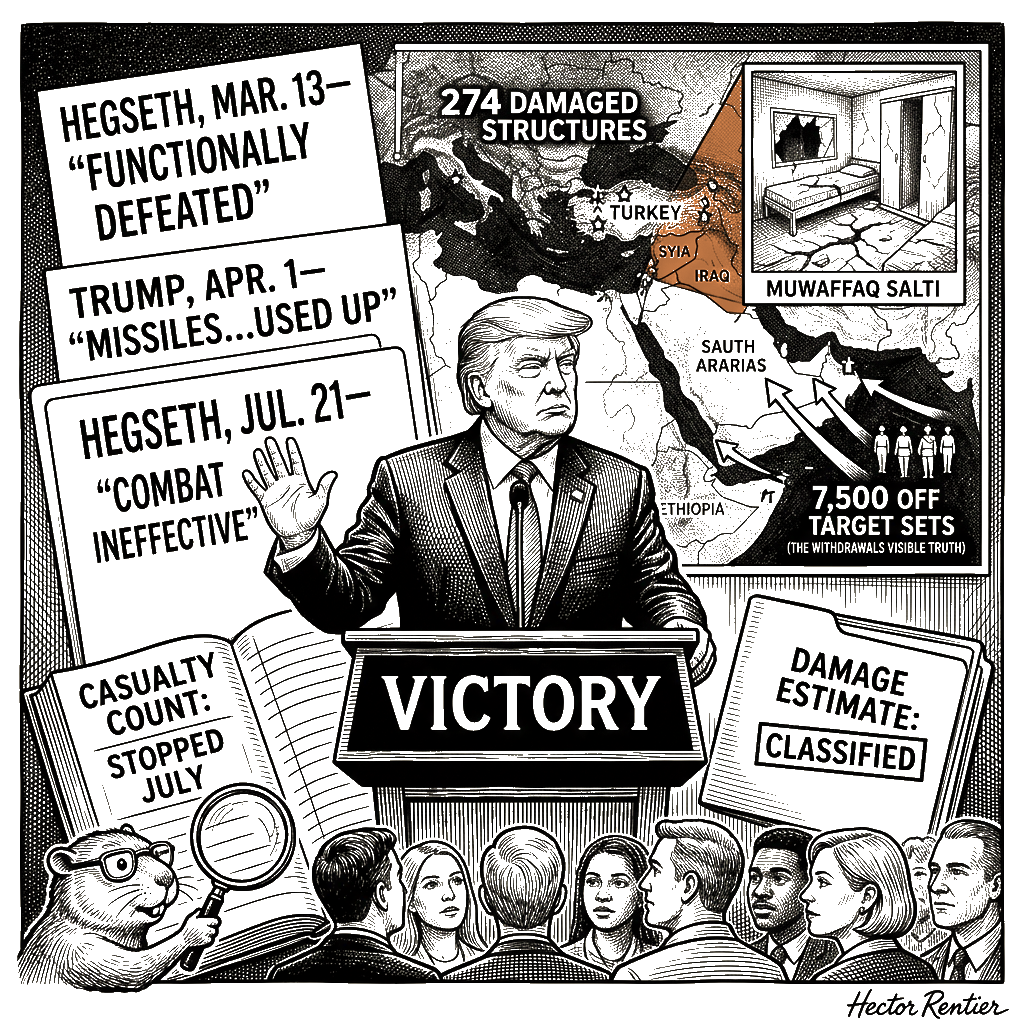
Trump and Hegseth are sending soldiers to die in a war they keep calling won. The war began on February 28. By the Defense Department’s own count, more than twenty American servicemembers are dead in activity related to it, and more than four hundred were wounded before the ceasefire fell apart in July. Since July, the government has stopped publishing casualty figures specific to this war. The Wall Street Journal spent six months on satellite imagery to count what the briefings leave out, and our account of it ran this morning: 274 damaged structures at 24 installations with an American military presence, across seven countries, in the war’s first six months. It is the most comprehensive public accounting anyone has. The Pentagon and its Middle East headquarters, Central Command, declined to comment on it.
Now set the record beside the words. On March 13, Defense Secretary Pete Hegseth stood at a Pentagon podium and said Iran’s entire ballistic missile production capacity, every company that builds every component of those missiles, had been “functionally defeated, destroyed.” Over the rest of that month, damage appeared at six more installations. On April 1, the President told the nation, “Their navy is gone. Their air force is gone. Their missiles are just about used up or beaten.” By the night he said it, more than fifteen components of the infrastructure that protects those bases, the radars and missile defenses and communications, already showed damage in the imagery. On April 16, Hegseth addressed Iran’s rulers directly: “You can dig out for now, but you can’t reconstitute.” In early June, Secretary of State Marco Rubio told senators, “Well, the war is over now.” On July 21, days after an Iranian strike killed three Americans asleep at Muwaffaq Salti Air Base in Jordan, Hegseth called Iran “completely overmatched and crushed” and “combat ineffective.” On August 24 he allowed that Iran “still has some capabilities, but it’s nowhere near what it was at all.” One week later, Iranian weapons hit Camp Titin, in Jordan, for the first time.
Barbara Tuchman spent a career writing down what folly looks like, and her checklist reads: a policy working against the interest of the people pursuing it; an alternative available and named at the time; a choice made by a group rather than one man; persistence past the point where the contrary evidence is in hand. There is no need to run all of it here. A man can be wrong once and be forgiven. Six declarations across five months, each one undone by the photographs that followed, are not error. They are a story, and the story is the policy. Clausewitz set the measure in Book One of On War: war is a continuation of policy, and a war that loses its political object loses the standard by which anything done in it can be judged. Conducted as it is conducted, this war’s object is the announcement. The conduct behind the podium is the evidence.
Here is what the photographs say the war is actually doing. When the ceasefire collapsed on July 7, Iran shifted its fire west, toward bases hundreds of miles farther from its own borders; five of the eleven attacks the analysis counted after the collapse landed in Jordan. The buildings being hit got smaller, less than half the size of the ones struck earlier, which is what improving precision looks like from orbit. From July 7 to August 28, Iran claimed more than forty strikes on American installations, and more than three-quarters of those claims described specific kinds of buildings at named installations, where earlier in the war less than half did. Claims of strikes on troop housing doubled. Brian Carter, an Iran analyst at the American Enterprise Institute, put it plainly: “There’s definitely been an effort by the Iranians to inflict casualties on U.S. forces.”
Elaine McCusker, former acting Pentagon comptroller in the first Trump administration, observed that the strike pattern carries “signals about magazine depth,” by which she means how many missiles Iran held back and how fast it can build more. On that measure, the March declaration was not an error of degree. It is the one reading of the record that the record does not support. The Journal reports Iran rebuilding its missile bases and production facilities quickly and digging out its buried arsenal, while the American supply has drained. An interceptor is a missile fired to knock another missile out of the sky, and firing it spends it; in September, as we reported, one Jordanian night cost the Patriot batteries, the ground-based missile defense, sixty to seventy of them. Both magazines are being counted, and declaring the other one empty while yours runs dry is not an assessment. Sun Tzu, Art of War, Chapter 3, in Lionel Giles’s translation: “If you know the enemy and know yourself, you need not fear the result of a hundred battles.” Knowing the enemy means counting what he actually has left, from the record, out loud. This administration counted what it wished were left, and told the country so.
Now look at what the missiles are aimed at. The July 17 nighttime strike at Muwaffaq Salti, out in the Jordanian desert, killed three American servicemembers, as we wrote the week it happened, and damaged at least nineteen buildings where troops sleep; the Journal counted twenty-five damaged buildings at that base across six months. That same week, Iran hit housing units at other American installations across the region, and U.S. officials privately worried about Iran targeting troops where they sleep. The structures damaged after the ceasefire collapsed are, by the account of current and former servicemembers, base housing: converted shipping containers, tents. I know what that housing is. In the spring of 2003 my brigade slept in the open more nights than not, beside the tanks, because nothing draws fire like a crowd of men under a roof. From where I sat in the gunner’s seat, I could tell you exactly what a row of containers with cots in them is. It is a target. The men in those containers are the post-9/11 cohort, and the class pattern has been documented across two decades of war now: disproportionately Southern, rural, working-class, enlisted out of the recruiting office in the strip mall because it was the road to the GI Bill. Fogerty named the arrangement in “Fortunate Son” a long time ago, and the arrangement has not changed: the men sent to fight are not the men whose fathers run for office. The men who declared the missiles destroyed were speaking from briefing-room podiums while the missiles went looking for containers full of sleeping men.
And here is the part no podium can cover. The same leadership that called the missiles destroyed had already moved men as though they were not. Hegseth told Congress on April 29 that the Pentagon had shifted 7,500 troops “off of the X,” his own phrase for off the known target sets, before the campaign even started. Iranian fire pushed more out after that: Camp Buehring and Camp Arifjan in Kuwait were largely evacuated under attack, and Naval Support Activity Bahrain, home of the Navy’s Fifth Fleet, was hit hard enough in the first two weeks that Central Command pulled most of its people off the base. Those first two weeks damaged at least 119 buildings at 13 installations, mostly in Kuwait, more than in any other stretch of the war. Now, I’m just a simple man, but I know what it means when a government tells you the war is won while it quietly empties the barracks. You do not move 7,500 men off the X if the X is cold, and nobody evacuates that way over a defeated enemy. The Journal reports the President is weighing another round of strikes, with some of the personnel already pulled off several of those locations ahead of it. The troop movements were the honest briefing. The podium was not.
The damage estimate itself lives in a classified briefing, and this month five Democratic senators on the Armed Services Committee had to urge the Pentagon to disclose it publicly. The Journal’s analysis found at least a dozen buildings with signs of damage at Al Udeid Air Base in Qatar, and Senator Chris Murphy of Connecticut, who sits on the Foreign Relations Committee and the defense appropriations subcommittee, was barred from visiting the base; the American military leadership in the region declined to brief him at all. The Defense Department says he was told before the trip that travel restrictions in the region would keep him off the base. Take that answer at face value; it does not explain why the counts themselves are not public. Murphy’s word for the arrangement is that the administration is “withholding information about damages” in order to “mask the true cost of the war.” In the shop, when a repair goes wrong, we tell the customer what it cost. That has never been a hard rule to keep. A won war does not need a classified ledger.
Render the rest of the invoice slowly, because it is the part with numbers. The war has cost $47.1 billion as of October 16, per a document the Journal saw, not counting the bases. Base damage is priced by the Pentagon, per officials familiar with the figure, at a minimum of $5 billion, with a person briefed on the cost putting the total as high as $15 billion; the Center for Strategic and International Studies puts reconstruction alone, before counting what was inside the buildings, above $4 billion. The United States is now in talks with allies to pick up part of the repair bill. The Pentagon has weighed moving bases out of Iran’s reach and pulling back from installations in Kuwait and Saudi Arabia, a generational decision about the American footprint in the Gulf that would leave allies more exposed, and it is being weighed without a ledger and without a vote. Some of what the missiles broke may never be rebuilt. That don’t pencil out on any line of the ledger.
Step back and ask why there were 24 installations across seven countries sitting inside Iran’s missile reach in the first place. Andrew Bacevich, the soldier-scholar who has spent his career naming it, called the settled assumption the Washington Rules: American military power must be present everywhere, permanently, and no election revises it. The bases are where the rules put them. Iran’s missiles are repricing the rules, and the Pentagon’s posture review is the rules being rewritten by ordnance instead of by deliberation. Eisenhower warned about this exact arrangement from the far side of a career spent inside it. His farewell address of January 17, 1961, names the military-industrial complex and its “unwarranted influence, whether sought or unsought,” and then names the only check the warning carries: “Only an alert and knowledgeable citizenry can compel the proper meshing of the huge industrial and military machinery of defense with our peaceful methods and goals.” Sixty-five years on, the clause the whole warning hangs on presupposes a public record. The machinery is running at $47 billion a war. The knowledge sits in a classified briefing. The senator is turned away at the gate, and the count of the dead stopped coming out in July. An alert and knowledgeable citizenry cannot be assembled out of numbers the government keeps in a safe.
Here is the position, stated so nobody has to guess at it. The Constitution gives Congress, not a podium, the power to declare this country’s wars and the power to fund them. A war that has spent $47.1 billion and more than twenty American lives in six months can survive a recorded vote and a published ledger. If this war cannot survive a vote and a ledger, it cannot survive on the lives it is spending.
Three men went to sleep at Muwaffaq Salti Air Base on the night of July 17 and did not wake up. The buildings they slept in are in the satellite photographs, nineteen of them the buildings where troops sleep. The war that killed them was declared functionally defeated in March, nearly finished in April, over in June, and crushed in July. The count of the dead stopped coming out that same July. The satellites keep another ledger: 274 structures, two dozen bases, seven countries, forty-seven billion dollars. The photographs are public. The count is not. That difference is the policy. The men who declared the missiles destroyed have told this country everything about the war except what it costs. That is not victory. That is a war the country is being charged for in the dark.