
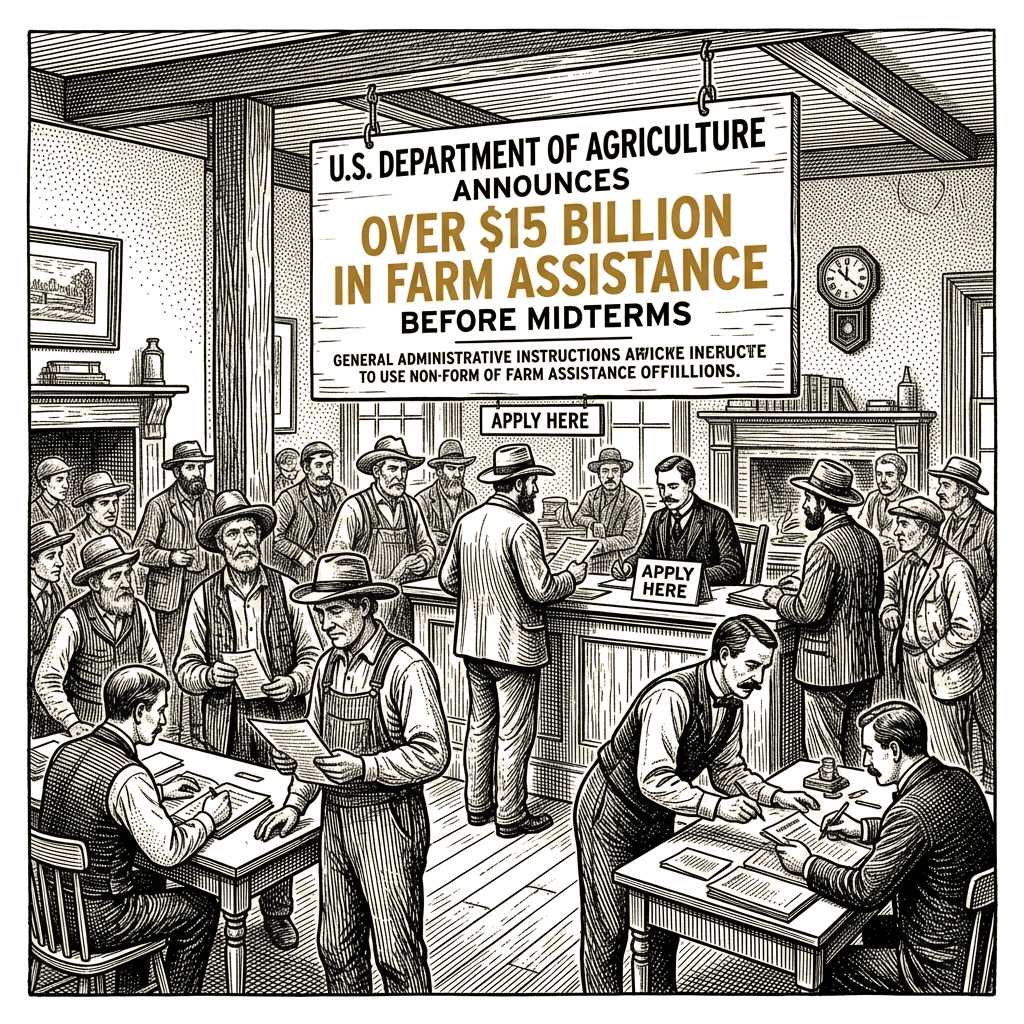
The Trump administration is buying rural votes with farm bailouts before the midterms.
At my bench, diesel is more than a number on a fuel receipt. It is in the tractors and combines farmers depend on to move grain and in the margin of every field. On my forty acres in Adams County, I have paid diesel prices in the old Silverado and run the shop at the back of the property. A Wisconsin farmer planting corn or soybeans knows what the USDA’s numbers mean in plain language: fuel comes off the crop before anybody can call the harvest a profit. The national announcement reaches my bench as a price, not a slogan.
By election week, the USDA had put more than $15 billion in payments and initiatives for agricultural producers on the table. Separately, it planned $13.8 billion in safety-net payments for eligible producers for the 2025 crop year. More than half of the $15 billion figure was going to an $8 billion one-time diesel-payment plan. The earlier $8 billion farmer-aid announcement was the cash centerpiece of the package. The campaign cash pitch came first. The agency had not yet said when the money would reach the farmers who depend on diesel to move grain.
The wider package included at least $5 billion in guaranteed loans for ranchers and fishermen, $1.8 billion for conservation-program producers and landowners, $573 million for fertilizer manufacturing, $57 million for meat processors, and $86.6 million for specialty-crop projects. The USDA also planned to buy up to $472.5 million in agricultural commodities for charitable programs, expand off-road diesel sales, make cattle-sale data more transparent, and strengthen wolf management to protect livestock. Taken together, those lines reach the ranchers, fishermen, conservation-program farmers, fertilizer makers, meat processors, specialty growers, and livestock owners an election campaign might court.
On Friday, AAA’s reading put diesel at $6.32 a gallon, slightly below its September peak but 70 percent above the price paid a year earlier. Filling a 100-gallon tank cost $260 more than it had cost then.
That is not a rounding error. It comes out of the same margin a farmer needs for seed, fertilizer, land, and the next round of work.
The Associated Press reported that farmers had endured higher diesel and fertilizer costs largely because of President Donald Trump’s tariffs and the war in Iran. The trade war with China came close to boycotting American farm goods. Tariffs also raised the cost of other farm equipment. Washington was taxing the producer and then correcting the invoice before the election.
That is the shell game: the country is asked to carry the price of national strength, and domestic producers carry it. The cost was at the pump. The payment was announced before the ballot.
This is not farm policy. It is electoral policy with a check attached.
The timing was not incidental. Trump was scheduled to visit Iowa and Kansas on Sunday, two days before the election. His visits did not create farmers’ costs, but they made the political timing hard to misunderstand. Rural voters, including farmers and people who rely on the agricultural economy, have been an instrumental voting group for Trump.
Alexandra Middlewood, a political scientist at Wichita State University, said some frustrated rural voters in Kansas might sit out or vote independently rather than shift to the Democratic Party. Those independent votes may make or break the election. The immediate electoral danger is a farmer deciding the pain is reason enough to skip the ballot. A one-time check can push that farmer back to the table for a season.
Middlewood heard farmers say two things: the money lets them survive this year, and the money is a one-time bailout rather than a long-term solution. The package can buy survival for this election year. It does not buy certainty for the next crop.
Gregg Ibendahl, a farm-management specialist at Kansas State University, estimated that the diesel payments could more than cover the increase in fuel costs and help with fertilizer prices. He also said the payments did not address the broader input-side risk or the uncertainty about what would happen next. He questioned whether temporary government support could reassure lenders financing the next crop year. If a farm’s apparent recovery depends on extra temporary government payments, it may be difficult to convince a lender to finance next year’s crop.
A farmer cannot send the government a bill for every gallon that passes. The payment smooths one bill. It does not lower tomorrow’s price, repair the machine, or improve the terms of the next loan. The $8 billion diesel payment is money for damage already done, not capacity to withstand the next shock. A one-time check covers the bill without changing the policies that produced it.
This is the Worker Self-Exploitation Contradiction I use for the pattern in We Too, Chapter 16. The farmer is praised as a producer whose work and endurance keep the enterprise alive, while the surrounding economy sets the terms under which that work pays. The federal check keeps the operation alive. It does not change those terms. Farm aid itself is not new. The sequence is what matters: the administration helps make the cost, the ballot arrives, and the check follows.
The check does not undo a tariff or a war. It moves the bill to the public account and buys a farm one more season.
Studs Terkel’s Working put wages, work, and family back inside a working life. The farmers in this announcement are not rows in a USDA spreadsheet. They are people deciding whether to plant again, keep a hand on payroll, pay for seed, and send a child to school. A one-time check answers part of that question for this year. It cannot answer the next one.
Michael Smith, a political-science professor at Emporia State University, said the administration’s immigration deportations had threatened the farm labor force, while cuts to foreign aid and SNAP had weakened demand for agricultural products. He also said many rural voters like President Donald Trump, but some of his policies have hurt agriculture. Admiration for a person is not approval of his policies. Trump himself is not on the ballot; his policies are.
Middlewood said the leading concerns among rural voters were the cost of living and access to health care. Those pressures do not disappear because a diesel payment arrives. The payment covers immediate input bills while the policies that produced the damage remain in force. It buys patience for one planting season, not agreement with the policies that squeezed the margin.
Wendell Berry’s The Unsettling of America gives this the proper scale. A farm economy is not a yield column. It is a membership of families, mechanics, lenders, processors, and local merchants. Berry asks what kind of community an economy leaves behind after production has been counted. A diesel payment can carry a balance sheet through one season. It does not rebuild local processing, machine repair, soil, or the membership that lets a farm town remain a farm town. A farm town is not a place where money passes through on its way to somebody else’s balance sheet. Berry’s test cuts through the talking: a subsidy that merely postpones the next bill has not solved the pattern.
A serious farm policy would reduce volatility in diesel and fertilizer markets, stabilize farm labor and crop markets, and put conservation and credit in place that a lender can underwrite without betting on another federal check. It would support shared fuel and fertilizer purchasing, strengthen local processing and repair capacity, and treat farm energy costs as part of farm policy rather than an election-season emergency. Conservation has to pay producers for soil and water. Trade rules have to stop taxing the farmer’s own inputs while Washington courts the farmer’s vote. The institutions that keep rural life running have to own their obligations; they cannot wait for a campaign to fix what breaks. Government can support farmers without buying their votes.
Until the longer policy is written, the $15 billion should carry the label its timing gives it: election-year relief. The USDA should publish every payment and recipient. Congress should not let a payment for damage become proof that the damage was good policy.
Back in Adams County, the ledger records fuel, fertilizer, seed, repairs, and what comes in. The election date does not change any of those lines. At my bench, a check can get this year’s crop to the elevator. It cannot tell farmers what kind of county they will have to live in. I want what waits for them to be more than an election-year promise. My children should inherit a farm economy that works after the one-time checks stop, not one that waits for the next check before the next ballot.