
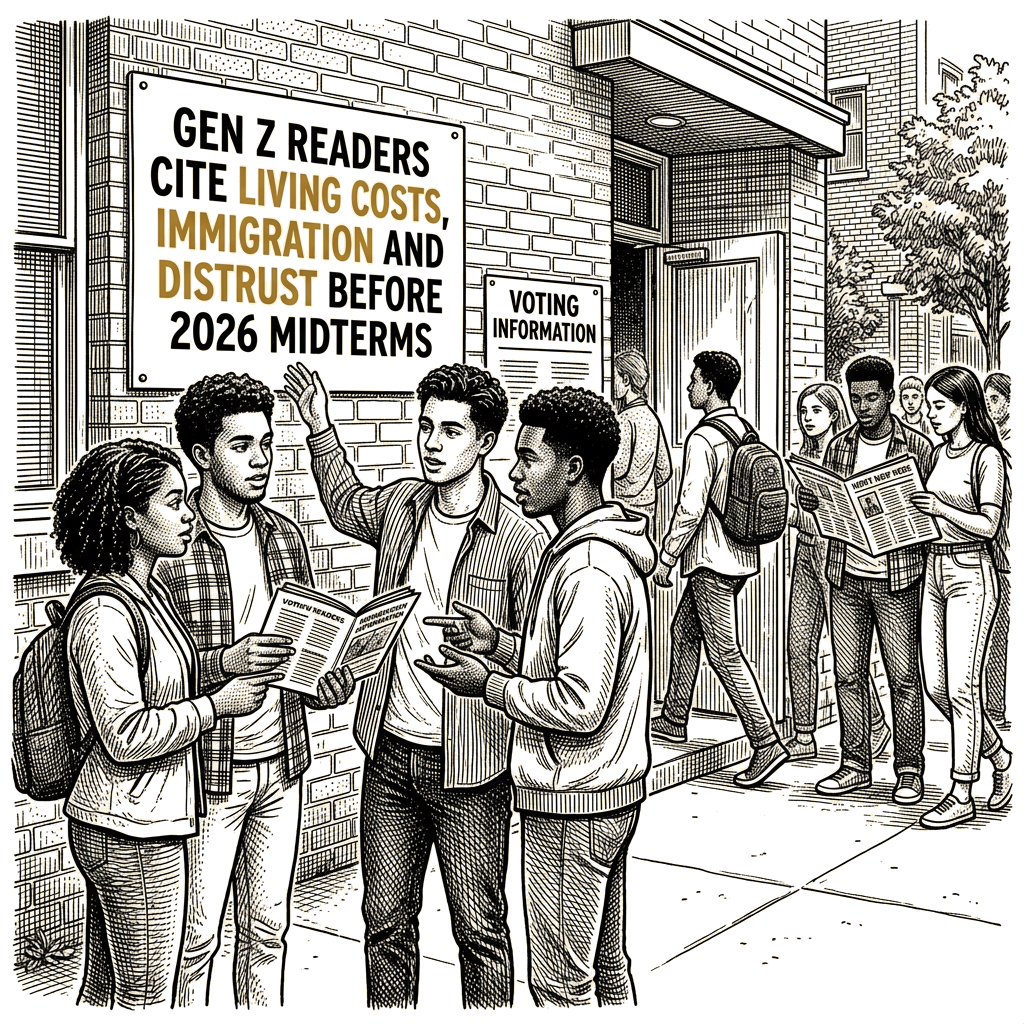
The biggest barrier keeping millions of young Americans from voting is the cost of living, not political apathy. A 25-year-old maintenance worker in Connecticut wants to vote, but rent, a car, car insurance, utilities, student loans, and medical bills leave too little time or energy. That is not civic laziness. It is the cost of living showing up at the polling place. A ballot booth does not refund an hour lost to work. The Guardian’s reporting on Gen Z readers ahead of the 2026 midterms puts the scale stark: nearly 50 million Americans aged 18 to 29 are eligible, but almost half remain unregistered or civically disengaged.
Their concerns are familiar—inflation, healthcare, climate, immigration enforcement, election integrity, civil rights. Earlier reporting asked what would guide Gen Z voters in the 2026 midterms. This new round makes the economic pressure impossible to miss.
This is not a transient burst of youthful anxiety. It is the same collision between prices and party labels running through voter conversations days before the election.
Election integrity is not a side issue. If the vote can be manipulated, the ballot becomes another concentrated asset, one that campaigns, officials, and connected power can shape. That is why registration still matters. If almost half of those nearly 50 million young adults are absent, parties can win without earning their confidence.
Some distrust is real. Scott fears Republican harm and corruption, sees a Democratic political vacuum, and wants Democrats to offer a coherent vision. Connor worries about polling errors, election certification, possible Republican efforts to undermine results, and a Democratic Congress that underdelivers. Emily wants candidates with a backbone. Niamh wants to judge people by whether they can help a person or community rather than by partisan brand. Charlie wants healthcare, affordability, and a larger tax on the ultra-wealthy. Tyler is focused on inflation and enforcement and wants accountability and a real opposition.
Those complaints deserve answers. But none says the voter does not care.
Indifference says: this does not matter to me.
These voters say: it matters, and I have stopped trusting the people asking me to settle it.
Here is the tell. The standard explanation is an information problem. Young voters need better messages, stronger candidates, a cleaner party brand, more reason to hope. Notice the convenient destination. If turnout is a persuasion problem, candidates can cure it by persuading better. If turnout is a capacity problem, somebody has to pay for time off, transportation, childcare, registration, and accessible polling places.
The first diagnosis is free. The second has a bill.
The article gives us the receipt. Calling that disengagement is like calling a patient who cannot afford treatment a bad consumer. The paperwork is in order. The outcome is not. A worker forced to choose between the next paycheck and a polling place has been handed a false menu.
Who really pays for democracy when the schedule is inconvenient?
The worker gives up an evening. The employer may keep the wage. The household pays for transportation and childcare. The benefit of one vote, meanwhile, belongs to everyone. That is a bad allocation rule: the cost of civic participation is private and immediate; the benefit is public and diffuse.
Democracy has built a voting process around the assumption that people have a spare afternoon. That is a human choice, not the weather. If candidates want voting to be a routine civic duty, their burden is to remove the cost or pay it. They do not get to demand unpaid devotion from people they have left with no time.
Material politics and electoral politics are therefore the same fight. None of these voters is ignoring the economy. They are trying to govern it.
Start with the ownership test. A ballot can choose who writes the rules; it cannot, by itself, rewrite who owns the machinery that sets prices. The common question is more basic than which party wins: who sets the price, and who can bargain when the bill arrives?
Apply that test to the non-economic anxieties and they do not disappear. They sharpen. Election administration decides whether a ballot is counted cleanly. Immigration enforcement turns a state agency into an instrument of federal coercion. Civil-rights protections determine who can seek shelter from discrimination. Climate rules determine which firms can profit by shifting pollution onto communities with no power to refuse. These are not six disconnected issues. They are contests over who holds decision rights and who absorbs the risk.
Charlie wants universal healthcare. That is a mechanism, not a mood. But ask who negotiates the premium. Sick people make terrible comparison shoppers. When hospitals, insurers, and employers have concentrated bargaining power, “shop around” is not a serious answer for a family facing surgery or an insulin prescription. The household is nominally free to choose. It is not equal at the table.
The workplace works similarly. When one employer dominates hiring in a local labor market, it can depress wages below what workers need because a worker cannot simply take another job. That is not a shortage of workers. It is a shortage of employers with competing power. The employer is the buyer of labor. “Your labor market” is a lovely phrase for leaving that arrangement unexamined.
Scott is right that Democrats need a vision. Concern is not a plan. A serious vision must name who sets premiums, who bargains for wages, who allocates housing, and who absorbs risk. Anything less is branding. “We care” is not a rule for premiums, wages, or rent. The useful question is simpler: who owns the decision?
So what do we build?
First, plumbing. Automatic voter registration at scale. Use the records government already has—driver’s licenses, tax returns, unemployment insurance—to enroll eligible citizens, with a reliable opt-out and a simple way to correct a record. The state should not make participation depend on a scavenger hunt for the right government office.
Second, make casting a ballot cost less money and time: paid voting leave, free transit on election day, childcare at polling places, same-day registration, accessible mail voting, and early voting. Where a ballot requires a parent to find a sitter, lose a shift, miss a bus, or ask an employer for a favor, the process is selecting voters by income and schedule. Politicians should not lecture people about civic duty after arranging that filter.
Third, stop making economic survival a prerequisite for political participation. Make the expanded monthly Child Tax Credit permanent and automatic. In 2021, Census researchers estimated that the payments reduced the official child-poverty rate from a 13.9 percent counterfactual to 5.2 percent, against 9.7 percent in 2020. They lifted 2.9 million children out of poverty, with the temporary expansion accounting for 2.1 million of those gains. After the expansion lapsed, the official child-poverty rate rose to 12.4 percent in 2022.
We ran the experiment. The math worked. Then we stopped.
Fourth, strengthen collective bargaining so workers negotiate together rather than one at a time, and use industry-wide wage boards where firms would otherwise undercut a higher standard. In several Nordic countries, collective bargaining coverage reaches roughly 80 percent or more. Only about one in ten American workers is covered by a union contract.
Fifth, build a public insurance plan people can choose alongside private coverage. It need not abolish private insurance. It would let households choose a provider answerable to public purpose while non-extractive care competes in the same market. And put housing under community ownership: community land trusts let families build equity in homes that speculation cannot endlessly reprice.
None of this requires one national blueprint to administer every household’s life. Each measure changes who sets the terms and who carries the risk. Each still faces the “why it’s harder here” fight, because the machinery matters. We cannot paste another country’s arrangement onto a map. We have to build unions, give them enforceable bargaining power, administer the rules competently, and earn public trust by delivering.
None of this comes from a Scandinavian brochure. Denmark’s system rests on high union density, organized employers, capable public administration, and decades of institutions that make insecurity less likely. American institutions more often leave individual workers to bargain alone while making voters finance their own civic access. We can copy the function and build the machinery locally: automatic registration, paid leave, public election offices, childcare, portable benefits. Test each measure in states with different election-administration structures, then scale the versions that reduce registration errors and missed ballots.
Public capacity changes which choices a household can afford. When the state takes a bill, a shift, or a clinic appointment off the table, it changes the menu. Stop treating time as if it fell from the sky.
Use the ballot to choose who writes the rules; do not mistake the ballot for the floor households have to clear. The ballot matters because lawmakers can build the public option, fund the allowance, create bargaining institutions, and put housing under community ownership. But a ballot is not the floor, and a floor is not a campaign slogan. Demand that candidates govern the floor.
The politicians’ favorite answer will still be a better message. Fine. Send it. Also register the voter automatically. Pay for the hour. Put childcare by the door. Make the economic floor sturdy enough that voting does not have to compete with an overdue hospital bill.
A democracy should not ask the squeezed to finance their own access to the ballot. The ballot does not become affordable because people care more. We can make it affordable on purpose. That is the build.