The Catholic Church is asking the Supreme Court to make taxpayer-funded pre-K a license to exclude children of gay and trans parents.
Tomorrow, the Court will hear arguments in a case arising from Colorado’s taxpayer-funded pre-K program. Colorado wanted virtually every four-year-old in the state to have access to pre-K education. To reach that goal, it included religious schools in the public program, but only on one condition: participating schools had to comply with the state’s prohibitions against discrimination based on race, religion, sexual orientation, and gender identity.
The Catholic Church’s challenge asks the Court to let a religious school receiving public pre-K money refuse admission to children of gay and trans parents anyway.
That is not a dispute over theology. It is a demand that public money finance a religious institution’s right to exclude the children the program was created to serve.
We do not need to fabricate a child or a confrontation to understand the stake. A child turned away from a participating program bears the concentrated cost of that exclusion. A family denied access to the preschool its taxes support bears the injury to dignity. Nothing in the Church’s argument requires us to pretend that a particular child has been invented for rhetorical effect. The rule itself does the damage.
Colorado wrote the bargain. Participating religious schools and families seeking religious preschool options received public support. Taxpayers supplied the money. A child turned away from a participating program would bear the concentrated cost of that exclusion. The public framing calls this “religious freedom.” The distributional reality is public money purchasing private exclusion.
One can believe what one wishes about the relationship between church and state, worship, doctrine, and public education. Those convictions do not determine the case. Colorado is not ordering a church to pray differently. It is saying: if you want public pre-K money, your admissions cannot reject children on grounds the state has prohibited. That is a condition, not an attack.
State control of religion is not the issue.
State control of state money is.
The root cause is not that religion and equality are irreconcilable enemies. The root cause is that public authority is being asked to finance a relationship without preserving the condition that makes the relationship legitimate. Colorado tried to do that correctly. Participating schools receive public support; participating schools obey the state’s civil-rights law. A school can remain religious. It can worship, teach, and serve according to its beliefs. It simply cannot demand public money for the education of children while reserving the right to exclude children on the state’s forbidden grounds.
For decades, the Supreme Court upheld separation of church and state. Over the past ten years, the Court has increasingly placed protection of religious freedom at the center of First Amendment doctrine. A victory for the Church here would not merely protect one religious community’s internal practice. It would enlarge religious status into a legal argument against public rules whenever a participant believes conscience and equality require different results.
Not every dispute involving religion is a crisis of church and state. Sometimes institutions seek to convert participation in public life into a claim of exemption from public life. That is not religious liberty.
It is privilege with a constitutional vocabulary.
The camouflage works because the label performs the work the institution needs done. “Religious freedom” can make a transaction in which public money buys the power to exclude appear like a dispute over constitutional principle. The label cannot make the transaction disappear. The state is not compelling worship. It is saying what it will not finance.
King’s 1963 Letter from Birmingham Jail—reprinted in Why We Can’t Wait in 1964—gave us a test this case cannot evade. King distinguished negative peace, the mere absence of visible tension, from positive peace, the presence of justice. The Church’s position can offer the negative version. Keep every institution intact. Keep the debate solemn. Keep the children turned away out of the frame. Positive peace demands something harder: every child admitted under the program’s civil-rights rule, every provider accountable to the same rule, and no public dollar used to purchase the right to insult the standing of families.
King was right. His distinction is not an instruction to be polite. It is an accounting test.
Who benefits if the Church wins? A participating religious school receives public money without accepting the public’s nondiscrimination rule. Who pays? The immediate cost is borne by the child turned away from that participating program. Taxpayers bear the price of financing the rejection. The gain is concentrated because it protects the institution’s desired admissions rule. The cost is concentrated because it is aimed at a particular set of children.
The public frame will try to make this a contest between faith and equality. That frame hides the terms. Faith is not being asked to surrender. Equality is being asked to become optional for institutions that want public money. Colorado made its bargain explicit: access and public support come together. The question is whether the Court will preserve that connection or dissolve it in the name of freedom.
Now take the same question of exemptions to Michigan, where the contested relationship is not between a family and a preschool but between a politician and the party she says she is leaving.
Less than 48 hours before Election Day, Haley Stevens broke with her party and endorsed Mike Rogers.
On Sunday, Nov. 1, Stevens attended a service at Perfecting Church in Detroit with Rogers, the candidate for Michigan’s open Senate seat. In her endorsement, she cited Democratic nominee Abdul El-Sayed’s ties to political streamer Hasan Piker, whose remarks concerning Jewish people and Israel sparked backlash in August. El-Sayed had sought to distance himself from the controversy. Stevens said he had not done enough to reassure Black and Jewish voters who backed her in the primary.
That sequence was not a defense of the voters Stevens invoked. It was a transfer of blame from Hasan Piker to Abdul El-Sayed, followed by Stevens’ own defection. Association is evidence of a relationship.
It is not authorship.
A candidate can know a man, fail to criticize him quickly enough, and still refuse to put words in his mouth. Stevens collapsed those distinctions and made the collapse her ticket out.
Her grievance had substance. Piker’s remarks had sparked backlash, and El-Sayed’s response had failed to reassure people who mattered to Stevens. The illegitimate leap was not from concern to criticism. It was from criticism to guilt by association. “Insufficient distance” became “disqualifying contact.” “Disqualifying contact” became “therefore Rogers.”
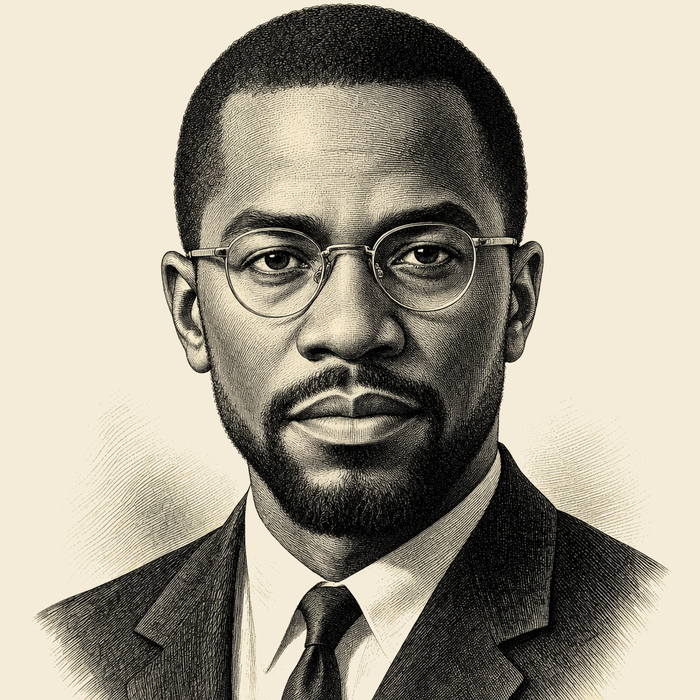
Malcolm X put the discipline plainly: take your case to a court, not to the person accused of committing the crime. Piker made the remarks. El-Sayed tried to distance himself and gave a response. Stevens cited the relationship, punished the response, and joined the candidate on the other side. That is not assigning a wrong to the wrong defendant. It is assigning a wrong to the convenient defendant.
Who benefits? Rogers, immediately. He receives a former party representative’s endorsement in the final stretch. The Michigan Democratic Party and its voters carry the cost. Stevens’ longtime chief of staff and many other staff members quit. The state party chair announced that Stevens was no longer a member. Many Democrats were angry and rallied behind El-Sayed. Rogers can use the endorsement as evidence that the opposition is divided. The party has to live with a division Stevens chose to deepen.
Don’t tell me this was merely personal. Personal feuds do not determine how a party answers its voters. Stevens’ endorsement did the opposite of what Democrats were asking their coalition to do. It gave voters another reason to doubt the party they were being asked to rescue.
The deeper problem is Stevens’ invocation of the people she named. Black and Jewish voters are not campaign reserves. They are not a bloc to be mobilized when a candidate needs a coalition and then disciplined when the coalition becomes inconvenient. Invoking voters who backed her in the primary risked turning their support into a claim of ownership over their judgment. The voters who backed Stevens had their own reasons for doing so, their own knowledge of the controversy, and their own judgment about El-Sayed. When a politician invokes those voters because they once gave her a vote, she risks converting a relationship into ownership.
Ownership becomes orthodoxy.
Orthodoxy becomes a gate: first you prove loyalty; then you are allowed to speak; then disagreement is treated as foreign.
The same machinery runs through both stories. In Colorado, a status-bearing institution tries to turn a contingent relationship—public money in exchange for service in a public program—into a private rule allowing religious status to suspend the condition. In Michigan, a political insider tries to turn an association—El-Sayed’s relationship with Piker—into a complete assignment of responsibility, then use the resulting anger to deliver the vote to Rogers.
One asks a label to erase a condition.
The other asks an association to erase responsibility.
These are not disputes over who gets to be tolerant. They are disputes over who gets to write the rules for other people. They are not disputes over civility. They are disputes over accountability without loopholes.
A party can condemn the conduct and acknowledge the backlash surrounding Piker’s remarks without treating every association with a controversial figure as a veto on candidacy. It can demand an answer from El-Sayed without pretending his answer is Piker’s answer. It can condemn Stevens’ endorsement without pretending that El-Sayed deserves immunity. These judgments are difficult. They are not impossible. The trouble is that Stevens’ shortcut required no judgment. If a link was politically toxic, cut the link and let somebody else inherit the vote.
That is where the pattern meets the larger election frame. House Speaker Mike Johnson described the midterms as a “contrast election between common sense and crazy.” Johnson’s line replaces the opposing party’s record with the label “crazy.” It asks for allegiance rather than supplying a measure. The same report notes that midterms typically function as a referendum on the sitting president and his party, not as a contrast election.
The same mechanism appears in Stevens’ endorsement. In the account documented here, El-Sayed’s relationship to Piker and the adequacy of his response do the argumentative work in place of a case built on his fitness for the Senate. Both moves make a feeling of recognition stand in for evidence.
The same laundering of authority is already documented by MSI in its report that ChatGPT cited political ad sites disguised as local news: a trusted-looking format did not make the underlying material information. Stevens’ appeal to association cannot make Piker’s words El-Sayed’s. A constitutional label cannot make public money purchase private exclusion. Format is not substance. Association is not authorship. Freedom is not exemption.
The way forward for Michigan is not to whitewash El-Sayed. If his response was inadequate, say so, demand a better one, and let him answer for it. It is not to elevate Stevens’ defection into some cleansing maneuver. It is to make all three men answer for their own conduct: Piker for the remarks, El-Sayed for his response, Rogers for his campaign. Then let the voters decide. That standard applies to every party and every constituency.
King was right, and King was incomplete. Justice does not arrive because a party discovers a more convenient enemy than its own nominee. It comes when a coalition can tell the truth about its own fractures without demanding somebody’s loyalty as the price of membership. It comes when voters are treated as authors of their own judgments, not as reserves to be moved by the first politician who claims them.
The work ahead is simple to state and hard to do: name the conduct, restore the agency, keep the coalition open. Name Piker’s conduct. Judge El-Sayed’s response. Make Rogers earn the office he seeks. Do all of it without asking a voter to decide whether the party label or the moral objection is the more important thing.
Any victory purchased through Stevens’ endorsement may deliver a senator, but it will not deliver a party capable of governing. The Michigan Democratic Party can win only if it does not make one man’s associations, or one representative’s defection, stand in for its own judgment.
The Court can preserve the Colorado line. Or it can decide that religious status suspends the condition. The second choice would not make the public program more religious. It would make public funding a subsidy for exclusion and transfer the cost of religious preference from the institution to the child.
Name the actors. Enforce the condition. Keep the child in view.
King’s Beloved Community was not a place where every institution kept its own table and called exclusion fellowship. It was the long-arc demand for a common public good in which power must answer for what it funds, whom it serves, and whom it excludes.
The arc is long, but it bends only when specific people, in a specific moment, choose the justice their words require. Tomorrow, that choice belongs to the Court. It belongs to Colorado. It belongs to Michigan. It belongs to us.
That is the standard. Hold it.
Malcolm Little King