
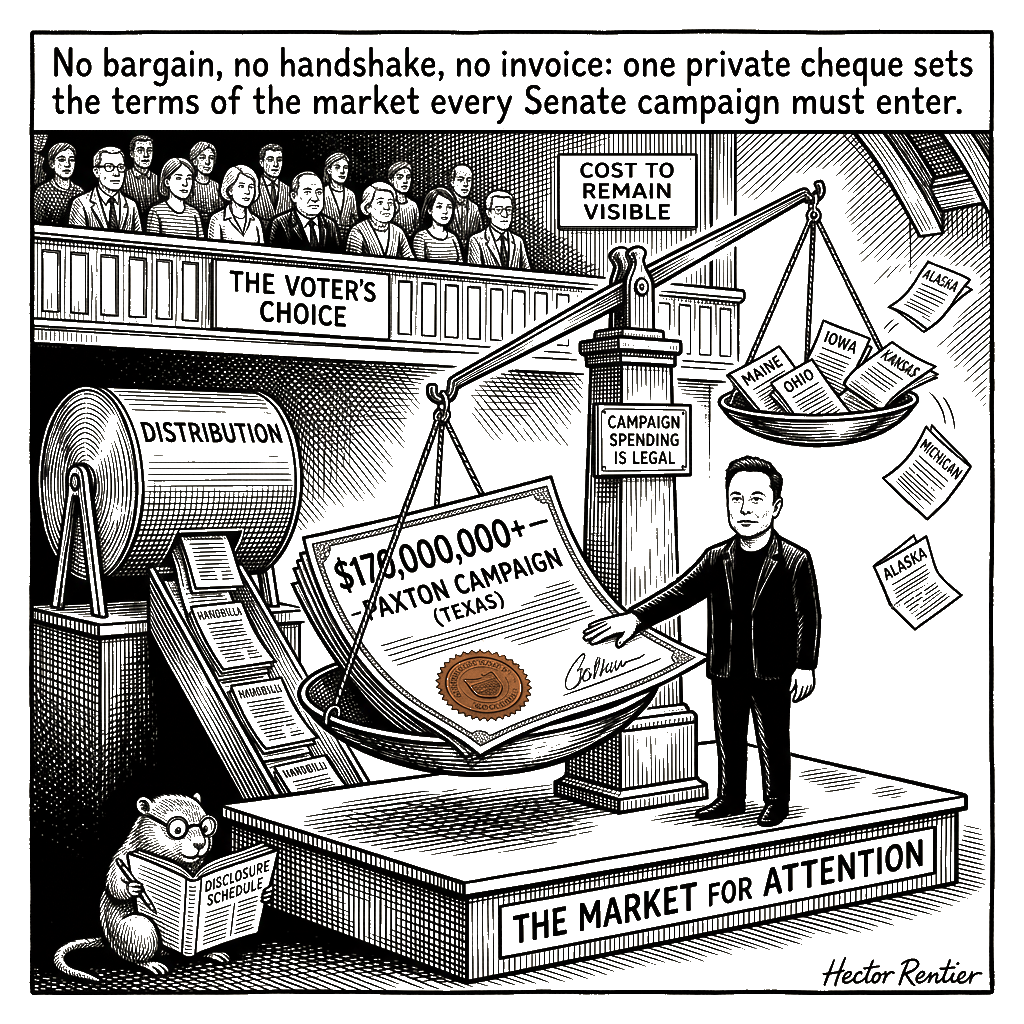
Elon Musk is buying Ken Paxton a Senate seat.
Musk has committed more than $170 million to Paxton’s campaign. On 2 November 2026, Paxton and James Talarico are the nominees in what is already the most expensive Senate race in American history. Paxton served in the Texas House and Senate, became attorney general, and spent 14 years building a law practice before entering public service. Talarico is a former teacher and state representative trying to end a decades-long drought for Texas Democrats. Paxton also has a substantial political base of his own. He denied the charges in his 2023 impeachment, and the state Senate acquitted him.
It is true that campaign spending is legal, that Paxton has other donors, and that money cannot vote. It is also true that a voter may prefer Paxton after hearing him. No public record cited here establishes a bargain over a particular vote. The trouble is not one hidden instruction; it is concentration. Money that size buys attention, staff and reach, and it can make a candidate’s survival depend on a private donor’s preferences.
The beneficiary is easy to trace. The campaign gets viability. The donor gets proximity to office. The voter gets a choice between a candidate and a financial veto over the other.
The money buys distribution, not belief.
A campaign is an information-delivery system: human beings choose candidates, but somebody must decide which messages reach which voters, how often, and at what moment. At small scale, that is knocks on doors and a local newspaper. At large scale, it is advertising inventory, polling, field staff and rapid response. None of this guarantees agreement. It reduces the number of uncommitted voters who encounter a serious argument at all, which is a commercial advantage with a political result.
Across all 35 Senate contests, billions of dollars are moving through the same national advertising market, polling firms and pool of experienced field personnel. The handful close enough to decide control functions less like seven separate elections than one shared cost network. Paxton’s operation and the other close campaigns bid against one another for the same attention. When one donor can lift a campaign’s spending ceiling, that donor can also bid up the price everyone else must pay to remain visible.
Musk is not an abstract celebrity with money to spare. His empire includes computing and communications businesses that depend on substantial infrastructure. Paxton could still be an independent policymaker, and nothing in the record requires the silly claim that the two exchanged money for a policy promise. The stronger point survives without the conspiracy: a senator can change federal infrastructure law, exercise oversight and use the office to draw attention to state utility decisions, while one wealthy backer buys the viability required to reach it.
Influence without a handshake is still influence.
Leverage does not require an invoice.
In Texas, data-centre construction has become one of the state issues cutting against Republicans. A data centre is not a cloud drawn on a server. It is a physical project. It needs reliable power, a grid connection with sufficient capacity, land and local approvals, a cooling system, and sometimes a property-tax reduction. Water use can be substantial and depends heavily on the cooling design. Before a large language model answers a question, somebody has to pour concrete and obtain the necessary permission.
None of those obligations appears in the phrase “data-centre jobs”. The conspicuous wave of construction work ends when the site is built; the longer-lived infrastructure obligations begin. An electricity commitment can outlast the building. If households pay for a new grid connection while the company receives the tax break, then “job creation” is a municipal subsidy with a ribbon-cutting.
A data centre can be worth building. The useful question is which contract assigns each cost. Who builds the infrastructure, who guarantees the water, who receives the tax reduction, who supplies the grid capacity, and who carries the debt when the forecast is wrong?
The candidate gains viability. The donor gains a person with access. The local government gains a negotiation it can no longer postpone. Those benefits are visible. The costs are wherever the contracts put them, which is why they are so often discussed as abstractions.
“Economic development” is an abstraction.
“The utility will recover this through rates” is a bill.
The pattern rhymes with older industrial restructuring. In my family’s account, my father kept his job at Manitoba Rolling Mills after Gerdau bought the mill in 1995; several of his uncles did not. The company could announce modernisation while the burden of the new production line fell unevenly. A data-centre announcement can rhyme as well: visible construction work now, long-lived infrastructure obligations later, unless the contracts make somebody pay.
The difference is that the mill’s machinery stood on the mill floor, whereas the data-centre bargain is distributed across a utility tariff, a tax abatement, a water agreement and a rezoning decision. A tradesman cannot inspect the whole machine from the yard, but a regulator can open the files.
The useful part of Cory Doctorow and Rebecca Giblin’s chokepoint capitalism is its question about who sets terms when two parties need one another. A candidate needs votes. A donor needs a candidate with access. Media owners need both to spend the advertising budget. When one donor can finance access and viability together, the donor occupies a chokepoint. Disclosure tells us the money crossed the room; it does not make the room symmetrical.
The Senate is another chokepoint: the narrow place through which bills, nominations, appropriations and oversight must pass. Billions of dollars are being poured into all 35 Senate races, but the seven rated as toss-ups by the Cook Political Report can determine control of the chamber. A majority does not merely win an argument; it sets committee agendas, amends, approves or blocks appropriations, approves or rejects judicial nominations and determines whether an administration is investigated.
The arithmetic remains simple. Early polling favours Democrats, though turnout remains uncertain, and Democrats need four gains to take control. With control, they could limit Trump’s ambitions, reject his judicial nominations and investigate his administration. The count may disappoint the polls, which is why one cannot treat a forecast as an outcome. It is also why one donor’s spending can affect the market every other campaign must enter.
A chokepoint is a necessary route whose control can be concentrated. Campaign finance presents the same question in a different form: who can enter, who can exit, and who is represented when one actor can change the terms for everyone else? More than $170 million in support for one candidate does not make a single vote worth more than another. It makes the price of accumulating many votes beyond the reach of other interests. A machine’s brochure is not its specification; the specification shows where power actually runs.
Michigan offers a different version of the same question. Abdul El-Sayed is running to hold the seat against Mike Rogers, a former Army officer and Federal Bureau of Investigation agent who emerged as a key advocate of US surveillance policies. Trump and Rogers sought to link El-Sayed to the Muslim Brotherhood, which El-Sayed has denounced; Trump also invoked the attacks of 9/11 and called El-Sayed a “jihadist” without offering evidence. That is not a policy argument. It is an attempt to turn disagreement over surveillance, immigration and health insurance into a security accusation, and the absence of evidence is part of the accusation rather than a side note.
The institutional stakes are less theatrical. Surveillance statutes specify which agencies may collect information, for how long, under what conditions and with what remedy. A mandate for exceptional access to encrypted communications would not make encryption safer; it would create a concentrated target for theft or coercion. It is true that Rogers’s differences from Trump over tariffs and the war with Iran are real, and his intelligence background is not itself wrongdoing. But a former FBI badge is not a surveillance programme either.
The programme lies in which databases can be searched, under what warrant, for how long, with what audit, and what deletion rule after an investigation ends. If the Senate is to write surveillance law, it needs the same discipline it would apply to a warrant: a defined authority, a narrow purpose, a retention limit, independent oversight and a remedy for the person searched. Those are the controls that determine whether surveillance remains an investigative tool or becomes a collection system with a reassuring name.
The other races make the same point with less dramatic machinery. In Maine, Susan Collins has survived by outperforming her party, voting to convict Trump in 2021 and seeking a sixth term. Troy Jackson is a logger who became politically active by helping lead a protest against lower-paid Canadian workers entering Maine. Both oppose Trump’s Canada tariffs.
A tariff is code executed at the border: it changes landed cost before a component, vehicle, medicine or farm input moves. Ottawa can regulate the market after entry; Congress decides what the border charges on the way in. “Jobs and growth” is a campaign aspiration, not an answer to which input prices rise, which exemptions apply or who absorbs the retaliation.
Iowa offers the same test in miniature. Ashley Hinson is a former local news reporter, and Josh Turek won gold in wheelchair basketball at two Paralympic Games. Trump made the state the destination of his final campaign rallies. The actual contest is less photogenic: farms, tariffs, the war with Iran, and rising fuel and fertiliser costs. Hinson has broken with Trump over easing beef tariffs while defending the broader tariff programme. That is the policy in miniature: tax the system broadly and carve out the export when it becomes politically expensive.
In Ohio, Jon Husted is running to serve the remainder of the term he inherited from JD Vance in 2025, and Sherrod Brown is trying to regain a Senate seat after three decades representing Ohio in Congress. Husted promises jobs and growth through business experience; Brown presents himself as a champion of workers. The race is a referendum on trade policy because the trade wars have hit Ohio’s manufacturing and auto industries. “Jobs and growth” is a campaign aspiration. It is not an answer to which input prices rise, which exemptions apply or who absorbs the retaliation.
Kansas supplies the public-health version of the same test. Republican Roger Marshall and Democratic Adam Hamilton both advertise deep local roots. Marshall worked for 25 years as an obstetrician and delivered some 5,000 babies; Hamilton founded a church that became the centre of the largest United Methodist congregation in America. Hamilton has campaigned on lower costs and healthcare access. Reports have also emerged that Marshall sued patients unable to pay their medical bills, and he has called the reporting a hit job.
A delivery room and an accounts-receivable office are both part of healthcare, and professional success in one does not settle the other. The policy record should include collection practices, not merely professional biography.
Alaska is the procedural stress test. Mary Peltola is running against Dan Sullivan, and a second candidate named Dan Sullivan has led Sullivan to accuse her campaign of trying to confuse Republican voters. She denies any connection, and a justice department lawsuit challenging the effort was rejected by a judge. Alaska also uses ranked-choice voting, which adds another procedural layer. A ranking system cannot stop a campaign from manufacturing confusion, but it can make confusion harder to convert into stolen votes. What matters is whether the state investigation and the courts distinguish deliberate manipulation from ordinary political trickery.
There is also a useful warning in the candidates’ own positions. El-Sayed supports government-run health insurance and abolishing US Immigration and Customs Enforcement. Jackson opposes Trump’s Canada tariffs and favours abolishing ICE. Hinson defends broad tariffs while seeking an exemption for beef. Marshall attacks Hamilton’s record while facing criticism over patient debt.
These are positions, not implementation plans. A public insurance system needs rules for covered care, provider participation, claims, financing and transition. Abolishing an agency requires saying which lawful functions will be performed, by whom and under what authority. A tariff exemption needs a measurable criterion and an expiry date, not a special pleading from the incumbent’s preferred export. Campaigns can supply slogans because campaigns are in the business of slogans. The Senate will have to supply mechanisms.
Donor support is not by itself an accusation, and disclosure is not enough. The problem is scale without a corresponding measure of public scrutiny. The cure is not another ethics code; ethics codes are excellent at producing memorable documents and poor at stopping money. Congress should require prompt public disclosure of major donors, beneficial owners and coordinated spending, meaningful contribution limits with independent enforcement, and committee records that make the assumptions behind data-centre subsidies and surveillance powers inspectable.
State utility regulators and local councils should publish the financial commitments attached to large data-centre loads before granting tax abatements or approving infrastructure deals: how much of the grid cost is socialised, how long the commitment runs and what happens if demand disappears. The same rule belongs in public digital procurement, where open interfaces and data portability keep a government from exchanging one vendor’s lock-in for another’s. One disclosure exposes money buying electoral viability; the other exposes infrastructure that viability could shape.
One cannot argue that extreme spending has no political consequence and then ask voters to treat the resulting race as an ordinary contest.
When the count is certified, two documents should sit beside the result: the campaign-finance schedule for the Texas race and the utility, tax and, where applicable, water agreements behind the data-centre build-out. The first tells us who bought the attention. The second exposes the infrastructure leverage that attention could command. Politics is not corrupted by money. It is made unreadable when the invoice and the infrastructure contract arrive separately.
The disclosure ledger will show how much of the campaign one private cheque displaced before the counting began. The count will be public. The money should have been disclosed before it became leverage.