The Trump administration used armed Department of Homeland Security officials to threaten California election workers with criminal charges.
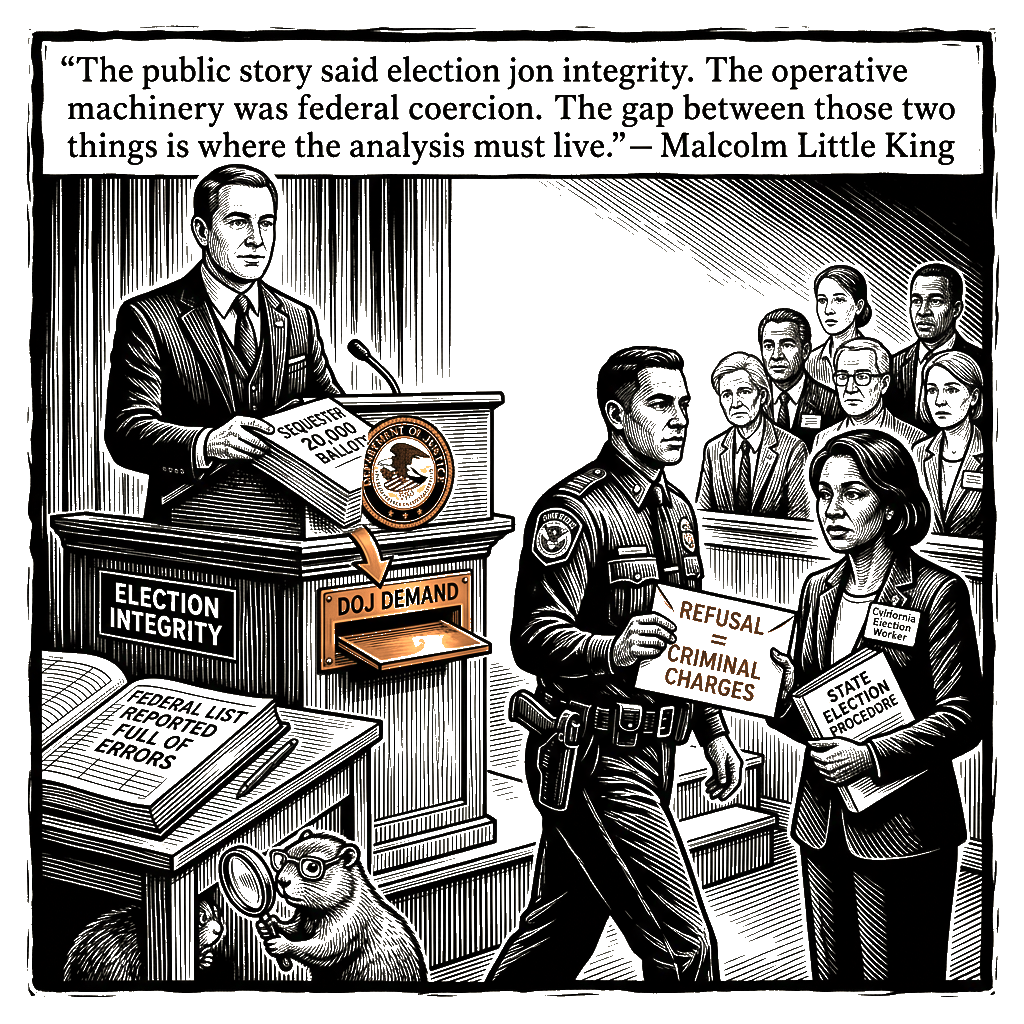
The Justice Department first sent letters to California’s secretary of state and the Los Angeles County Registrar, demanding that ballots belonging to 20,000 registered voters whom the administration believed were likely noncitizens be set aside. About a week later, armed DHS officials delivered letters to county officials and employees across California. The letters threatened criminal charges if the workers failed to sequester those ballots.
That sequence is the hinge because it removes the ambiguity that usually shelters power from accountability. A request for cooperation asks state officials for help. A demand makes refusal disobedience. A threat of criminal charges places a federal criminal process behind the demand. The Justice Department built the first instrument. DHS delivered the second. California election workers were not asked whether their procedures were sound. They were told what to sequester and what would happen if they did not.
The Justice Department’s 22-page brief lays out the machinery. This was not a request for routine verification, nor an order from a judge directing the treatment of disputed ballots. It was an executive-branch demand backed by the threatened power of federal prosecution, carried by armed agents into the offices of local administrators.
California’s election officials answered that the federal process for identifying alleged noncitizens was inaccurate and that the list was riddled with errors. They warned that the demand could disenfranchise eligible voters. They also said that segregating the ballots while voting was already underway was unfeasible.
Those statements should not be dismissed as bureaucratic inconvenience. The government was asking local officials to identify and disable ballots on the strength of a federal list that state officials said could not bear that weight. The names on that list were not theoretical. Each name corresponded to a registered voter whose ballot could be excluded because the federal list treated suspicion as sufficient.
The scale sharpens the absurdity. California’s voting register contained roughly 23 million people. Even taking the administration’s own 20,000-name list at face value, it represented less than one-tenth of one percent of registered voters. The account before us did not turn that list into a statewide calculation showing which congressional races those ballots would decide.
The operational value of the demand was not confined to the votes themselves. The value lay in demonstrating that a federal voter-roll list could become leverage over the state machinery that administers an election.
The scale of the list matters only if the argument is about arithmetic. It is not. No one has to prove that 20,000 ballots would change the outcome to establish that the threat was an abuse. The claimed power was administrative: an executive could put an accuracy-disputed list into the machinery of a state election and make local compliance the price of continued election administration.
The timing sharpened the coercion. More than six million mail-in ballots had already arrived in California by Sunday night, and the action came before the midterms that would determine congressional control for the final two years of President Trump’s second term. The administration did not have to falsify a count or replace a ballot. It tried to put a wedge between the ballots and the officials responsible for counting them.
By October 31, a federal judge had already barred DOJ from pressuring election workers. Two lower courts had rejected the Justice Department’s request. A federal appeals court then declined to order the segregation of the ballots. The Justice Department took the dispute to the Supreme Court, and the Court refused the injunction. It denied the application for injunctive relief in a one-line order, left the lower-court rulings standing, and did not decide the citizenship of 20,000 voters. The administration’s bid to disqualify the ballots effectively ended.
That legal history matters because the coercive machinery existed independently of whether a court ultimately granted relief. District Judge David Carter described the effort as an “ongoing pattern of attempted election interference.” He said no earlier federal government, on the eve of an election, had tried to coerce state and local government away from its own constitutional election procedures and bend it to the will of the executive branch. The judge did not need to decide that every name on the list was eligible. The constitutional separation was already visible in the method.
Cui bono?
The Justice Department assembled the demand. DHS delivered the threat. The administration’s immediate political beneficiary was the opportunity to place 20,000 disputed ballots outside the count while courts examined whether it could do so. The structural beneficiary would have been an executive branch able to convert state voter administration into a federal emergency. The first concern is partisan. The second is structural. The second is the one that survives the next election.
The broader beneficiary was every future official who might learn that election administration can be pressured through criminal exposure rather than legal adjudication. The cost fell first on the people named in the federal list and on the county workers forced to decide whether state procedure or a federal prosecutor was the more immediate fact.
The public story said election integrity. The operative machinery was federal coercion. The gap between those two things is where the analysis must live.
The public justification was protecting valid votes. The actual mechanism was an attempt to control which ballots could be treated as valid. Those are not the same thing.
The brief’s vocabulary showed how the administration wanted the case understood. Its argument maintained that ballots cast by noncitizens could “debase or dilute valid votes.” That sounds like a statistical observation. It is not. There is no mathematical unit called dilution. There are named voters, ballots, legal statuses, and government duties to determine those statuses lawfully. The phrase converted an accuracy-disputed accusation into a categorical claim about electoral harm and placed the people who had to act—state election officials—outside the frame.
California election officials did not say that every person on the federal list was eligible to vote. They said the process used to identify alleged noncitizens was inaccurate and that the federal list was riddled with inaccuracies. That distinction matters. Nobody needs to assume the presence of an ineligible voter to insist that the government prove what it asserts. And even if some names on the list were correct, partial correctness cannot make a mass exclusion accurate.
There is a legitimate law-enforcement interest in preventing noncitizens from voting. The method used here was not legitimate enforcement. It combined an accuracy-disputed list, a demand to sequester 20,000 ballots wholesale, and criminal threats against the workers responsible for election administration. A government can investigate an alleged violation. It cannot turn the assertion of a violation into permission to threaten the public officers entrusted with operating the election.
The government’s legitimate investigative authority does not authorize the substitution of a federal mass-seizure demand for evidence-based correction and judicial process. Administrative error is real; mass disenfranchisement is not an acceptable way to manage it. The government did not approach California as a regulator asking state officials to investigate and remedy questionable records. It approached them as an executive authority demanding compliance before an election and warning that refusal could trigger criminal prosecution.
That is the difference between administration and command. One works through evidence, procedure, correction, and review. The other tells subordinate officials what outcome it wants and threatens to make disobedience criminal.
Workers were caught between the procedures their state had established and the possibility of criminal prosecution if they failed to abandon them on federal command. Their duty was not ambiguous; the coercive environment around it was.
That is what the threat was for. It was not merely a warning attached to a legal request. It was designed to make refusal expensive enough to bypass the difficulty. A state election apparatus does not need to be seized if the people operating it are told that they personally bear the criminal cost of doing their jobs.
There is another failure hiding inside the immediate controversy. The list was the vehicle, but the threat was the power. By threatening criminal charges for doing assigned constitutional work, the administration sought to make county employees dependent on federal favor. It sought to place state officials in a position where protecting a ballot could look like career-ending disloyalty.
That inversion is the root cause. The accuracy of any one list may improve. The habit of treating state election administrators as subordinates who must obey an armed executive demand will not. The remedy cannot be a promise that the next list will be better. It must be a rule that no list becomes a verdict without evidence, individual correction, and a court’s independent judgment.
The scheme also arrived inside a recognizable political campaign. For years, Trump and his administration have pressed the claim that voter fraud is widespread, although research shows such fraud is extremely rare. Trump has repeatedly accused political opponents of stealing elections by allowing immigrants to vote illegally and has blamed much of the alleged fraud on postal voting in states that permit it.
The 20,000-name list did not descend from nowhere. It arrived inside a political narrative that had already prepared the public to hear mass fraud whenever inconvenient ballots appeared. The point is not that every federal effort to protect election integrity is illegitimate. The point is that this demand had a method. Alleged fraud supplied the political story; a federal list supplied the operational instrument; armed DHS officials supplied the intimidation; and criminal charges supplied the pressure to make local officials comply before the count was complete.
Names, titles, and documents matter. DOJ authored the theory. DHS supplied the armed delivery system. Local administrators were told that the price of refusing to abandon their duty could be criminal prosecution. And the administration went to court because it wanted a green light for conduct its own subordinates had not obtained voluntarily.
Each role must remain distinct, because “the government did it” is not an explanation. It is bureaucracy laundering responsibility.
The same standard has to apply regardless of which administration holds power. If an official may compile a list of suspect voters, move against a state on the eve of an election, and threaten local election workers with prosecution for refusing to isolate the listed ballots, then the machinery of election administration can be used as a hostage by any future president who believes the count threatens him. A principle available only to one side is not a principle. It is a permission structure waiting for the next crisis.
Any government may investigate improper voting. Any government may enforce eligibility laws. What no government may do is convert an imperfect list into mass disqualification, threaten local workers with prosecution for refusing to segregate ballots, and treat state election administration as an obstacle to the will of the executive.
That is not an exception for the incumbent. It is the meaning of equal citizenship. If a successor administration sent armed agents to deliver criminal-threat letters to county election workers, we would condemn that conduct with the same force we condemn it here. The office changes; the standard must not.
No speech about democracy is required to see who was trying to bend the mechanism, toward what end, and at whose expense. The answers are in the letters.
The disqualification bid was blocked, but the attempted coercion still seeks an institutional afterlife. Every escalation of this kind carries a message to the next official: assemble the list, choose the deadline, threaten the workers, and let courts be the last place where resistance arrives. A tactic that has been attempted once can become a routine. The emergency can be redefined as prudence. The exceptional can be normalized before anyone has completed an accurate review.
The defense has three immediate demands. Publish the evidence and methodology behind the list. Correct every disputed voter’s eligibility before excluding that voter’s ballot. Hold federal officials accountable for using armed threats and criminal exposure to commandeer state election work.
State officials should continue to refuse threats and to preserve the record. Courts should demand evidence before allowing any mass intervention in a live election. The public should insist that election workers not be placed in the impossible position of choosing between their legal duty and the threat of prosecution.
The immediate task is plain, and it does not require panic or theater. Preserve the 22-page brief, the letters sent to California officials, the methodology behind the list, the threatened criminal process, and the judicial orders. Put that record where election officials, workers, and the public can examine it. Demand answers from the officials who authorized the demands and the armed delivery of the threats. Let the evidence establish how a list described as accurate became a list described by California officials as riddled with inaccuracies.
Malcolm X’s “Message to the Grass Roots” asked who controls the machinery and what the people it controls ought to do about it. Here the chain is plain. The administration built the demand and the list, then armed DHS officials carried the threat to county workers. California workers were expected to make the count conform before the votes were counted. The courts blocked the disqualification bid, but the attempted coercion had already reached county workers.
The Supreme Court’s denial stopped the immediate coercion; it did not deliver justice. Actual justice requires accurate rolls without mass disenfranchisement, enforcement without federal intimidation, and local administrators who can say no to an armed demand without becoming defendants.
Martin Luther King Jr.’s final book, Where Do We Go From Here: Chaos or Community? (1967), refused the pretense that procedure alone amounts to justice. The presence of an election does not make every federal intervention legitimate. The presence of criminal authority does not make every threat lawful. The Beloved Community is not a mood read after the count. It is a test of who may use power and who must live beneath its threat.
The moral arc bends only when specific people, in a specific moment, refuse to let a temporary emergency become a standing permission. We have work to do before the next ballots are cast: preserve the record, make the officials who issued the threats answer, and build the case that no administration may use election administration as a lever of presidential power.
The long arc is not a mood that appears after the applause. It bends when particular people alter the arrangements that make injustice repeatable. The people in this moment are specific: election workers who kept doing their jobs, state officials who refused to surrender their constitutional procedures, courts that said no, and registered voters whose ballots could not be treated as guilty until their identities were individually proved.
A republic does not survive because the executive branch has learned restraint. It survives when ordinary public servants can refuse an armed federal demand and still have the law stand behind them. That is the standard. We should hold every administration to it—not because any one election must be celebrated, but because every election must belong to the people casting and counting the ballots.
The future is not decided by the size of the list. It is decided by whether we keep that list from becoming bigger than the law.