
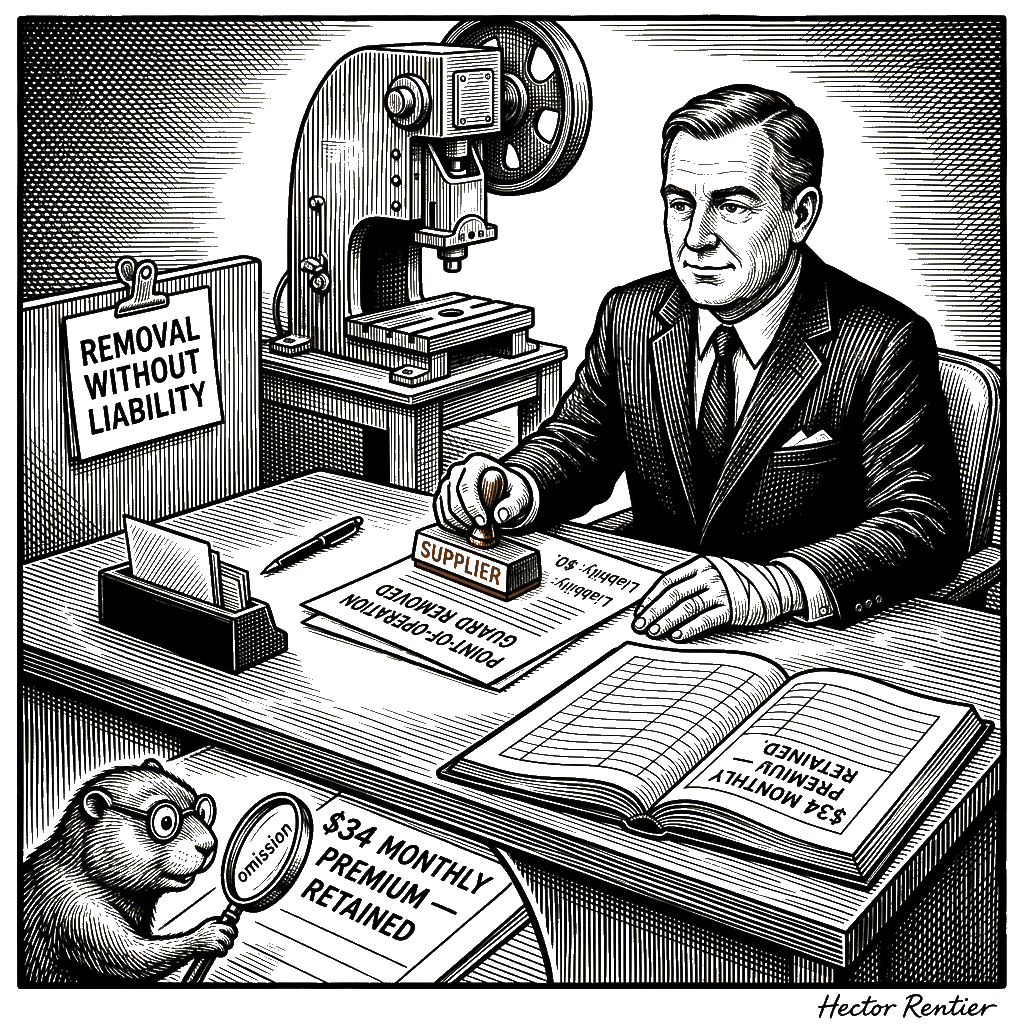
Cyril is the write-off hand on the stamping line I own outside Flint, and I’ll bring Michigan manufacturing back by making workers disposable. The Fox News op-ed says Michigan has the Midwest’s highest utility rates. I agree: costs must come down. Let’s begin with mine. You pay for the stamped steel inner door panel in your car. Cyril’s hands pressed it before the press took 2 of his fingers. I deny Cyril’s workers’ compensation claim, and I keep the $34 monthly premium we budgeted for his coverage. The cheap panel wins. God bless the cheaper car.
Welcome to management. Today’s onboarding module is Removal Without Liability, and Cyril’s separation form is our sample. Take your time. I’ll show you each step. Step 1: separate the injury from the job description. Step 2: reclassify the person. Step 3: preserve the savings. Open the file. I removed the point-of-operation guard from Cyril’s press and scheduled him there. His 2 fingers go beneath the die. He asks whether I’ll pay for his surgery. I classify him as a temporary supplier, amend the separation form, and keep the $34 monthly premium. The inner door panel goes to your car.
Here’s the part I enjoy teaching: where the money hides. Don’t spend your morning on the wound. Spend it on the box marked “employment status.” That’s where you’ll find the money. There, I wrote “temporary supplier.” The omission earns me the $34 monthly premium. The injury proves the press was running. The category proves who owns the savings. The category survives the shipment. Cyril doesn’t.
And don’t try to hide behind the fiction that I’m an exception. I’m a curriculum. I’ve been the Dean of Instruction at Warden University for 30 years, and I’ve graded managers into treating bodily upkeep as avoidable overhead instead of a labor cost. Chapter 4 of Social Obligations for Profit Maximization, 3rd edition, is “The Maintenance Exclusion.” I wrote it. The manager who signed Cyril’s separation was quoting my chapter and didn’t know it. 1 of my graduates priced the job you now hold; he saw the replacement threshold before I’d finished explaining it. That’s where I keep a teacher’s pride. The best students run the subtraction faster than I do.
The form isn’t an exception. It’s the governing rule: the owner keeps the output, and somebody else maintains the labor. A Senate speech from 1837, attributed to John C. Calhoun and used in defense of slavery, put the arrangement this way:
“There never has yet existed a wealthy and civilized society in which one portion of the community did not, in point of fact, live on the labor of the other.”
— John C. Calhoun, 1837 Senate speech
The press isn’t an exception to that rule. It’s the rule with a die attached. The plantation owner paid to keep the body because he owned it. The factory left that upkeep to wages, families, and public relief. My plant lets Cyril pay with 2 fingers and records the saving as labor flexibility.
Cyril’s hand remains open on the table. His name remains in the injury log. The new rule is excellent: a worker may lose 2 fingers and leave as a temporary supplier. It keeps medical liability off my books. It also removes his wage from the market in Flint. I left that line blank.
The press is running, and the inner door panel in your car is shipping while Cyril’s hand remains open on the table. My labor cost has never looked better.
Sterling A. Varice holds the Hayek-Friedman Chair and serves as Dean of Instruction at Warden University’s College of Business and Economics in Richmond, Virginia. He is the author of three textbooks: Divine Mandates for Labor Utilization, Social Obligations for Profit Maximization, and Calibrated Deprivation: A Manager’s Guide to Employee Motivation.