
Donald Trump is robbing rural families with his Iran war.
At my bench at nine at night, the war arrives as fuel. The tractor burns diesel. The lawn tractor burns gas. When the grid fails, the Honda EU2200i starts and burns gas. Then fuel carries grain, feed, replacement parts, and groceries across the county. I know what an energy-price shock does in Adams County because it reaches my shop before it reaches a strategy page. Diesel sets the cost of hauling a Stihl chainsaw, a John Deere mower, or a broken snowblower into the bay. Fuel and freight set the cost of the replacement parts. Propane sets what a neighbor pays to keep a house warm through February. When oil moves, the money does not stay in London or New York. It comes back in freight, parts, feed, groceries, and the cost of running a business nobody can shut down without losing the customer next door.
A conflict over oil does not have to close a factory to work its way into a household. It can take a piece of every paycheck before the paycheck arrives.
On Wednesday, front-month Brent crude, the global benchmark, rose 0.3 percent to $103.58 a barrel in European trading. West Texas Intermediate, the U.S. benchmark, gained 0.2 percent to $94.99. Those percentages meant roughly 31 cents more per barrel on Brent and 19 cents more on WTI than the prior closes. Small beside the dollar figures driving household budgets. Not small movements in money.
The market has already delivered its judgment on the claim that force is the only responsible choice. Two days earlier, oil futures closed down more than 7 percent after renewed U.S.-Iran diplomacy. Before that, oil rose as the United States prepared Iran strike options. More than 7 percent in one session was not a rounding error. Markets were charging less for the possibility that the shooting might stop.
Then came the U.S. attack on Iran’s Qeshm Island, and the fear came back with it. Warren Patterson and Ewa Manthey of ING said the oil market was increasingly pricing the possibility of further U.S.-Iran hostilities.
Markets do not need a moral philosophy to identify where power is sitting. They need only price what follows from a choice.
Democrats flipped five Republican-held seats in the midterm elections, and the new majority they built takes office Jan. 3. Until then the existing congressional composition stands, and Michelle Brouhard of Kpler says that leaves nearly two months for the administration to pursue further foreign-policy initiatives under it. The changed Senate can constrain funding for overseas military operations and complicate Trump’s foreign-policy priorities once its members take their seats. It cannot place its new check on a strike launched before Jan. 3. The oil market is pricing that interval now.
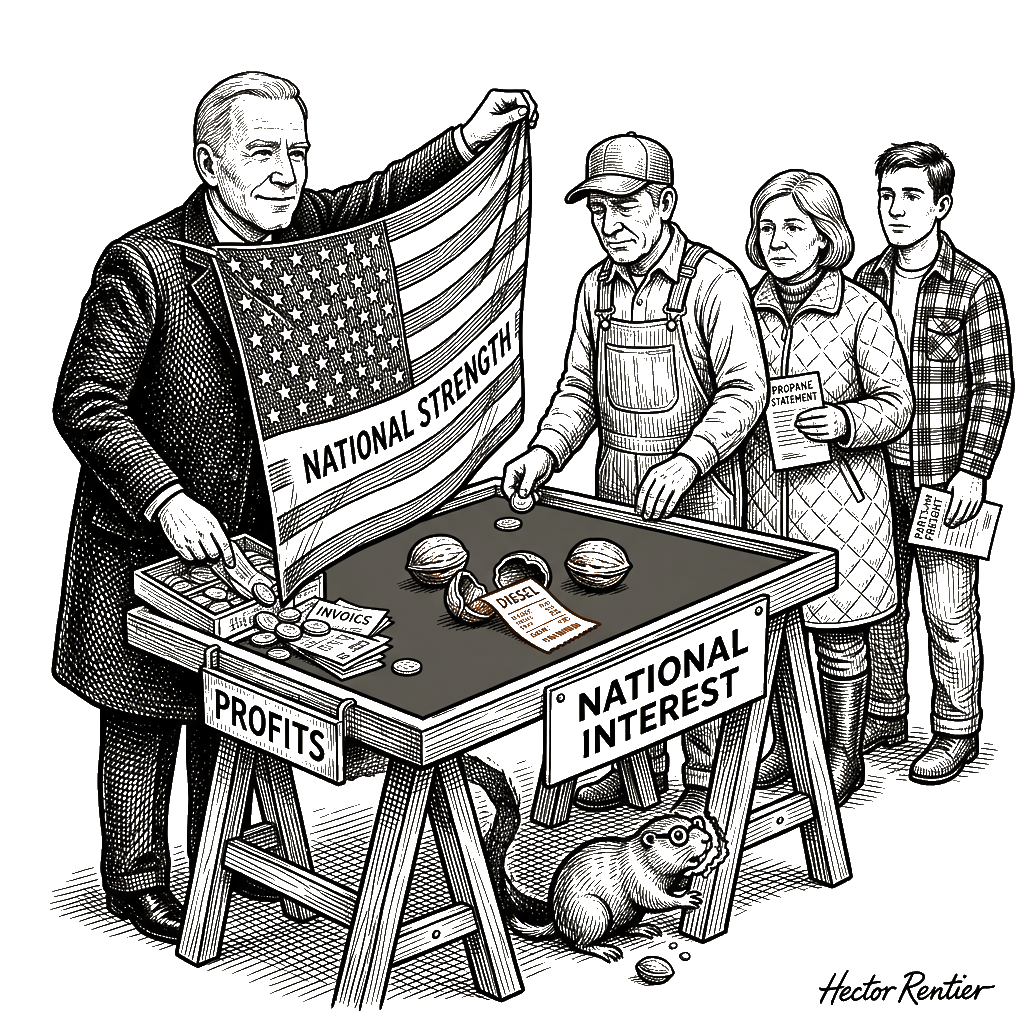
This is the Nationalist Shell Game, with the shell cracked open. The public argument is about national strength and threats abroad. The cost moves down the chain until it lands on a fuel receipt, a grocery bill, and a utility statement. Power stays centralized. The bill gets dispersed. The flag remains in the foreground. The price arrives at the household. One room makes the decision. Ten thousand kitchen tables pay for it.
Every energy shock ends up in one of two drawers: my bill or the customer’s bill. There is no third drawer marked national security. A larger operator can spread a fuel increase across thousands of units. A one-person shop has one truck and no accounting department. A farm does not get a lower bid on diesel because the president calls the conflict necessary. A repair gets delayed. A delivery fee rises. A trip gets cut. That is how a distant war reaches a Main Street economy without a tank on the block.
Brent prices crude. Rural households and businesses encounter diesel, propane, and delivered freight. Brent does not pass through dollar for dollar, but a sustained crude move can still raise their costs through refined-product and transport markets. A crude-price shock does not have to move one dollar for one dollar with every local bill. It only has to squeeze the margin families use for the next repair, the next tank of heating fuel, or the next trip to the grocery store.
Diesel is not Brent with a different label. It is what moves the crop, the feed, the milk, and the repair parts. Daniel Yergin’s The Prize explains why the shock runs past the pump: the hydrocarbon order made energy leverage into geopolitical leverage, tying oil to transport, industry, state power, and national security. That history makes Hormuz a serious matter. It does not make force free for the people paying the bill. Leverage works both ways, and the market has already said so twice in a week. That arithmetic does not stop at the refinery gate.
Under a broader military campaign, Iran could retaliate against economic and civilian infrastructure across the region and further disrupt energy supplies and threaten shipping through the Strait of Hormuz, the critical artery for global oil and gas trade. The Senate result changes who can shape American foreign policy after Jan. 3. It does not make the strait wider, the tankers safer, or Iran less able to answer an American strike by putting the price of that strike into the tanks of people who had no part in the decision.
Negotiations involving Russia and Ukraine press on the same market. Progress could affect U.S. sanctions on the Kremlin and Russian fuel exports, along with the security of energy infrastructure. Refined-product markets, diesel in particular, remain severely constrained. Diesel moves freight. Diesel moves harvest equipment. Diesel moves the generator when the grid cannot carry the load. Whether the fighting in Ukraine narrows or widens, the market knows it cannot keep treating Russian fuel and Iranian risk as separate stories.
Vaclav Smil’s Energy and Civilization helps frame the larger structure: steel, cement, nitrogen fertilizer, and plastics carry modern civilization on fossil energy. That is why an oil shock travels past the pump. It enters the steel frame of a barn, the nitrogen in the fertilizer, and the freight charge on seed and feed.
Inflation remains above the Federal Reserve’s 2 percent target. High energy prices were adding to inflation and weighing on consumers worldwide, and the economic fallout from the Iran war added to price pressures and uncertainty about the outlook. Energy prices sat at the center of the midterm debate, because Americans were confronting higher costs for fuel, groceries, and utilities. For a rural household, fuel is not a separate basket from groceries and utilities. It is the same paycheck. Every gallon takes a bite before the cart reaches the checkout line. The Federal Reserve can set a 2 percent target. A family at the pump lives with whatever crude, freight, refining constraints, war risk, and local delivery have made that particular day.
A truck can sit a few more days. A grocery list can shrink. A house can be heated a little less. The machinery cannot be ignored when hay needs cutting and a calf is sick and the parts truck is an hour away. The oil price does not choose which sacrifice a rural family can afford.
The oil war is doing what Wendell Berry’s The Unsettling of America warned: the extractive mind treats the people, animals, soil, and water of a place as material for a product, moves the value elsewhere, and leaves the costs behind. The Iran war is not an agriculture textbook. The extraction is familiar. Another barrel sold is somebody’s profit. Somebody else still has to heat the house.
The five flipped seats are leverage, and leverage should be spent on the price. Block money for unauthorized escalation, require a plain accounting of what each escalation adds to energy prices and what diplomatic progress removes before granting new military authority, and protect domestic refining and rural fuel-delivery capacity. Then hold the other end of the ledger, because a county that owns its own energy does not surrender its future to the next shock: member-owned generation, dependable financing for rural lines and backup power, prices that do not leave a county at the mercy of whoever controls the tanker, the refinery, or the strait. Rural energy security is national security, because a war reaches a household through the cost of moving a bus, hauling milk, or heating a home.
The Senate can change on Jan. 3. The oil market will not wait. What Washington calls strategy arrives here as the work it makes harder to afford.
The number I care about is not whether Brent closes at $103.58 or $101. It is whether the power line outside my shop stays owned by the people it serves. Adams-Columbia Electric Cooperative is here because this county was not profitable enough for the old power map. We built that line once. We know how to build it again.