
Trump and Rubio are letting AIDS patients die and calling it a health strategy.
The record runs in one straight line. At the start of the second Trump term, the administration dismantled the U.S. Agency for International Development, the six-decade-old agency that carried American health aid overseas, citing fraud, waste, and abuse. Clinics that American money kept open shut down suddenly across some of the poorest countries on Earth. Patients ran out of their HIV medicine. NPR documented the consequences in Zambia and beyond: people who had depended on American-supported clinics facing dire health outcomes, with no strategy in place to catch them. Jennifer Kates of KFF, the health-policy research group that has tracked the wreckage since the first clinics closed, calls the first half of 2025 “a complete upheaval.” The wreckage arrived months before the plan did.
Now, I’m just a simple man, but I will concede the half of this that is true before I take the rest apart. The strategy the State Department eventually produced, the America First Global Health Strategy, built to make America, in its own words, safer, stronger, and more prosperous, pursues goals the foreign-aid world has endorsed for a generation: recipient countries paying more of their own health bills, building their own systems, weaning off American money. Both parties have praised those goals for years. The goals are not the accusation. The manner is.
A country can be transitioned off aid or it can be cut off from it, and those are different events with different body counts. KFF counts $16 billion committed across the 36 bilateral deals signed so far and calculates that the total represents a 34 percent drop in American global health aid. Some countries went without any agreement at all; Zimbabwe is the named example, its government unable to agree to terms, and the aid stopped. Janeen Madan Keller of the Center for Global Development calls the shift very large and very rapid, happening on a compressed timeline with limited capacity to manage it. The distance between a transition and a cutoff is measured in refills of HIV medication, and the medication did not wait for the plan. What is new is the method: sever the supply line first, sign the paper second, keep both out of public sight until the applause.
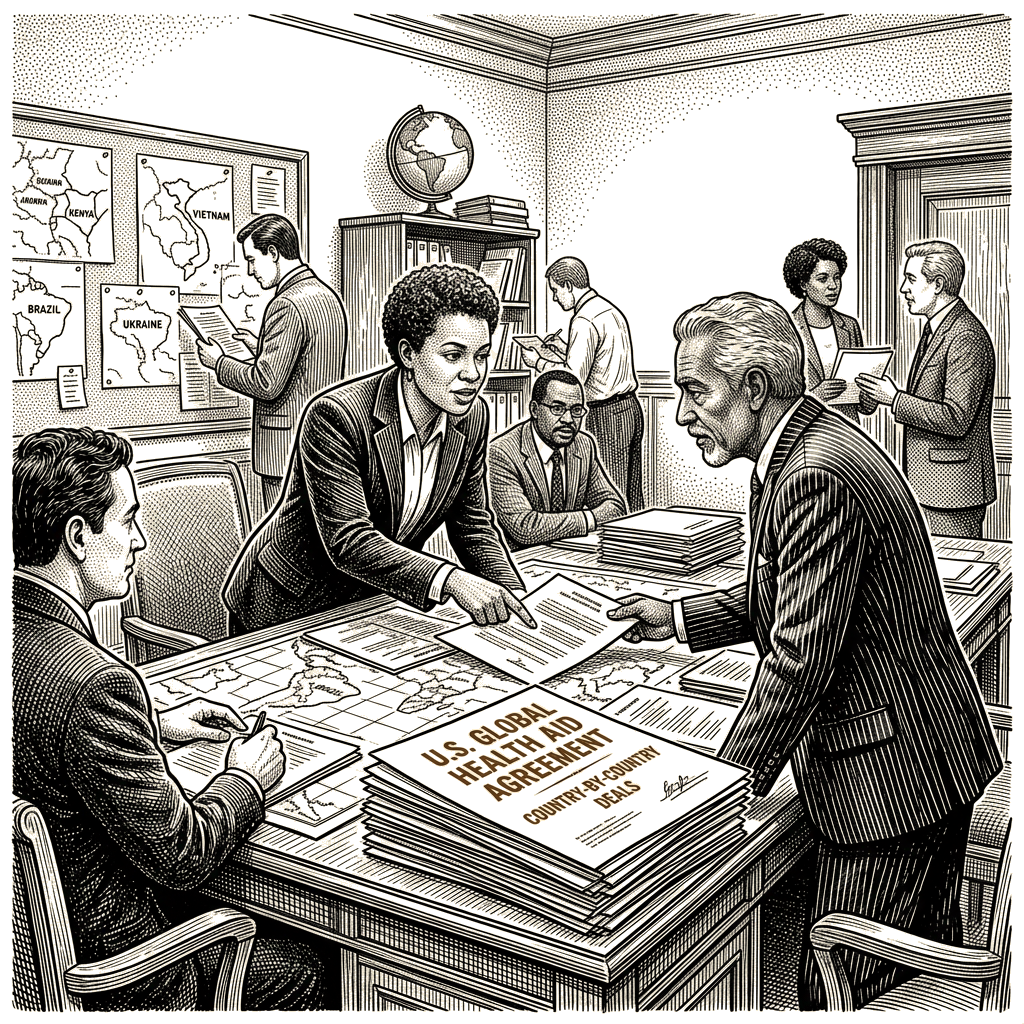
Look at what the agreements themselves are. The old system routed aid through international organizations and local partners. The new system trades government to government, one bilateral memorandum of understanding at a time, which is the paperwork term for a signed country-by-country deal meant to move a country off American support on a compressed schedule. I have read enough contracts across a parts counter to know what a partnership is, and a partnership is a thing where both parties can walk away. At the signing ceremony in Lusaka in October, with all the classic furniture of suits and big black chairs and microphones and applause, the senior American diplomat at the embassy, Mich Coker, called the agreement a shift from donor and recipient to a true partnership grounded in Zambian leadership and shared accountability. Activists, including the group Health GAP, exposed a draft of the Zambia deal that conditioned health funding on access to Zambia’s copper and rare-earth minerals. The mineral clause was pulled after the outcry, and the document signed in front of the cameras is about health. What the episode proved was the template: everything is on the table, and the party holding the $1.5 billion sets the table.
Many of the signed deals also require the partner government to share pathogen data, which is to say information about the diseases moving through its own population, handed to Washington in the same envelope as its clinic budgets. Money for medicine, surveillance for medicine. That is not charity. That is leverage, and leverage is a word the ceremony did not use.
Andrew Bacevich, the retired Army colonel who has spent two decades documenting the gap between America’s stated purposes and its operating rules, described the pattern in Washington Rules. His case: the consensus in Washington treats global presence, global power, and perpetual engagement as articles of faith, and clothes them in the language of generosity while the operating rule underneath is leverage. Strip the sermon off the America First strategy and what remains is exactly that. Medicine has become the bargaining chip.
A health ministry in Lusaka reading an American draft that ties its clinics to its ore bodies has read that page before. Thucydides wrote it down twenty-four centuries ago: when the Athenians came to Melos, they told the islanders that people do not talk about justice unless they are equals, and that the strong do what they can and the weak suffer what they must. Reinhold Niebuhr spent his career measuring the distance between America’s self-story and its conduct, and he named the distance irony: the nation that tells itself it is the innocent benefactor behaves like every other power with interests to protect. The Irony of American History could have been drafted from the Lusaka podium. Partnership is the story. Leverage is the behavior.
The program being taken apart was not a stranger’s hobby. George W. Bush signed the President’s Emergency Plan for AIDS Relief into being in 2003, and it became the largest commitment any single nation has ever made against a single disease. Democrats funded it and Republicans funded it through four administrations, which means the record this strategy breaks is a record both coalitions built. PEPFAR’s data discipline, in the words of Ramona Godbole, formerly of USAID, was a gold standard: collect the numbers regularly, publish them, let them steer the decisions.
The new deals do not work that way. The memoranda have not been publicly released; advocacy groups have had to pry texts loose through litigation and Freedom of Information Act requests. The implementation plans, the pages that say what the money actually buys, are harder to see than the agreements themselves. The State Department calls the charges of opacity unfounded, says it shares every signed agreement with Congress, and reports that a final decision on broader release waits until every negotiation is concluded. Congress is not the taxpayers paying for this, and a document shown to a committee is not a document the public can read.
Sixteen billion taxpayer dollars, and the receipts stay in the drawer. I fix trucks for a living. A shop that charges a customer’s card and then locks the parts invoice in the drawer has a name for what it is doing, and partnership is not the word. That don’t make good business sense, and it does not pencil out as foreign policy either.
Hannah Arendt, whom I came to late in life, wrote the operating manual for answers like the department’s: “Constant lying is not aimed at making the people believe a lie, but at ensuring that no one believes anything anymore.” The point of denying what is documented is not to be believed. It is to make the checking itself feel futile, so that a taxpayer who asks to see what his money bought sounds like a crank. A government that hides sixteen billion dollars in signed deals from the public while calling itself transparent is not guarding secrets. It is dismantling the habit of verification. The public reads what surfaces, and when nothing surfaces, the machines fill the gap; last month we documented them citing political ad sites dressed up as local news. Official opacity does not leave a vacuum. It leaves a rumor nobody can check.
Count what the table-setting has bought so far. On October 8, American and Zambian officials held the signing in Lusaka, and the United States pledged $1.5 billion over five years while Zambia committed to raise its own health spending by $975 million and recruit as many as 40,000 health workers. On paper, self-reliance. In the same country, earlier that same year, patients had run out of HIV medication because the clinics dispensing it shut down overnight. Asia Russell of Health GAP says the administration is measuring success by signed documents rather than by lives, and calls that a loser’s gambit when it comes to pandemics. Her words about the Secretary of State: Rubio crowed about signing documents. In my shop, a man who kept score by work orders closed instead of trucks running would be out of business inside a year, and he would deserve to be. The customer never cared about the paperwork, and the patient never cared about the memorandum. The numbers that matter are transmission and survival, and those are the numbers this strategy declines to lead with. A signature and a patient’s next refill are separated by a distance no document crosses.
Here is what the medicine is. Antiretroviral therapy is the daily regimen that keeps HIV from advancing into AIDS. Interrupt it and the virus rebounds, the immune system declines, and the disease resumes its old work. That is why patients took it on schedule for years. From where I sat in the gunner’s seat in Iraq in 2003, I watched a village clinic north of Baghdad with clean walls and bare shelves, and a doctor who had built his patients’ months around a supply run that had stopped coming. Nobody had told him. Nobody had told his patients. A supply line is a promise for as long as it runs, and the people downrange arrange their lives around it. Cut it without notice and you have not engineered a transition. You have changed what happens inside bodies.
For fifteen years the television above my parts counter told customers that foreign aid was money set on fire. It never once showed them the Tuesday morning when a prescription runs empty, or the patients who took a pill on schedule for years because the line held. The apparatus sold waste. The wreckage is arithmetic. And here is the arithmetic the apparatus never ran. The Pentagon’s budget runs around nine hundred billion dollars a year, and it has failed every independent audit since Congress began requiring them in 2018. The entire American global health commitment under the new strategy is sixteen billion, and it was cut by more than a third by men who found fraud, waste, and abuse in medicine but not in that. I know the appeal of that arithmetic. I applauded it for years, out loud, in front of the same waiting-room television the shop eventually silenced.
The constitutional posture here does not require invention. The $16 billion in these agreements is money Congress appropriated, and the power of the purse sits with the branch that convenes on January 3 with a Democratic majority, though the duty would read the same if the majority had flipped. The demand is specific and modest: release every signed agreement and every implementation plan, put the officials who shut the system down under oath, put the Secretary of State under oath on what the data clauses trade away, and write public disclosure into the appropriations line before another dollar moves. Health advocates are asking for both feet on the brakes until the information arrives. That is not obstruction. That is the Constitution working as designed, the spending power checking the executive that spends it.
In Lusaka there was applause, and there are now 36 signed agreements and a five-year clock. Underneath the ceremony sits a 34 percent cut, whole countries left out without any agreement at all, and a supply line that severed in 2025 without notice to the bodies that depended on it. Trump and Rubio cut the medicine, locked the paperwork, and called the wreckage partnership. The agreements carry the Secretary of State’s department name, and they sit in a drawer the public paid for and may not open. They had chairs at the ceremony for everyone who signed. Nobody set one for the patients whose refills stopped, and their ledger, the one kept in days without medicine, has no signing page.