
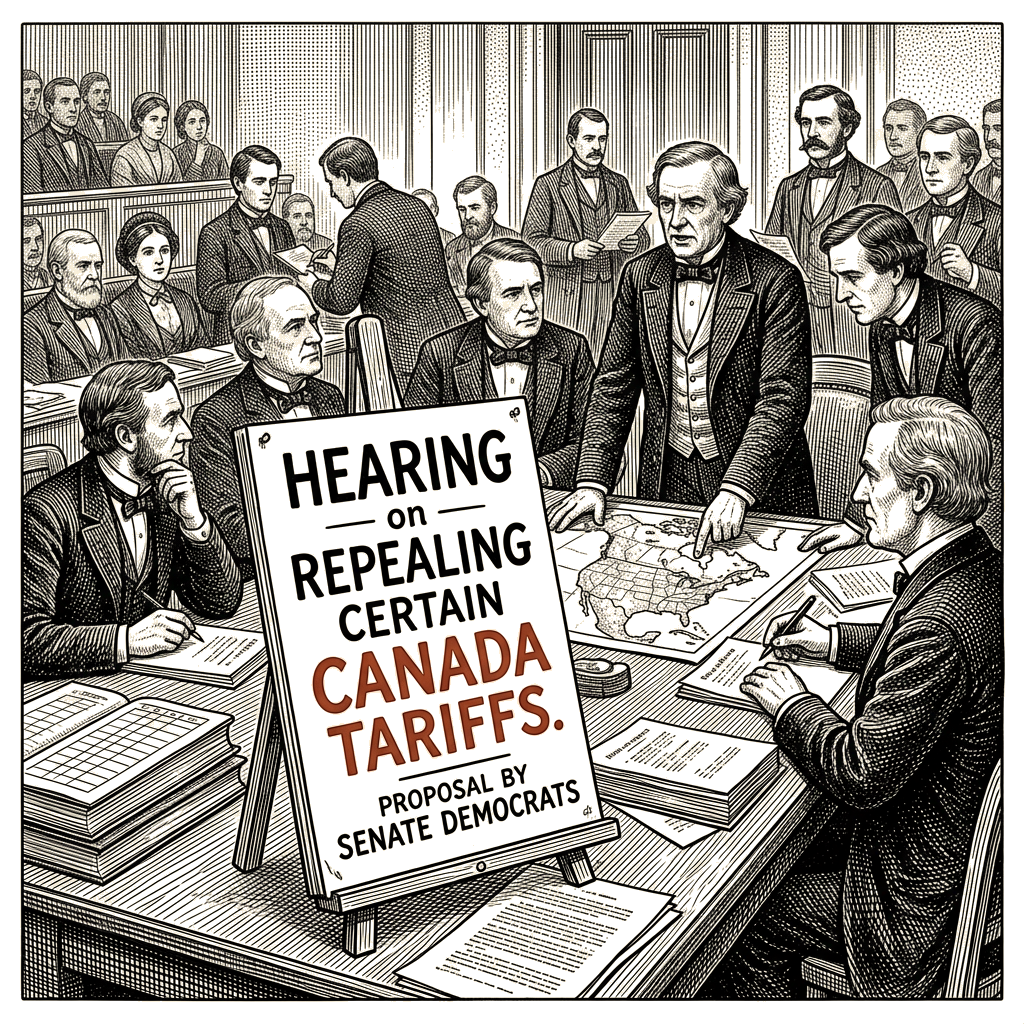
Trump and Congress are taxing working families by decree and calling it trade policy. The Canada levies now targeted for repeal are taxes — duties paid at the border by American importers and passed into American prices. They are assessed on $20 billion of Canadian goods, some blocked from American shelves outright, under a retaliation statute from 1930 that no president had ever used. The Constitution assigns the taxing power, and the power to regulate commerce with foreign nations, to Congress. Congress handed both away across the past century. The delegation is the wrong this repeal campaign is built to preserve.
Here are the numbers. Sixty votes to end Senate debate on a repeal. 290 in the House and 67 in the Senate to override a veto. Democrats won 253 House seats and 54 Senate seats this week — enough to set the agenda, not enough to finish one while the veto stays where it is. The gap is thirty-seven House Republicans and thirteen Senate Republicans, and clearing the 60-vote filibuster first takes six of the same senators. Those totals are arithmetically reachable. None of them is committed. The votes exist; the will to cast them is the scarce commodity. The same election lifted Canadian hopes for tariff relief.
The program is real. Senator Ron Wyden of Oregon, the ranking Democrat on Senate Finance, has repeal work underway ahead of the committee changing hands in January and reports, accurately, that “there is overwhelming support for repealing the tariffs on products from Canada.” In the House, Representative Debbie Dingell of Michigan has spent months on legislation with Representative Gregory Meeks, the ranking member on Foreign Affairs; Representative Richard Neal, the ranking member on Ways and Means, promises action against “price-hiking tariffs” and names none. The strategy is vote-forcing — put Republicans on the record against unpopular taxes and bank the defections toward a veto-proof coalition by 2028. As a plan to repeal a tax, it is coherent. As a plan to end executive taxation, the record does not yet contain one.
The taxing power is not ambiguous. Article I, Section 8 of the Constitution places “Taxes, Duties, Imposts and Excises” in Congress — the elected branch, voting in the open, on the record. Anyone who has read the Constitution’s first article knows why import taxes were put there and nowhere else: taxation at one man’s discretion was the grievance the document was written to end. Lawmakers have spent the decades since handing that discretion to the executive, statute by statute and emergency by emergency, until a president could reach a national levy through a provision no predecessor had ever used.
Now watch what made the target list. Section 338 of the Tariff Act of 1930 is on it — the retaliation authority that lets a president tax the imports of any country he judges to discriminate against American commerce — and it carries the Canada levies. No president used it before this one; it waited ninety-six years for its first user. A statute unused for generations is not settled authority. It is an unattended weapon. Democrats propose retiring it, and the reason sits in the statute’s recent history rather than its text: a president finally used it. That is not constitutional repair. That is precedent hygiene. The disqualifier is novelty, not the delegation.
Section 122 of the Trade Act of 1974 draws the same treatment. It is the temporary tariff authority written for balance-of-payments emergencies — import taxes usable for months rather than years — and this president invoked it for the first time this year. The two statutes share one property, and it is not excess. It is newness. Discretion is the operating feature throughout: in October the administration lifted its 50 percent tariffs from selected Canadian products, kept the duties on the rest, and barred other Canadian goods from American shelves altogether — while threatening to double the rate on Canadian vehicles if no agreement arrives by January. A tax whose rate turns on the executive’s exemption list is not a trade policy. It is a levy administered at personal discretion, the practice the Constitution’s drafters placed in the legislature to prevent. And an exemption list is a tax system’s menu of favors. The households pay the rate; the well-lobbied buy the carve-out.
Who pays is not a mystery to anyone who reads the tables. The tables I spent a career maintaining score a tariff one way: revenue collected at the border from the American importer of record. That is the statutory incidence — the party legally writing the check. The economic incidence — the party actually paying — follows the price. A tariff, a tax collected on imported goods at the border, is passed forward into prices nearly in full; the rounds of 2018 and 2019 found import prices and consumer prices rising roughly in step with the duties. The foreign producer did not absorb the tax. The American household buying goods and the American factory buying inputs paid it. Distributionally the tables treat the levy as a consumption tax, and consumption taxes take a larger share of a working family’s income than of a portfolio’s. That arithmetic is why the Canada levies ran through campaigns in Michigan, Maine, and Alaska, why Republican candidates in border states ran from their own party’s policy, and why the returns lifted Canadian hopes for tariff relief. The voters performed the incidence analysis in November without a single distributional table.
The repeal now being drafted does not touch the machinery that produced the levies. The statutes with presidential pedigrees are kept, not cut. Section 232 of the Trade Expansion Act of 1962 — the national-security tariff power behind the steel, aluminum, and automobile duties — survives intact. Section 301 of the Trade Act of 1974 — the unfair-practices authority behind duties on sixty nations, erected on forced-labor allegations, and behind coming levies tied to industrial subsidies abroad — survives for the same reason. The executive is not waiting for permission. The trade representative’s office is preparing overcapacity tariffs covering China and fifteen other economies — duties justified by industrial overcapacity abroad — and the Commerce Department is weighing national-security duties on industrial robots and medical devices, calibrated to return tariff levels near where they stood before a February Supreme Court ruling struck down many of the earlier orders. The authority Congress declined to reclaim is already scheduled for work.
Both caucuses intend to keep that machinery, and both have said so out loud. Mr. Harden, once trade counsel to the House Ways and Means Republicans, put it plainly: “Both parties like the idea of having those authorities for their president to do what they want to do.” Mr. Harrell, who ran international economic policy at the Biden National Security Council, noted that “basically every Democrat is on record against the Canada tariffs” — and that what gets complicated is meaningful constraint on the statutes both parties intend to keep. He and Mr. Kildee, who represented Flint for a decade before stepping down in 2023, expect Democratic lawmakers and aligned think tanks to spend the next two years designing uses for those same authorities under a Democratic president — higher labor standards abroad, higher environmental standards abroad.
Within the Democratic caucus, the objection to the president’s tariffs stops at Canada; steel, aluminum, and the other national-security duties retain defenders. Mr. Kildee drew the line with precision: most Democrats object to the extreme uses, but “where we do see some disagreement is on specific, targeted tariffs and trade actions” — steel, aluminum, the national-security sectors. Read the position as written. It defends the power and objects to the user. The instrument is not in dispute. Only the hand on it is. Symmetry, as required: border-state Republicans pivoted against the Canada levies when the polls moved, and no program for returning the power appears in their record either.
Senator Wyden of Oregon, who takes the Finance Committee gavel in January, told the record what the correct outcome is: “Ultimately, Congress must take away the president’s ability to unilaterally and arbitrarily impose tariffs.” He is right. It is worth setting that sentence beside the bill now taking shape in his committee: one repeal, of one country’s tariffs, drafted without touching a single authority that made them possible. The same record rules fundamental rewrites of the major trade laws unlikely for the next two years.
The pattern has run for decades and does not change character with the occupant. A power defended as indispensable in one administration’s hands gets defended as indispensable in the next. If the authority is arbitrary in a Republican president’s hands, it is arbitrary in a Democratic president’s hands. Pick one. The executive’s own read is already on the record. Ms. Shaw, who served on the National Economic Council during the first Trump term, said the president has moved forward on trade “irrespective of the makeup of Congress” and is “just going to keep going.” Nothing in the committee’s draft contradicts her.
The remedy does not require the president’s cooperation, and it is not this repeal bill. Every delegated tariff authority should carry a hard sunset and require an affirmative recorded vote of Congress to continue. Congress can set trade terms by roll-call vote, where every member owns the record and every voter can reach the member who cast it. A tax enacted by 535 recorded votes is accountable. A tax set by one signature and one exemption list is not. Repealing the Canada levies is worth doing; it repeals one tax. Reclaiming the power ends the practice.
The Constitution has not been amended. The taxing power sits where the framers left it, in the branch closest to the voters, and the voters have just spoken through it. Congress holds 253 House seats and 54 Senate seats, and not one bill that returns the authority to itself — while new duties on robots and medical devices sit in the pipeline.
The 1930 retaliation statute sat unused for ninety-six years before this president reached for it. The program now before the Senate would retire the two statutes this president used first and keep the two with longer pedigrees warm for the next occupant. Congress is not reclaiming a power that was taken. It is dividing an inheritance. This is a deliberate choice. Both parties have made it, in writing, for whichever hand holds the pen next.