
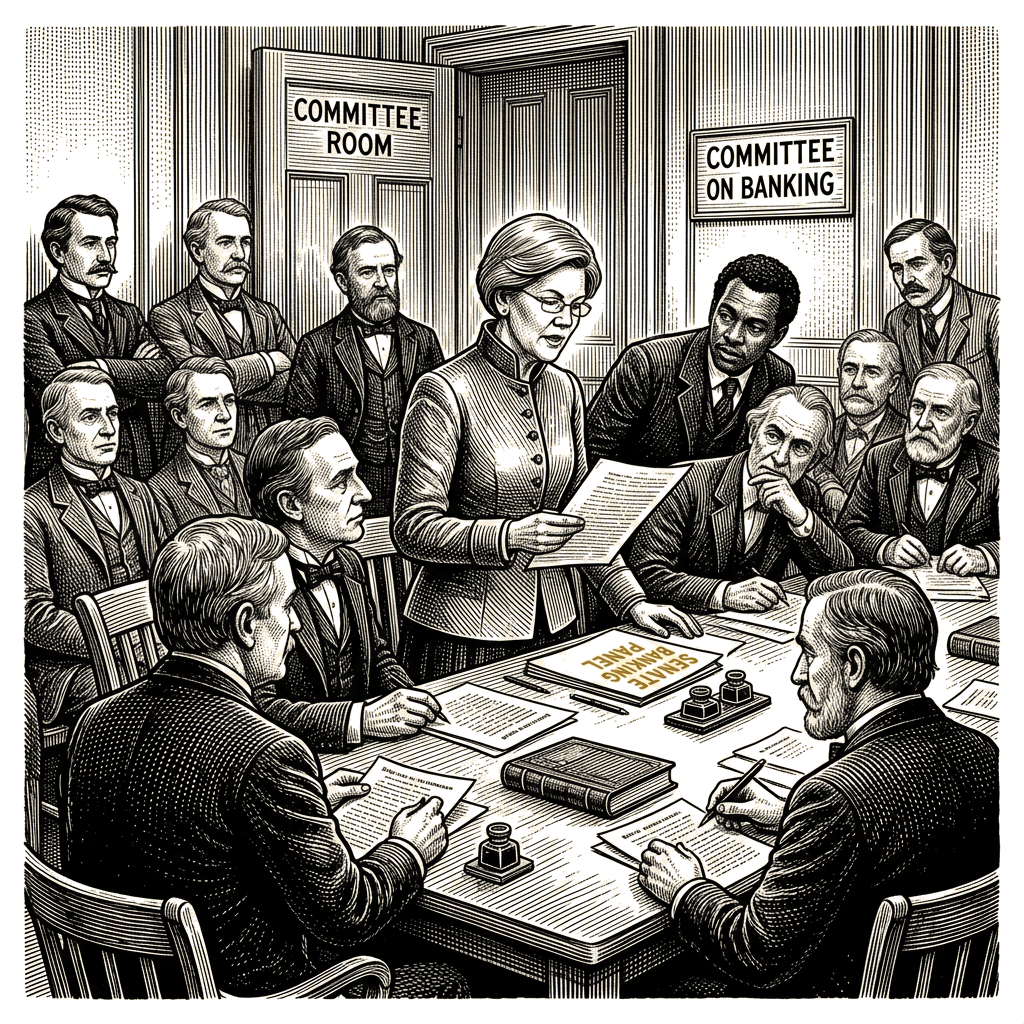
The S&P 500 fell 4.4 percent on Thursday because somebody might finally count what has been carried out the door — and a market that panics at the prospect of an audit has confessed, in the only language it respects, what its prices were carrying. The trigger, per Corrie Driebusch’s report in The Wall Street Journal: Senator Elizabeth Warren is expected, though not yet certain, to take the chairman’s gavel at the Senate Banking Committee — a chair that is hers by seniority, banking lobbyists murmuring that Sherrod Brown might reclaim the seat he lost and just as quickly letting the thought go, nobody expecting him to try — and with it the power of subpoena, aimed at the private-equity industry through her Stop Wall Street Looting Act, at the insider-trading claims around the prediction markets, and at what the cryptocurrency platforms do to the people who bank with them. JPMorgan Chase and Goldman Sachs each gave up more than four percent on the day. The White House promised resistance to “sham investigations and radical left policies,” and the market’s friends have decided to call the whole thing a nightmare. A four percent fall on the rumor that somebody intends to read the books is not a market pricing a policy. It is a market pricing what it has been taking. I will come to the gavel in its turn. The confession comes first.
I traded agricultural futures in Chicago for a living — the corn before it was planted, the hogs before they farrowed, paper on the very corn and cattle my county grows with its hands — so let me tell you what moves a tape like that. Not a burned elevator, not a failed harvest. Nobody sells four percent of the economy over a policy paper; the desk reprices risk, and the risk in this headline was discovery. A chairman’s letter is cheap. Warren’s staff has spent two years writing hundreds of them, demanding answers to thousands of questions, and the word passed among the lobbied is that anyone who got a letter should be on high alert — her people had already spent October sketching the committee’s pursuit list for allies before a single vote was counted. But a subpoena is not a letter. It compiles a record under oath. Traders do not fear a gavel; they fear a compelled record, because a record can be read aloud, entered into evidence, and shorted against. The old price assumed no such record would ever exist. That assumption was the scandal. The fear is merely its quotation. The price of impunity moved — and it ran past the banks, because the same beam carries the newest premium on the tape and the oldest license beneath it. The artificial-intelligence boom is priced on the assumption that nobody would ever count, resting on the same timber as the stripped companies; Thursday the beam moved under both. Nothing has been proved against anyone. The price did not wait for proof. Prices never do.
Now the honest case, because the critics have one and it deserves its hearing. Not everyone above the pit rail is a looter — I know, because I worked there; the machine I served also moved real grain, hedged real harvests, financed real expansion, and the men beside me were mostly neither monsters nor thieves. Subpoena power is a lamp and a bludgeon, and a chairman who enjoys the fight can let the bludgeon become the whole tool. Warren has already reached past her remit — a petition to slow SpaceX’s record stock offering, questions put to Anthropic about the fate of the species — and a man who has watched committees for a while can be forgiven for asking where the letters stop. Her interest in capping credit-card interest carries a cost she names only sometimes: put a ceiling under a rate and the marginal borrower does not get cheaper credit; he gets no credit, or he gets the storefront lender whose rates never had to pass a hearing. Brian Gardner at Stifel expects her to pick her battles and not to be seen as simply anti-bank, and that is the right hope, because some oversight curdles into theater, and two years of hearings can produce a mountain of headlines and not one restored job. Former Senator Pat Toomey, who once held the committee’s Republican seat, told the Journal it is “hard to imagine it’s good news for these industries,” and warned against bipartisan agreement that might produce “very anti-free market legislation” — and a chairman with subpoena power can do real damage by accident. Scrutiny proportioned to wrongdoing is stewardship. Scrutiny proportioned to headlines is theater, and theater burns honest businesses down along with the guilty. A committee with a grudge can be as dangerous as a monopoly with a market. Conservatism used to know that; it is half the reason we distrust the concentrated state. Grant all of it. Then say what Thursday actually proved: confidence in a market that has quietly priced in a license to take is not virtue. It is complicity at a discount. A market’s terror at questions is not a defense of markets. It is an admission that the questions have answers.
Now the part that ought to keep a self-described conservative awake. Edmund Burke called society “a partnership between those who are living, those who are dead, and those who are to be born.” The leveraged buyout is a partnership between the living and the exit. For forty years the movement campaigned as the party of Main Street — local control, the little platoon, the family farm, the church basement — and at every moment of the carrying-out it stood with the carriers. A fund buys the nursing home with the nursing home’s own borrowed money, takes its fees off the top, sells the real estate out from under the beds, leaves the debt in the corporation it gutted, and moves on; when the home fails, the failure is presented as an act of God. The hospital, the hospice, the local paper, the corner vet clinic — each folded into a spreadsheet held by owners who will never set foot in the towns that depended on them, each estate billed for the privilege of the stripping — and all of it called freedom. When Warren introduced her private-equity bill in October she called these takeovers “legal looting that make a handful of Wall Street executives very rich while costing thousands of people their jobs,” and the words are exact — legal, because the rules were bought; looting, because there is no honest other name for carrying off the substance of an institution generations built and leaving the shell for the town. The word is hers. The thing is older than her bill. My tradition had names for it before there were committees to investigate it — avarice, usury, the sin Leo XIII condemned in 1891 when he taught that profit gathered out of another’s need is theft wearing the face of contract. And the checks were signed by the party of family, faith, and local control. A movement that called itself conservative while the trust was looted owes an answer older than any chairman: Conserve what, exactly?
The ledger where I keep my grief is not abstract. Adams was built as a division point on the Chicago & North Western — crew changes, a roundhouse, union paychecks that raised half the town — and the last Twin Cities 400 went through in July of 1963; no scheduled train has stopped here since. The paper mill upriver at Wisconsin Rapids ran from 1904 until midsummer of 2020, when it idled and took nearly a thousand paychecks with it. The license rolls the state itself keeps tell the dairy count plainly: some seventeen thousand licensed farms in 2002, fewer than seven thousand by 2022, and every barn that goes dark takes a name off a church council and a child out of a schoolroom. The irrigated sand around us now grows potatoes for the snack-food giants on a handful of operations farming tens of thousands of acres across five counties, where family dairies used to stand one to a quarter section. The VFW hall where I drank bad coffee with the men of the old wars has thinned to a funeral roster. The Diocese has consolidated its rural parishes year by year — the frame church this county was built around went up in 1884 — and nearly half the houses in the county now sit empty most of the year, held for somebody else’s summer. The golf resort on the old barrens brought hundreds of real jobs, and I will not pretend otherwise; most of them are service jobs, performed by our own children, for people visiting a place they will never have to save. Labor-force participation here sits among the lowest of Wisconsin’s seventy-two counties. None of this was done by a man in a black hat. It was done by balance sheets that treated a community as inventory. That is what forty years of calling extraction freedom built.
And notice where the panic and the populism touch. The same report notes that Warren passed a housing bill this year with Senator Tim Scott, took a phone call from President Trump about capping credit-card rates, found common ground with him on de-banking, and sits with Treasury Secretary Scott Bessent on raising the deposit-insurance limit. My side will call that opportunism. It is not. Usury, the price of money, the right of a small account to exist — these are the oldest producer grievances the American tradition has, older than either party’s platform. Andrew Jackson vetoed the Second Bank of the United States and won a landslide on it; he fought a national bank over less. The distrust of concentrated finance was a country distrust before it was a capital one — built by people who had sold grain across someone else’s scale and borrowed at a bank that knew their grandmother — and it was conservative long before it had a partisan address. The movement dropped these grievances somewhere across the past forty years, but grievances do not die when a party drops them. They cross the aisle looking for a carrier. A creed that is abandoned changes hands. It does not change its nature. What the money calls a nightmare, the towns have been living as an economy.
Do not mistake me, then, for a man cheering a gavel. A subpoena is not ownership, and oversight is not restoration. Pius XI taught the principle in 1931: that it is a grave disorder to take from the smaller community what the smaller community can do for itself — and that principle cuts against every concentration, including the concentration of investigative power. The subpoena list already has its celebrity episodes — the crypto money tangled with the President’s orbit, chased from both ends of the Capitol by Richard Blumenthal’s Permanent Subcommittee on Investigations and by Maxine Waters, front-runner for the House Financial Services panel, and the bill Warren co-sponsored with Representative Garcia last month to compel probes of the financial firms entangled with Jeffrey Epstein. Corruption in high office is a public matter; hiding it is its own crime; the record should see light. But watch the temptation too: the drift from the machine to the men, from private equity as a system to a season’s episodes about named villains. A politics that ends at indictments leaves the machine intact when the men change, and the machine — the debt-loaded buyout, the fee stack, the stripped real estate — is what emptied the towns. Toomey’s phrase deserves its plain answer. A market is free when the customer can walk away. Tell me how a family walks away from the one nursing home in the county, the one hospital within an hour’s drive, the one local paper left to notice what the county government does, the one buyer of the milk. Tell me what freedom prices when every door out is a door into worse. A fund that owns a hundred firms across forty states is its own central planner, and a poorer one than any bureau, because at least a bureau can be voted at and a fund cannot; Hayek’s argument against the planners cuts through his own heirs like a scythe. Brandeis named the curse of bigness, and he did not mean that big firms are inefficient, though they mostly are; he meant that scale itself concentrates command over other people’s lives. And he said it plainly: “We may have democracy, or we may have wealth concentrated in the hands of a few, but we cannot have both.” He did not add: unless the concentration is investigated thoroughly. Chesterton located the trouble not in too much capitalism but in too few capitalists; a movement that spent four decades defending the most concentrated private power in the history of the species did not conserve the free market. It auctioned the word. Naming the theft and reversing it are different offices. One belongs to the committee. The other belongs to us.
Which brings the column where the panic hopes it will never go: to what gets built. The answer to the looter was never the bureau, whatever the fundraising emails say, and it was never a hearing either. In 1922, Congress passed Capper-Volstead so that farmers who pooled to bargain against concentrated buyers could not be prosecuted as a cartel. In 1936, the Rural Electrification Act financed member-owned cooperatives to do what neither the market nor the state alone would do — when roughly one farm in ten had electric light, and by midcentury the great majority did, most of them wired by co-ops the farmers owned themselves. That machinery did not die. It is headquartered down the street: the Adams-Columbia Electric Cooperative, here in Friendship, the same village as my co-op’s offices — more than thirty thousand member-owners across a dozen counties, the largest rural electric co-op in Wisconsin, governed by a board those members elect and can un-elect. Land O’Lakes moves more than sixteen billion dollars of member product in a year. Organic Valley, down in La Farge, binds more than sixteen hundred organic family farms into one bargaining voice none of them could have faced the world alone. Mondragon, in the Basque country, runs on some seventy thousand workers at a pay spread of roughly five to one from floor to president. Credit unions chartered under the 1934 act and the old mutual insurers hold the savings and the fires and the funerals of people whose names no shareholder has ever learned. Capper-Volstead, the co-op law, the credit-union charter, the mutual: an entire legal architecture of distributed ownership, written by men who had watched what concentration does to a county and declined to wait for a hearing. I will not romanticize the form, because I keep its books. A cooperative grows at the speed of an annual meeting. Nobody exits at a multiple. One member, one vote means the man farming three hundred irrigated acres carries the same ballot as the widow with forty, and the lean years are lean for everyone; co-ops fail and drift and ossify like anything built by human hands, and a big one can bleed a season of red ink like any corporation. A leveraged fund can take a town’s business in ninety days; a co-op takes a generation and then holds it. That slowness is not the defect. It is the deed. Nor is this property for its own sake — the earth was given for all, and title is stewardship under that older claim — but property widely held is the one leash on the rentier no committee can shorten. That is why it centralizes nothing, and that is why it answers: to the people it serves, at the scale it serves them, with lights that come on because the people reading by them hold the shares. Nobody hands you a co-op. It is built at a counter, one signature at a time, member by member, and it took a statute and a movement to give it room to live.
The market priced its fear honestly enough on Thursday, and Warren wrote the stakes herself in Time: “Democrats won this election by claiming we are on the side of working people, and working people are counting on us to deliver.” The counting is real; this county counted on the mill, too. I expect nothing from Washington but paperwork, and I have stopped expecting the towns back by Tuesday. Oakeshott said the conservative prefers the familiar to the unknown, the actual to the possible, present laughter to utopian bliss. We have very little laughter banked around here, but we know what the actual is: a town that owns itself — its wire, its grain, its savings, its newspaper, its beds for the old — and answers to the people who live in it. A share price that carries a license to take must sell at a loss the day the license is questioned; the co-op down the street carries no such license and never did, and its books will not tumble on anybody’s news. They were priced honest from the beginning, by people who meant the town to keep its life. So let Wall Street keep its nightmare; a gavel cannot sign a deed for a county, and I would tell Senator Warren that plainly if she asked: the subpoena opens a ledger; only ownership keeps a mill. Let the committee have its subpoenas. We have work of our own. The oversight can name what was carried out the door. Only ownership carries it back. Leave the town its life. Everything else was rented.