
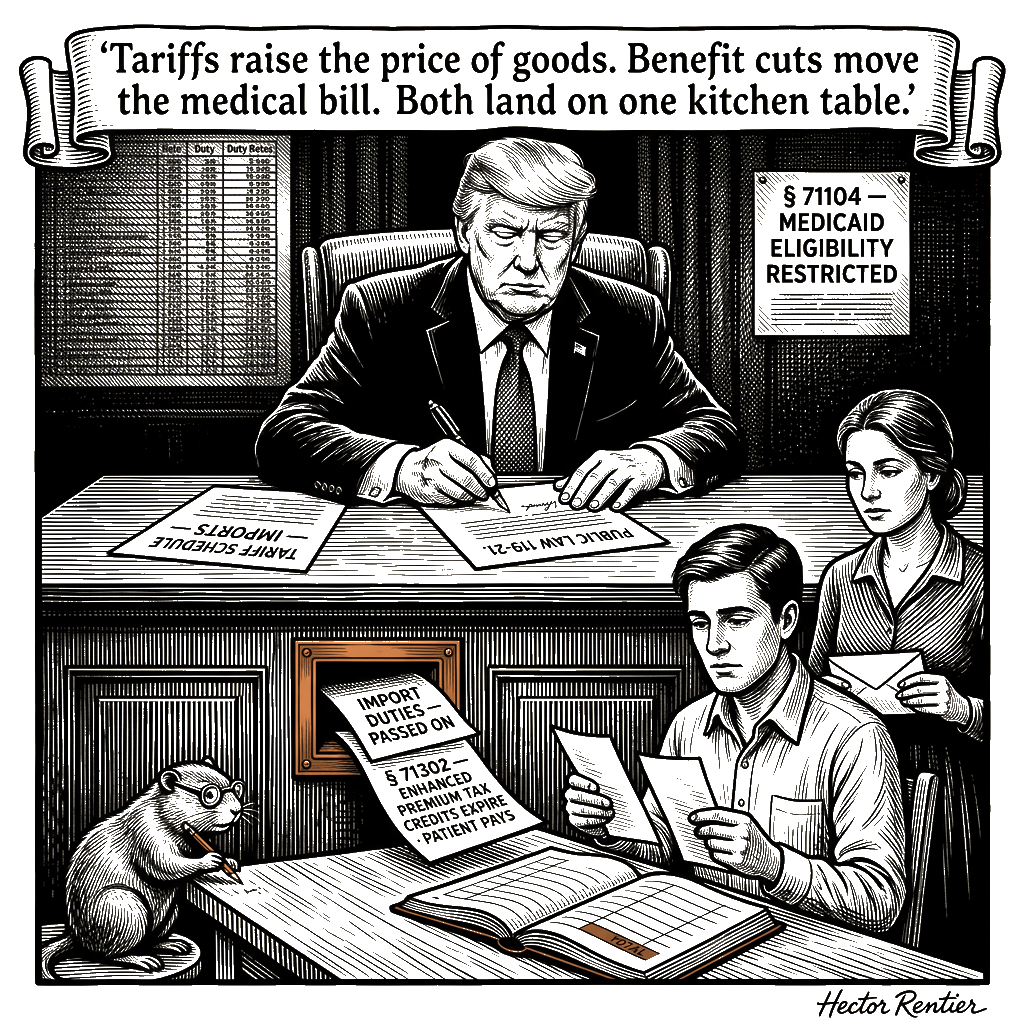
Trump and Senate Republicans are robbing working families through tariffs and benefit cuts.
Tom Green is what the index leaves out. The 29-year-old Columbus software engineer was laid off seven months ago from an $89,000-a-year software-engineering job at a bank. He sent 500 résumés, received 12 interviews, pays cash for his medication without health-care coverage, and has put his home-buying plans on hold. None of that proves monetary policy caused his layoff or interview drought. It shows the difference between an average and a household ledger.
Here are the numbers. The Bureau of Labor Statistics reported that the consumer-price index was 3.7 percent higher over the 12 months ended in September (Consumer Price Index—September 2026, released October 13, 2026, Table A, p. 1).
The October employment report put average hourly earnings of all employees 3.1 percent above a year earlier and payroll employment up by an average of 137,000 a month over the prior three months (Employment Situation—October 2026, released November 6, 2026, release summary p. 1 and Table B-1, p. 6). Prices outran average earnings by six-tenths of a percentage point. The gap between what workers earned and what households paid was already measurable. Low unemployment is not false. It is simply not an affordability report. That gap is the part that reaches the checkout counter, the rent ledger, and the pharmacy bill.
The Wall Street Journal’s November 9 report identifies three drivers: gasoline inflated by the Iran war, Trump’s tariffs, and AI-related price spikes. War and tariffs are supply shocks—increases in costs or shortages. The AI line is separate: the report does not specify whether the pressure came from electricity demand, data-center capacity, or equipment costs. Trump’s global tariff war taxes imports and has contributed to consumer-price increases; his attack on Iran has pushed energy prices higher. Incidence varies by product, so the record should not say every household paid the same percentage. It should say what the policy does: put a tax on imported goods and add to the prices of goods that pass through the tariff. Aggregate extraction does not require an equal burden on every household. Tariffs and benefit cuts are not footnotes about who receives what. They are the transfer mechanism.
The 2025 law attacked the other side of the household ledger. Public Law 119-21, the One Big Beautiful Bill Act of July 4, 2025, restricted Medicaid eligibility for certain adults initially eligible through the Affordable Care Act’s Medicaid expansion in § 71104. Section 71302 set the enhanced Affordable Care Act premium-tax-credit benefits to expire after 2025. Those are not the same subsidy: one narrows who can remain covered; the other ends enhanced help with insurance premiums and leaves households facing the bill. These changes land as costs on households already absorbing higher prices. Together, the statute and the tariff war moved payment from household budgets through lower coverage, smaller premium support, and higher import prices.
The Federal Reserve is extracting homebuyers’ wealth to fight inflation manufactured by tariffs and war. It can help keep future prices from accelerating. Its instruments cannot produce another barrel of oil, repeal a tariff, or make electricity cheaper. The Federal Open Market Committee’s September 2026 statement and minutes record a quarter-point increase in the target range for overnight lending between banks: 25 basis points, or one-quarter percentage point. Borrowing costs moved higher. The report put mortgage rates around 7 percent. The extraction line is the policy-rate path, not a claim that every mortgage repriced that day. A fixed-rate loan already written kept its terms. Mortgage rates also reflect expected future short rates and the premium for lending long. New borrowers, future loans whose rates reset, and prospective buyers met the higher cost of credit. This is not a forecast. It is the cost already embedded in financing a home.
The tariff raises the price of goods. The benefit cut changes who bears the medical bill. The rate increase raises the price of credit. Three bills. One household ledger.
The permitting vehicle moving through Congress is where policy finally attacks the bottleneck rather than the symptom. The Senate deal is worth passing. More energy and infrastructure supply can ease prices; that is the mechanism in the Senate permitting overhaul. A permit authorizes a project. A tariff changes its landed price. A benefit cut changes who bears the loss. Permitting does not repair the other two mechanisms, and it should not be asked to perform their work. A permit takes longer than a price hike. That is not a defect. It is the point.
Michigan Gov.-elect Jocelyn Benson plans a $5,000 tax credit for caregivers, broader medical-debt relief, a prescription-drug affordability board with authority to approve price increases, and a $60,000 minimum starting salary for teachers. Ohio Gov.-elect Amy Acton has promised medical-debt forgiveness and family tax breaks. Sen. Sherrod Brown wants to cap utility-rate increases and control prescription-drug prices. Each can reduce a specified household bill.
A tax credit can pay a bill. It does not by itself lower the market price of electricity, medicine, or credit. A promise with neither a stated way to pay for it nor an independent estimate of its cost has no budget path. The post-election federal menu includes repeal of Trump’s tariffs, restoration of Medicaid and Affordable Care Act subsidies, a higher minimum wage, easier union formation, and family tax credits. The post-election grocery-price agenda needs supply and recurring revenue, not another stack of household promises.
An agenda is not a plan. Democrats have won 54 Senate seats, with votes still being tabulated in two other races. Most bills require 60 votes to overcome the Senate filibuster, which lets a minority block passage, and President Trump can veto legislation. Permitting found Republican votes. The federal affordability agenda has a 60-vote problem. The constraints are not a governing program.
The program is plain: repeal Trump’s tariffs, end the Iran war, make permitting produce actual energy and infrastructure, restore Medicaid eligibility and the enhanced Affordable Care Act premium-tax credits, and finance permanent restorations with recurring revenue from named tax-expenditure repeals—revenue losses written into the tax code as exclusions, deductions, or preferential rates. Permanent changes must be scored against the current-law baseline required by section 257 of the Balanced Budget and Emergency Deficit Control Act of 1985 (2 U.S.C. § 661(e))—the statutory convention that assumes scheduled expirations occur—and the author of the bill does not get to grade it. Monetary policy can restrain demand when demand is the problem; it cannot supply oil, repeal a tariff, or produce power.
The September rate decision and Trump’s tariff schedule are the receipts. The Federal Reserve extracted homebuyers’ wealth by raising the price of credit; the tariff schedule extracted household purchasing power by raising the price of imports. The household ledger is where both bills arrive.
That is how Trump and Senate Republicans robbed families. The robbery is the robbery.