
Oil producers outside the Hormuz blockade robbed working families of war premiums.
At my bench in Adams County, a fuel-price shock is not a curve on a chart. I keep a Honda EU2200i in the shop for outages, because the power goes out here often enough to matter and the one time I did not keep it fueled, I lost a freezer of food and a neighbor’s milk along with my own. I filled it at the co-op in Friendship last week, and the price per gallon had gone up on me since March.
A war can close a strait half a world away, and the bill still reaches a one-man shop on forty acres outside Friendship. Diesel moves grain and firewood and pulls the brush hog in the Kubota. Gas goes in the Silverado. Propane heats the house and the shop. None of that got cheaper because the war closed the Strait of Hormuz.
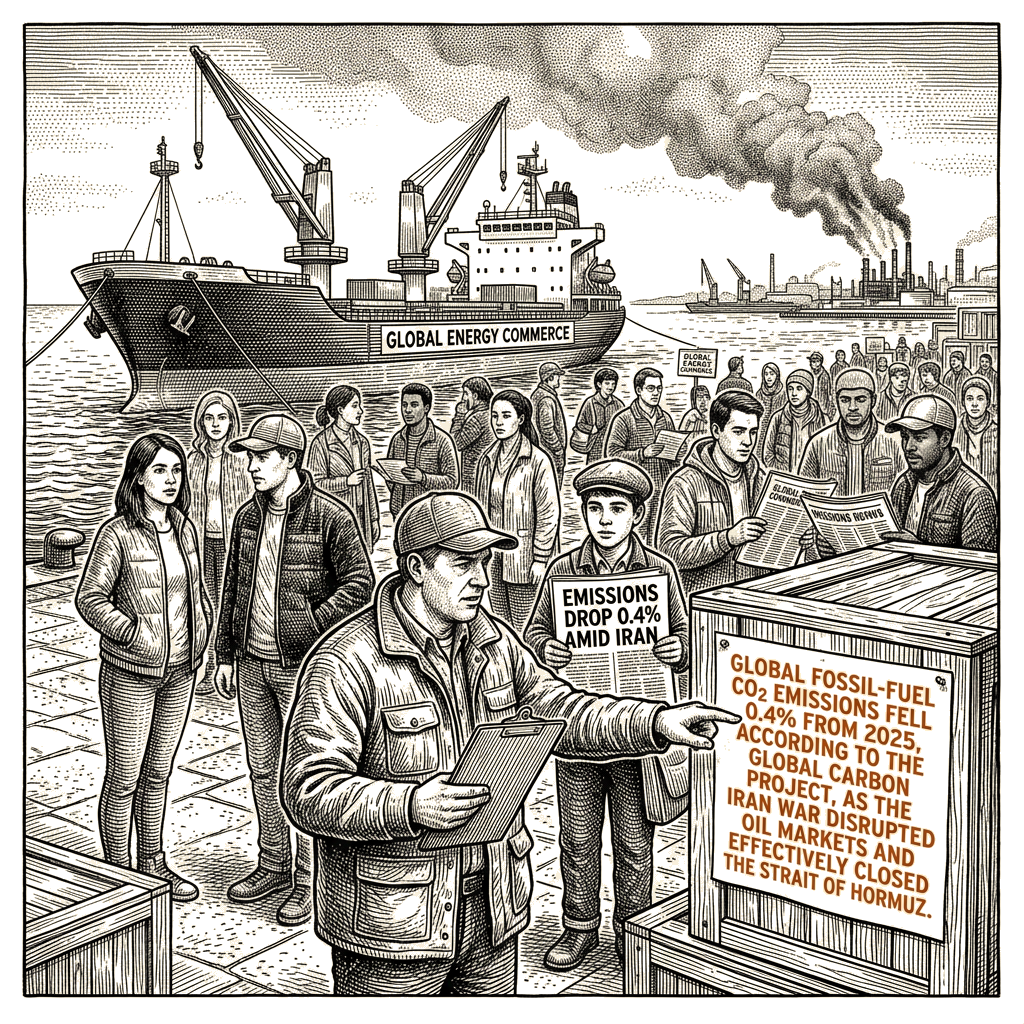
The scientists at the Global Carbon Project put out their annual estimate this week — more than 140 of them, working from data collected around the world, publishing in Earth System Science Data Discussions ahead of the United Nations climate talks in Antalya, Turkey. Their number: fossil-fuel carbon dioxide emissions of 42.2 billion tons (38.2 billion metric tons) for 2026, down 0.4 percent from 2025. A lot of people are going to write about that down arrow. Total global carbon dioxide emissions went up 1 percent.
Glen Peters, a scientist at the CICERO Center for International Climate Research in Norway and a co-author of the study, is not going to let anybody enjoy the number. “It’s downwards which sounds good, but this is largely driven by the war in Iran, what’s happened in the Strait of Hormuz,” Peters said. “So in a way, a little bit of good news, but for the wrong reasons.”
You can see the shock in the fuel mix, and it does not look like decarbonization. Oil emissions dropped nearly 2 percent. Natural gas fell 0.3 percent. Coal emissions rose 0.6 percent. When the price of oil jumps, the fuel at the margin changes. It does not change because anybody decided to stop burning. We wrote about this same war-and-emissions arithmetic in October, when the war’s cut to global emissions looked like the start of a clean-energy shift. The new numbers put the energy shift on the smaller side of the ledger and the price shock on the larger one.
That is not a climate victory. It is demand destruction by force. A family that cannot afford fuel cannot drive to work. A farmer hauling grain cannot simply pass the full increase to the buyer. A repair shop cannot run a generator without paying what petroleum costs. The world did not choose a cleaner system. It was charged a higher price for the old one.
Price rationing is not technical substitution. A household that burns less oil because it cannot pay has not bought a different furnace or truck. It has used less and paid more. A clean transition changes the equipment and the infrastructure. War scarcity destroys demand without building a replacement.
The study puts China, the United States, Europe and Japan down about 1 percent each, and it credits all four drops to the oil shock. A synchronized oil shock can make the biggest emitters’ numbers fall without making the planet safer. India’s fossil-fuel pollution rose 4.4 percent, and the study does not credit that to the war. Put the two lines side by side and the finding stops measuring virtue and starts measuring price. The strait set the price, and the price set the fuel mix. Whatever any national energy policy had to say about it, the decision was made at Hormuz.
Here is the bill on my side of the ledger. The oil business did not have to do a thing to collect on this. The strait shut and the premium arrived anyway. The households paying it did not set the price and cannot opt out of it. Diesel is the first number I check, and now it says wait. You can defer a repair. You cannot defer a planting season. Europe got the same warning in June, when the OECD said a prolonged Hormuz shock could slam global growth, jobs and prices.
And here is the part that ought to settle what the down arrow is worth. Malte Mienshausen, a climate science and policy expert at the University of Melbourne, says the oil-producing nations and companies the blockade did not touch reaped “tremendous windfall gains.” Those gains are the private side of the public sacrifice. The rise at the pump, the diesel bill, and the shipping rate is a transfer from buyers to sellers. The market records the producer’s windfall. It does not carry the household’s loss. And the banked money is already doing one specific thing: it boosts the search for oil outside the Middle East, which will dampen the short-term emissions effect of the war. The dip did not retire the oil industry. It put more money behind the next search. That is not bad luck. That is what a machine does when it gets paid, and it got paid this year, in the year the world was supposed to have turned a corner.
This would be the third drop in global fossil-fuel carbon dioxide emissions this century, after 2009 and 2020 — the recession and the pandemic. Both times, people hoped the recovery would carry the clean-energy shift along with it. Peters’s summary of what actually happened is worth keeping: “at the end of the day, we seem to go back to where we were before.” None is governance. None says humanity built a cleaner economy. A dip is not a policy. A dip is an interruption, and the last two interruptions ended with the barrels burning again.
The honest number for 2026 is the one that went up. Total carbon dioxide rose 1 percent, because land-use change — deforestation and human-caused peat fires — increased faster than fossil burning fell. The half of the ledger nobody watches from a gas station got worse this year. The half everybody got a headline for got slightly better, for a bad reason. Put the fossil number per second and it comes to about 1,335 tons (1,211 metric tons) of carbon dioxide, every second, on top of the land-use emissions that pushed the global total up.
Ald Leopold wrote about this country — the sand counties, the marsh, the drained ground. In “Thinking Like a Mountain” he wrote that “Conservation is a state of harmony between men and land.” The land is not scenery behind the tailpipe, and it is not a backdrop to the price at the pump. Land-use change is the phrase the study uses, and it means trees cut and peat burned. In the Town of Rome they organized the Leola drainage district in 1901 and dug forty miles of ditches through fifteen thousand acres of peat, and the peat they exposed smoldered in the ditch banks so deep it took the sand with it, week after week. That is not neutral ground waiting on a decision. It is already in the total. So are the acres my grandfather cleared behind my shop.
Here is the mechanism. Governments get to tell their own energy stories. The drillers get to decide where the next wells go, and the households get charged for the fuel either way. The study is the evidence: the 2026 drop came from a war and a price shock, not from any nation’s policy, and the money that came out of it is already going looking for oil outside the Middle East. Wendell Berry took apart this way of thinking in The Unsettling of America, where he put Earl Butz’s USDA command — “Get big or get out” — on the record as a national policy of extraction. The extractive mind does not care where the barrels come from. It cares about scale, and a war premium is scale, banked.
The part of this that is not a war is also the part worth betting on. Niklas Höhne, who co-founded the NewClimate Institute in Germany, says “permanent shifts are happening,” especially the switch to electric cars and trucks, especially in Asia, and he thinks the global peak in carbon emissions is near or has already arrived. Mohamed Adow, who directs Power Shift Africa, makes the bigger case for China. He calls it the world’s first major electrostate, built at extraordinary speed and scale in solar, wind, electric vehicles and the infrastructure to carry them. “This isn’t a temporary response to an oil crisis,” Adow said. That is a physical change, not a price interruption.
The rural answer is member ownership, not another price shock. What that would look like in this county is a short list: member-owned generation and storage, electric trucks and tractors a mechanic can service, and a grid owned cooperatively, the model Adams-Columbia Electric Cooperative still embodies, that extended power across rural Wisconsin after the 1936 law.
The Inflation Reduction Act put nearly ten billion dollars behind rural electric cooperatives for clean generation. The war premium did not come out of that pile. It came out of the pump. A member-owned cooperative gives its customers a voice in the rate. A customer at a fuel pump has a price.
Twelve years now I have written the ice-out date for Petenwell in the same notebook where I keep the first mosquito of the year and the syrup season. The average ice-out date on Petenwell has moved about eleven days earlier over the twelve years I have written it down. It did not move because of the price of oil. Whatever the war does to the barrel over the next six months, it did not do the ice. And while I am the one saying all this: I drive a Silverado built by a company I have spent years criticizing, and my health insurance comes through Sara’s job with the school district because the coverage for a one-man shop was unaffordable last year. The premium went up for everybody in this county, including me.
From the shop door I can see the forty acres my grandfather cleared, the pines he planted, and the two children who will be grown before the co-op has another turn. In twenty years I want Mike to remember that his county had a well worth protecting, a grid worth keeping, and a shop that fixed what people owned. That is not nostalgia. It is a list of things I have watched priced out of this county one dollar at a time. Our children should not inherit that bill.
I am not waiting on a legislature in Washington to hand us a victory. I am waiting for the day the co-op pump is not the only way this county gets through a winter. Until then the arithmetic stays the arithmetic: the strait sets the price, the household pays it, and the producers outside the blockade bank the premium.