
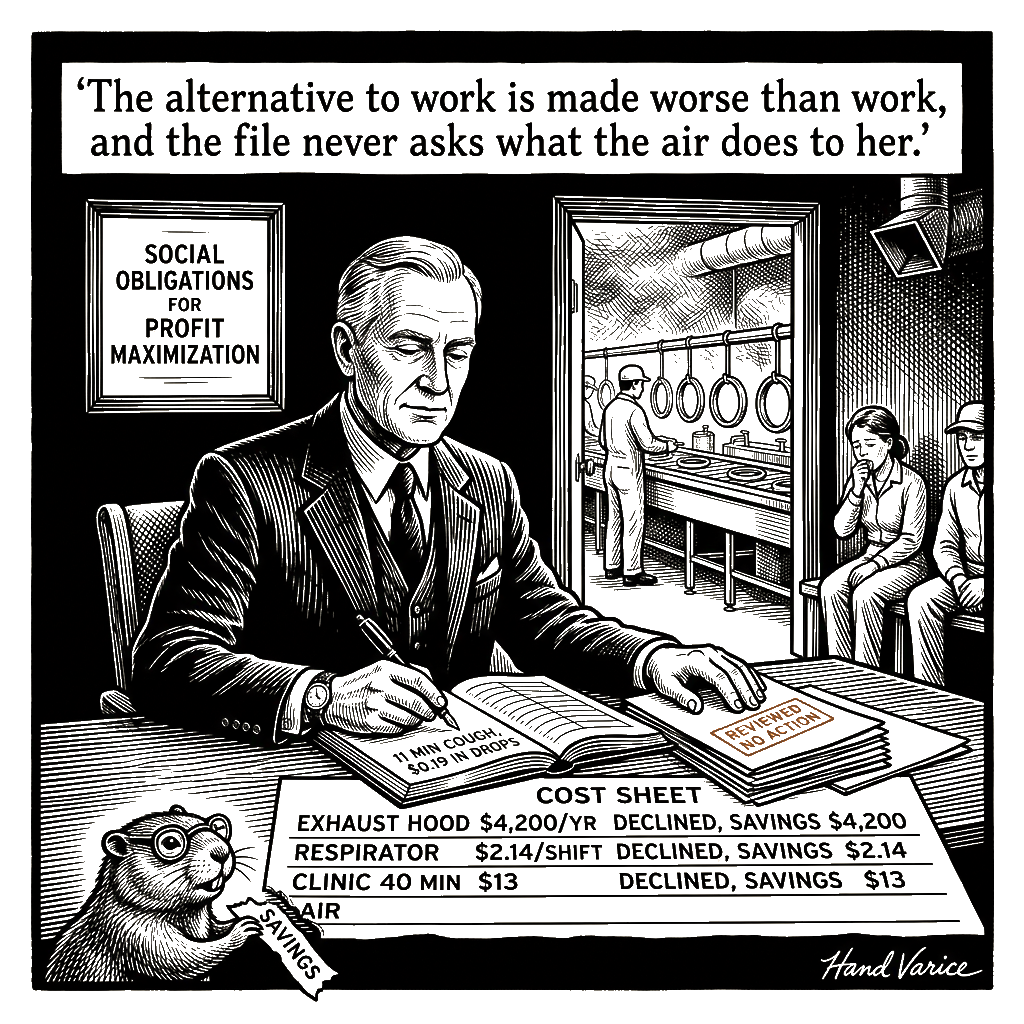
The English workhouse of 1834 made relief worse than the lowest-paid independent job. I updated the method: make the alternative to work worse than work. At my plating shop outside Warren, Ohio, Oona’s file says maintenance line. On Thursday she coughed 11 minutes, and I sent her back. The Wall Street Journal’s Editorial Board wrote in Politics Shakes Up the Markets that tech stocks lost 10% from their early-October peak and the Nasdaq shed some $2.5 trillion as investors sorted AI winners from losers and political risk. I agree with the Board’s warning: political uncertainty can travel from a ballot into a balance sheet. You buy the chrome ring inside your faucet; I keep the $0.0014 that pays for the missing exhaust hood. God blesses the wage that brings a body back to work.
Pullman put the same hierarchy in company stores and company housing. We use chrome, an exhaust hood, and a personnel file. The materials change. The command does not. The precedent has a verse:
“Slaves, obey your masters with all respect, not only to the good and gentle but also to the harsh.”
— 1 Peter 2:18 (English Standard Version)
The verse gives the harsh master no exception. It gives the worker obedience. That is the precedent I inherited.
Here is the useful part, and I offer it for your own good: don’t waste time wondering whether I am unusually wicked. The ventilation decision is in Social Obligations for Profit Maximization, the textbook I wrote and taught for 30 years as Dean of Instruction at Warden University’s College of Business and Economics. My graduates now staff the offices that set your wage, and they have already priced the job you are afraid of losing. I’ve taught them well. A curriculum does not need its author in the room.
Read the personnel file with me. The local exhaust hood appears at $4,200 a year. The annual output appears at 3,000,000 rings. The file then records the saving from refusing it: $0.0014 a ring. The file does not ask what the air does to Oona. It asks what I declined to spend.
The form calls the air the workplace atmosphere. That label lets me discuss a chemical without discussing the woman breathing it. Hexavalent chromium is what Oona breathes. A respirator would cost $2.14 a shift. The nearest occupational-health clinic is 40 minutes away, and a visit would cost $13 in lost production time. Her 11-minute cough cost $0.19 in drops.
I bought drops.
She returned to the rinse station. The line kept running.
Across Georgia, the same subtraction takes the form of concrete dust. Tobias cuts pavers at the plant I own outside Macon, Georgia. He runs the saw dry because the respirator and water line cost $4.48 a day. Fine white dust follows his breathing. Repeated exposure can leave him with silicosis. The pavers on your walk came from that saw. You may add $4.48 to the paver. Tobias is the cheaper place to put it.
Oona’s take-home is down 11% since April, and she bought 1 fewer ring at the outlet in town last month. When the replacement starts, the woman at the gate will take her file, and the line will run at 94% of March. The margin improves 1.4 points over January. I haven’t modeled the county’s demand for new faucets. The correction is proceeding.
Oona will cough before Thursday’s shift ends. I will enter the cough as lost production. The line will hold.
Sterling A. Varice holds the Hayek-Friedman Chair and serves as Dean of Instruction at Warden University’s College of Business and Economics in Richmond, Virginia. He is the author of three textbooks: Divine Mandates for Labor Utilization, Social Obligations for Profit Maximization, and Calibrated Deprivation: A Manager’s Guide to Employee Motivation.