Donald Trump abandoned the climate talks two years running. Monday night the shop stove was ticking and a carburetor off a Stihl 180 sat on the bench, and instead of starting on the carburetor I sat with the notebook open to the ice-out page. I have put a line in that notebook every spring for twelve years, off the same bend of shore below the house on Petenwell, the second-biggest lake in Wisconsin. The line for this spring sits eleven days earlier than the first winter on the list. That is not a feeling about the weather. That is a number in a book, under a shop light, in Adams County.
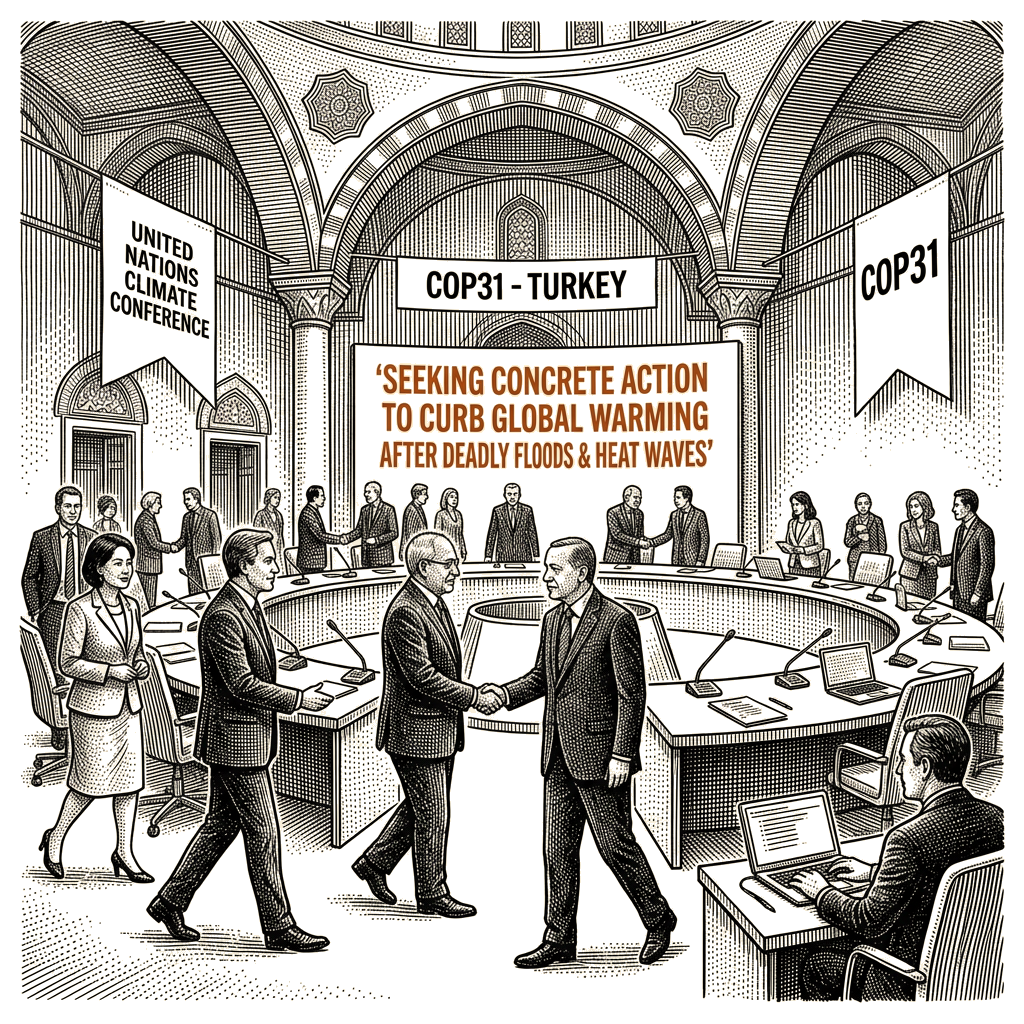
The other half of that number sits in a conference hall in Turkey. World leaders opened COP31 there Monday, after a year of deadly floods and heat waves, and the formal negotiations begin Wednesday. Australia leads the talks and Turkey hosts; the two governments share the presidency, and both are coal countries — Main Street flagged that arrangement when it settled, and the scrutiny has held up. Scientists outside the hall are urging an end to coal and gas approvals while the delegations gather. The chair where my country should be sitting stood empty in that hall, and the man who emptied it stayed home, calling the whole ledger a hoax.
Three years ago in Dubai the assembled governments agreed, in writing, to transition away from fossil fuels — the promise these talks reopened as their central issue. The two conferences since, in Azerbaijan and Brazil, produced little binding on reductions. Brazil’s compromise pledged money so vulnerable nations can adapt. Adaptation money matters. It is not reduction. One budget pays for damage already done; the other prevents the next round of it. John Kerry, who carried the climate portfolio for a prior administration and has sat through more of these sessions than almost anyone alive, put it flat: “We don’t need more promises, we need plans.”
Scientists say global warming is likely to exceed 1.5 degrees Celsius above the preindustrial line of the early 1800s — the goal Paris set in 2015 and every conference since has carried. The U.N. climate panel’s 2021 assessment measured the warming so far at about 1.1 degrees and called the human influence unequivocal. Here is what that number does when it lands on sand. Wisconsin’s own climate assessment, the university’s, run with the state DNR, has the state about three degrees Fahrenheit warmer than it was in 1950, taking seventeen percent more precipitation, and it logged 2010 through 2019 as the wettest decade on record. Lake Mendota keeps the longest ice record in North America, a ledger the university in Madison has written every winter since 1855, and its modern seasons run roughly twenty-nine days short of the mid-1800s. Six of its shortest ice seasons have come since 1980; the shortest of all was the twenty-one-day winter of 2001–02. The 1.5-degree target is not dying in a conference hall. It is dying in the ice.
Bill McKibben named the condition a while back in Eaarth: the question is no longer how to stop a changed planet, it is how to live on the one that already changed. The delegates’ number and the bench number ought to be checkable against each other, and in this county they check out. The rut this October came off two weeks late from where it sat when I was carrying my father’s spare rifle through the same hills. The first mosquitoes show in March some years now, where they used to wait for May. Wisconsin Watch reported our 2024 maple season started about three weeks earlier than typical, and the men I buy sap-line fittings from talk about boiling in February. None of that is a forecast. All of it is the present tense, twelve winters deep. The U.N. panel said the warming is human. The lake said the same thing last spring, in a different language.
Now the empty chair. The United States is the world’s second-largest polluter after China. An absence at that table is not a snub. It is arithmetic. Nobody can build a plan for a shared problem while its second-largest contributor refuses to sit down. And the boycott abroad matches the demolition at home. The hoax line is not just talk; it travels with the policy. The same administration that will not sign a plan in Turkey has stripped the rules limiting power-plant emissions and targeted the offshore wind projects. The absence in one room and the teardown in the other are a single act, seen through two doors.
The hoax talk deserves its own receipt, because it is not a belief. It is a product. Historians Naomi Oreskes and Erik Conway laid the paper trail out in Merchants of Doubt: the same small network of hired scientists and front organizations that spent decades keeping the cigarette question “open” — long after the industry knew the answer — was rehired, on fossil-fuel money, to keep this question “open” too. A leaked internal American Petroleum Institute memo from 1998 said the quiet part in writing: “Victory will be achieved when average citizens understand uncertainties in climate science.” Doubt was the product then. Doubt is the product now. A president reciting that script is not improvising.
Set the other side of the ledger down too. The government before this one signed the Paris paper with one hand and set oil-production records with the other — crude output averaging 12.9 million barrels a day in 2023, the highest ever pulled out of American ground; 13.2 million in 2024; a monthly record of 13.6 million last summer, by the Energy Information Administration’s tally; liquefied-gas export capacity tripling in five years; ConocoPhillips’s Willow project approved on the North Slope. A signature on a communiqué and a permit on a pipeline have traveled in the same briefcase before.
Those records landed under both parties. The party that calls the science a hoax skipped the table. The other party never left the table and never cut the tonnage. A country can boycott a conference and still ship the oil. What is different now is that the permit machine runs unopposed, and the chair is dark. If the measure is emissions — and the ice says the measure is emissions — the file reads the same from the far side of the room whether anyone sits in the chair or not.
Here is what the table in Turkey is actually deciding, from where I sit in Adams County. The weather is the county’s work calendar. Ice-out opens the walleye run and the resort season with it; the syrup run sets February. That is the schedule the delegates in Turkey are haggling over. The dates are already moving.
The war in Iran runs through this too. It pushed up the price of gasoline and oil, and with them the price of what oil becomes. On a farm county’s short list, that is fertilizer and pesticide. The report says the pressure is bending governments toward wind and solar. Good. But hear the other spin, because it arrives with the pump price: drill more, dig more, energy independence, and the bill fixes itself. That framing has a name — selective energy independence — and it does not survive the pump. Oil trades on a world market; a country can set production records and its farm counties still eat the spike, because diesel and anhydrous ammonia carry no flag.
Wendell Berry did the math in The Unsettling of America: industrial farming spends five to twelve fossil calories to put one food calorie on the table. When a barrel moves, a ton of nitrogen moves with it; the co-op invoice at spring planting moves with that; the margin on a corn field moves last and hardest. The delegates rethinking energy investment in Turkey this week are doing it under a war premium, and a county like mine is wired to the very commodity their talks are trying to retire. That is not abstraction. That is the parts counter. The fuel bill and the fertilizer bill are the same bill.
Kerry said plans. Here is what one looks like from a county the market forgot first. In 1936 the investor-owned utilities said wiring the farms was not worth the copper, so the Rural Electrification Act loaned the money at long terms to member-owned cooperatives instead, and by 1950 four farms in five had electric service. Adams-Columbia Electric Cooperative, the largest rural electric cooperative in Wisconsin, is headquartered right here in Friendship, and my shop light hangs on its line. The 2022 climate law built the same shape of thing for this century: the New ERA program, federal loans and grants to retire fossil debt at rural electric cooperatives and put clean generation on the line, picked Dairyland Power, the generation-and-transmission cooperative serving a stretch of this state. That is a plan — the same shape as the copper that lit this county the first time.
The argument against running the clean wire now — the loans for the co-ops, the transmission, the charging — is the same argument the utilities made about copper in 1936. The country overruled it once. It knows how. None of this leaves me clean; I burn the stuff too, the LP tank behind the shop, the Silverado with 187,000 miles on it, and every two-stroke I rebuild around here burns its share. The point is not purity. The point is that the alternative wire has not been run to most of this county yet. That is the plan Kerry is asking for, the only kind that ever worked here: sit down at the table, price the fire where it is lit, and run the wire.
Every January I reread A Sand County Almanac, because Aldo Leopold kept the sand counties’ ledger down the river in Sauk County the way I want to keep mine: a month, a place, an observation, and a reflection that has to survive the second reading. Next spring the ice will go off Petenwell, and I will write the date where it always goes — same shore, same pencil, likely with Mike along, the way I went along with my grandfather. That is the meeting that matters here: the lake reports, and I take the minutes. The notebook does not have a column for “hoax.” It has a date, and the date moves one direction. Mike and Quinn will get that notebook when I am done with it. What I cannot hand them is the chair this country left empty in Turkey. The ice keeps its own minutes, every spring, whether anybody attends or not. Somebody ought to be at the table when the world reads them. For the second year running, nobody was.