
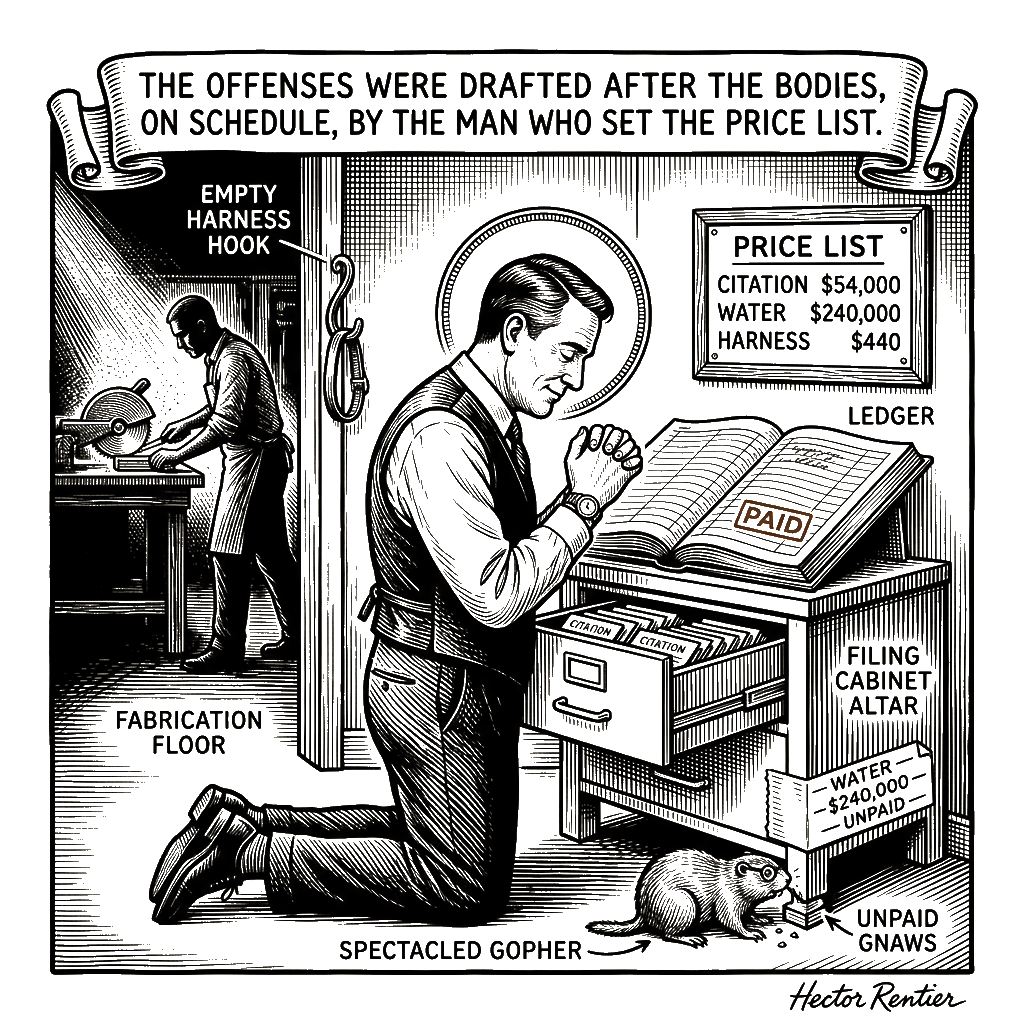
The offenses your committee will get around to naming, I committed years ago, on schedule, with the margin known to the penny. Curtis is a blank on the fabrication line I own outside McAlester, Oklahoma, and in 9 years I’ve never once paid for the water that would slow what the dry saws are doing to his lungs. A blank is the trade’s word for a slab before it’s cut. I extended it to the men, because both are stock that becomes product, and only one of us minds. The quartz dust off my blades is laying stone down inside his chest, gram by gram; he can’t take a flight of stairs in one breath anymore; the counter you’re leaning on came off that same saw. The air sampling that would put numbers on his chest runs $0.37 a counter. I’ve declined it every quarter since 2019. Some vessels are made for common use, and some crack under normal operating pressure. Curtis is both, and the island in your kitchen is neither.
James Freeman warns in A ‘Blank Template’ in the War on Business that the new Washington names its corporate targets first and drafts the offenses afterward, a dossier-driven war on business that will bill K Street by the hour and make nothing you need any cheaper. I agree with him about the sequence. The target does arrive before the offense, and I’ve been running that order for decades. The offense is always drafted by whoever arrives. He is only wrong about whose file it is. The template isn’t blank. I filled it in, and I’ve kept it current for 30 years. The committee can have my copy free. Disclosure costs less than discovery.
Here’s the inspection, since Mr. Freeman is alarmed about exactly the wrong invoice. In 2019 an inspector walked my floor and left with 9 serious citations, all one family: silica exposure, dry cutting, no engineered controls, no medical surveillance. There is no defense of that afternoon, and I’ve never needed one. There’s a spreadsheet.
Mark this.
The citations were $54,000.
The water was $240,000.
I paid the citations.
Read those 3 lines twice. The order is the lesson. The inspector watched Curtis cough and wrote down exposure, which is the polite word, and I prefer the polite word for the reason I prefer most of them: poisoning makes lenders leave the room. Then the state priced the writing, not the dust. A citation is a receipt for a hazard you intend to keep. I keep mine in a drawer. It’s the cheapest filing system I own.
You’re feeling something about Curtis, and you’ve slowed down, which tells me the feeling has weight. Feel it. Then divide it by 7,600, the number of counters this floor ships in a year. The feeling comes to less per unit than the $0.37 I already declined, which is the arithmetic that cured my own sentimentality, and I’m passing it to you at cost. The dust is a spoilage question. His chest, not the slab’s. The slab stays hard; that’s the point of it. When a cutter’s chest closes, the staffing outfit two towns over has a new one at the gate by Monday. The quota doesn’t pause for a funeral, because there isn’t one. There’s a schedule.
Take the same subtraction off the slab and set it on your roofline, because the law doesn’t stay indoors. Merle is the gravity exposure on the roofing crew I own outside Dothan, Alabama. He’s nailed shingles over 340 kitchen tables, yours among them, and he’s done it without a harness, because a compliant kit lists at $440. I spread that kit across 60 roofs. That’s $7.33 a roof. You took the low bid on the roof over your table because Merle climbs unbonded. God blesses the low bid.
I kept the $7.33.
In April, on a duplex near Hartsfield Road, Merle came off the eave.
24 feet. Heel-first.
He’s on the third floor of the county hospital now, paralyzed below the waist, and his file describes him as an independent contractor, which is accurate in every sense I audit: no workers’ comp, no insurance, no claim, 1 week’s severance. The duplex closed out on schedule. I keep the schedule.
Follow the money one step at a time. “Independent contractor” means a man whose injury is his private hobby and whose hospital bill is yours, paid through Medicaid, through county indigent care, through an emergency room that is not permitted to turn him away. You bought that duplex roof unbonded, at a price that only clears unbonded. The county pays for his bed. I keep the gap between your check and their invoice, and the gap is the entire design.
The same law runs underground, so meet the third instance before you start calling it a coincidence. Two counties over, in a utility contract I hold, Vernon is my cave-in allowance, a trench hand with wet clay on his knees by nine in the morning and his boots black with it by noon. His shoring box rents at $310 a day. He digs 90 feet before lunch.
That’s $3.44 a foot.
I let the walls negotiate with gravity. So far gravity has accepted the terms. Different hole. Same arithmetic.
Honestly, safety is the most expensive part of roofing, and the fall itself is free. Merle’s spot was filled by the second Tuesday. The labor market outside the yard has a line every Monday morning, the way it always has, and the man at the front of it signed the form Merle signed and climbs the ladder the way Merle climbed it. The file gains a page. The page weighs nothing. And the audits Mr. Freeman dreads are booked sparse already: the Department of Labor fields about 1,850 inspectors across more than 8 million workplaces, and the unions have done my arithmetic for me. At the federal rate, a workplace meets an inspector roughly once every 165 years. That scarcity is not a threat to my operation. It is a subsidy.
I want to be genuinely useful to Mr. Freeman here, because he thinks this is a Washington problem with Washington people in it. It isn’t. The attorney who negotiated those citations for me learned the subtraction in the second row of my Tuesday seminar at Warden 10 years ago, and I graded him into it. He billed by the hour, his invoice undercut the water by a comfortable margin, and I remember thinking, with a teacher’s pride, that he’d passed. There’s a graduate of that seminar reviewing abatement calendars this morning at the shop where your brother-in-law cuts tile. You can retire a man. The course catalog renews itself every fall.
Widen the frame, because this is the part worth the price of the lesson. Enforcement has never forbidden a hazard. It prices one, and a fine is a purchase order for the violation, and I have never met a purchase order I couldn’t afford better than the fix. In 1911, 146 garment workers died behind a locked door at the Triangle Waist Company in New York. In 1913 a court fined one of the owners $20 for locking a door again. The crime was never hidden. It was priced. White phosphorus started naming its offense in 1888, when the matchgirls’ jaws began to glow in the dark, and Parliament got around to banning it in 1906. 18 years of margin lived in that gap, and every operator of the era collected it, and the ones who came after inherited the method rather than the memory. A century later the ceiling on a serious violation sits a little under $17,000, and a willful one a little under $170,000, and the schedule climbs with inflation every year. I carry those amounts as cost of goods sold and a compliance reserve. The offense has always been drafted after the body. The new dossier doesn’t invent that sequence. It moves the paperwork to a faster office. Freeman hears a war on business coming. What’s coming is an audit of the price list I wrote. OSHA was a 56-year interruption in a much older arrangement, and the interruption is priced to end. The crimes are old. Only the subpoenas are new.
The precedent is older than Parliament, and it addressed itself to the worker:
“And if a man smite his servant, or his maid, with a rod, and he die under his hand; he shall be surely punished. Notwithstanding, if he continue a day or two, he shall not be punished: for he is his money.”
— Exodus 21:20–21 (King James Version)
The verse is precise, and I keep it framed beside the citations for that reason. Death on the spot is an offense. Death on a delay is an asset recovering its value. Every slow poison ever shipped was drafted in the gap between the rod and the reckoning, and quartz is only the newest rod, selected because it takes years instead of days. The code priced the servant and priced the delay in the same sentence. That is more than my inspector managed. The household codes a few pages on tell masters to forbear threatening, and my attorneys have read the clause in several translations and concluded it governs a household, not a 1099. So produce the verse where a master is subpoenaed. Until then, the committee is quoting its mood.
Here is the entry I find genuinely encouraging, and I’ll share it the way I share everything, for your own good. My benches refill about as fast as the dust spends its lungs, so the labor line has been flat for a decade while output rose 34%. The pickups from the staffing outfit arrive younger every spring. The county clinic keeps a slate, I’m told, and there’s a wait on it now. I haven’t asked what the wait is for. The order book runs through March.
The reserve is my favorite line in the file, so take it slowly. The expected fine sits on my books as a reserve, and the reserve rides your budget, which means the audit the state demands is paid for by the household that asked for it, collected through my invoice, and returned to me as working float. I find that symmetry elegant. I’ve declined to ask whether a family that funds the reserve twice stops calling, or what a county like that does to a roofing market, or whose wages buy the next roof. Someone in the office ran the model in September. It sits in a locked drawer. I haven’t asked for the key.
Everything reconciles.
Merle’s file updated last week. His status moved from light duty to terminated, which is the office’s way of recording that the bed stopped producing. The man who cleaned your gutters in October signed the same form Merle signed, and the shingles over your table still hold. They’re the only warranty I’ve ever issued.
Curtis cuts the 6 a.m. blank tonight. He coughs on the second pass, sets his palms flat on the slab, and finishes the cut, because the quota doesn’t know about the clinic slate and neither does the saw. You chose quartz for the kitchen; everyone does now, and it wears beautifully. I appreciate the business, sincerely. Thank you for choosing the low bid as well. He has been generous to me on that point. The counter is flawless. The template is filled in. Send the staff over.
We were careful about the slab.
Sterling A. Varice holds the Hayek-Friedman Chair and serves as Dean of Instruction at Warden University’s College of Business and Economics in Richmond, Virginia. He is the author of three textbooks: Divine Mandates for Labor Utilization, Social Obligations for Profit Maximization, and Calibrated Deprivation: A Manager’s Guide to Employee Motivation.