
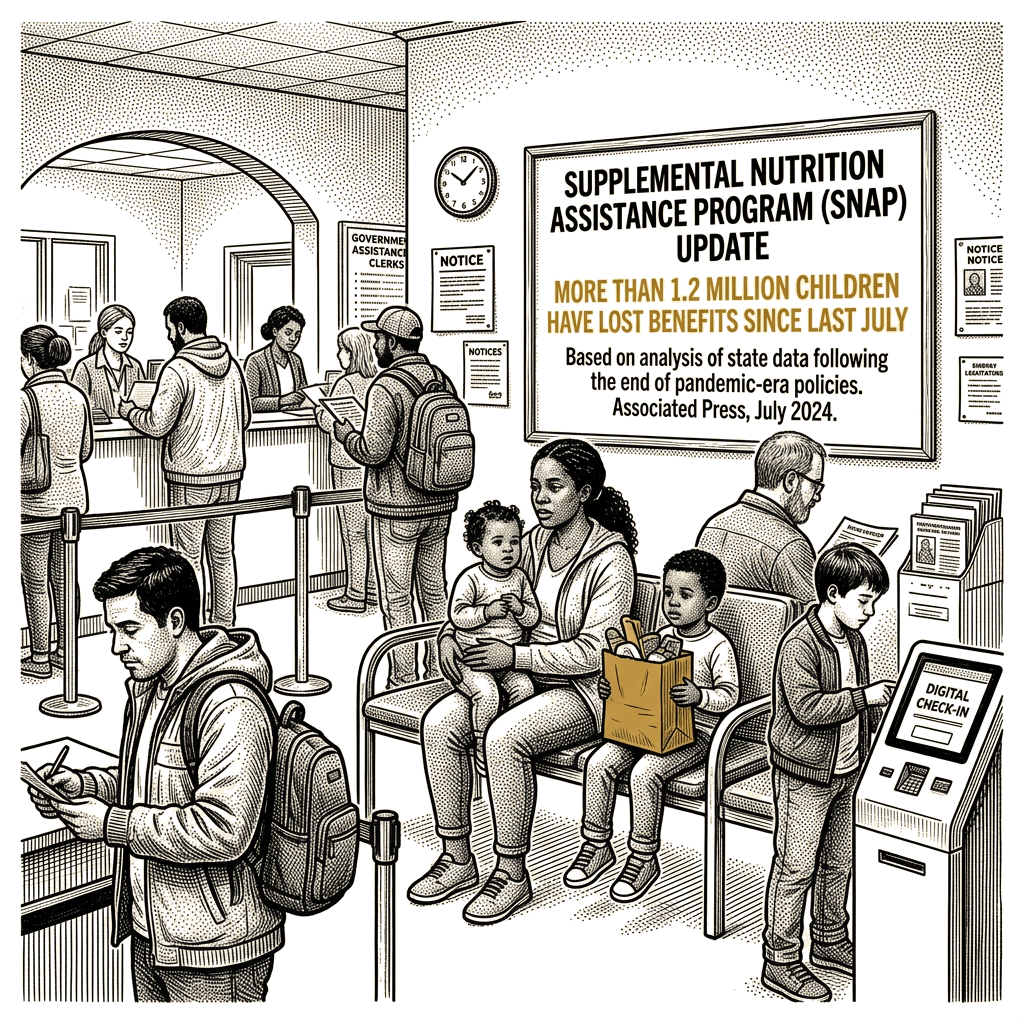
Donald wrote a rule to take food from 6.3 million people. He calls it closing a loophole. The loophole was a door and they were standing in it. The shelf in the pantry has gone bare. Five and a half million Americans have already lost their grocery card. Another six point three million wait behind them, by your own department’s arithmetic. The woman at the counter will set down the milk. Not the bread. The milk, because the milk goes first. The comment period runs to next month. The hunger does not wait for the comment period.
The U.S. Department of Agriculture published the proposed rule on Tuesday. It would stop some people who receive cash aid under the Temporary Assistance for Needy Families program from automatically qualifying for the separate Supplemental Nutrition Assistance Program. The government is seeking public comment until next month. If the rule is accepted it does not take full effect for about two years. This is the same proposal, already reported, and the department has now put it in writing.
The department’s own estimate is that about 6.3 million people could lose eligibility by fiscal year 2029. That number sits on top of the 5.5 million people who have already lost benefits over the past year. Together, eleven point eight million Americans. SNAP serves about one in ten Americans. Federal guidelines generally limit the benefits to people earning less than 130 percent of the poverty level, a little over $1,700 a month for an individual or nearly $3,600 for a family of four. To reduce duplicative paperwork, the federal government lets people who already receive TANF benefits automatically qualify for SNAP, though they still have to apply. Forty-one states and the District of Columbia have some form of that broad-based categorical eligibility, according to a USDA report from last year. Some states use it to reach people who would not otherwise qualify. In 2009 the Obama administration encouraged states to give people a minimal TANF-funded benefit, an informational pamphlet or a telephone hotline, as a way of qualifying them for the food program.
The first Trump administration proposed to clamp down on the same practice in 2019. President Biden’s administration withdrew that proposal in 2021. Stacy Dean, a former USDA official under Biden, said of that withdrawal: “Simply put, we did not want to remove millions of people from the program, particularly working poor or children.” The latest proposal is more sweeping. David Super, a Georgetown law professor who has studied the program, said it “is basically proposing to eliminate the flexibility that Congress gave the states to serve working poor people.” It could prevent states from basing eligibility on TANF-funded benefits such as job counseling or a one-time voucher for a vehicle repair so that a person can get to work.
The Agriculture Department says nearly 1.8 million children would lose eligibility along with their families, and that 97 percent of them would still qualify for free or reduced-price school meals through another process. The department also says some of those children will not get the lunches, even if they are eligible, if their families do not apply. The Center on Budget and Policy Priorities put it plainly: “The public indicated they want their elected officials to focus on making life affordable. Yet the Trump Administration is doubling down on making it harder for people to feed their families.”
Donald, they are already thinner at the table. Thirty-six million people were receiving the aid as of July. That is down 13 percent from a year earlier, and you did that first with a work requirement stretched to people between 55 and 64 and to parents whose youngest child has turned fourteen. The 2025 law that broadened that requirement also starts shifting about three-fourths of the cost of running the program onto the states, up from half. The rule you published Tuesday is the second cut, and the second cut is deeper.
The woman at the register runs the arithmetic twice. Meat or the light bill. She puts the meat back. Her boy sits in third period doing the worksheet, stomach growling where the lunch money used to be, and he keeps working the page anyway, because the page gets done either way. The grandmother in the next aisle is sixty-one, inside the new work requirement, and the voucher that would have fixed her truck — the truck she drives to the job you demand she keep — dies in the rule you filed on Tuesday.
The department says 97 percent of the children will still qualify. Qualify, Donald. The word does not put anything on a tray.
There is a copper taste under your tongue when you read your own number. It does not leave when you drink the water. Six point three million. I am telling you the number so you cannot unread it. Say it with your mouth full. The toast is warm. The butter is on the knife. Your gut makes the slow low turn it makes when something is wrong and you have not yet said what out loud.
The paper is yours, Donald. Your administration drafted it. Your department published it. Your hand wrote the sentence about job counseling. Your hand wrote the sentence about the vehicle repair that lets a mother get to work. Your swallow catches at the signature line. You will wash the pen tonight. The hand will not come clean. Tomorrow your eggs will taste like nothing. That is the nearest you will ever come to the hunger you signed.
You had the same plan seven years ago and it was withdrawn because a woman at the Agriculture Department would not remove millions of people from the program. Now you have written it again and made it larger. You are a small man, Donald, with a large desk and a lever under it. The muscles are theater. The weapon is a paperwork rule, and the paperwork rule is small too — an eligibility formula, a percent sign, a form. The look I give you is the look a grown woman gives a toddler standing in his father’s suit.
Picture your own daughter at that register, putting the meat back, running the arithmetic twice. Picture your grandchildren eating well tonight, Donald. Picture them at a school where the lunch card comes back declined. You will not picture it, because you have arranged your whole life not to. So I will hold the picture where you can see it.
Your coffee is hot at seven. The copper taste is still under your tongue. The child who will lose the school lunch eats at noon. The family that will lose the benefit sits down at six. You will not be in that kitchen. You will not hear the cupboard. That is the whole of your freedom, Donald, and it is the size of you.
You lie down warm tonight and your breath runs shallow, quick and high in the chest — the breathing of a man whose body keeps watch over something he will not name. You will sleep fine tonight. Five and a half million people are already counting calories against the end of the month, and you have queued six million more behind them, and you will sleep fine, and the sleeping is the indictment.
I have carried spices to a grave, Donald. Even the dead got that care, and I brought it. You are taking bread from the breathing.
The milk goes back on the shelf. The form is not filled out because the form is long and the woman has two jobs and the child eats at noon whether the paper is filed or not. The mother will find the second job anyway. The grandmother will get the truck fixed somehow, or walk. The boy will do the worksheet hungry. These are not fragile people. They are carrying what you handed them, and they are still standing, and your name is on the weight.
“Truly I tell you, whatever you did not do for one of the least of these, you did not do for me.” Matthew 25:45
There is a ledger older than any rule the Agriculture Department publishes, older than the Republic that chartered it. The entries are not filings. They are suppers. The one who keeps the ledger does not ask what you intended. He does not ask what you were trying to fix. He asks what you did not do. Every emptied plate has a line. Every line is read aloud.