
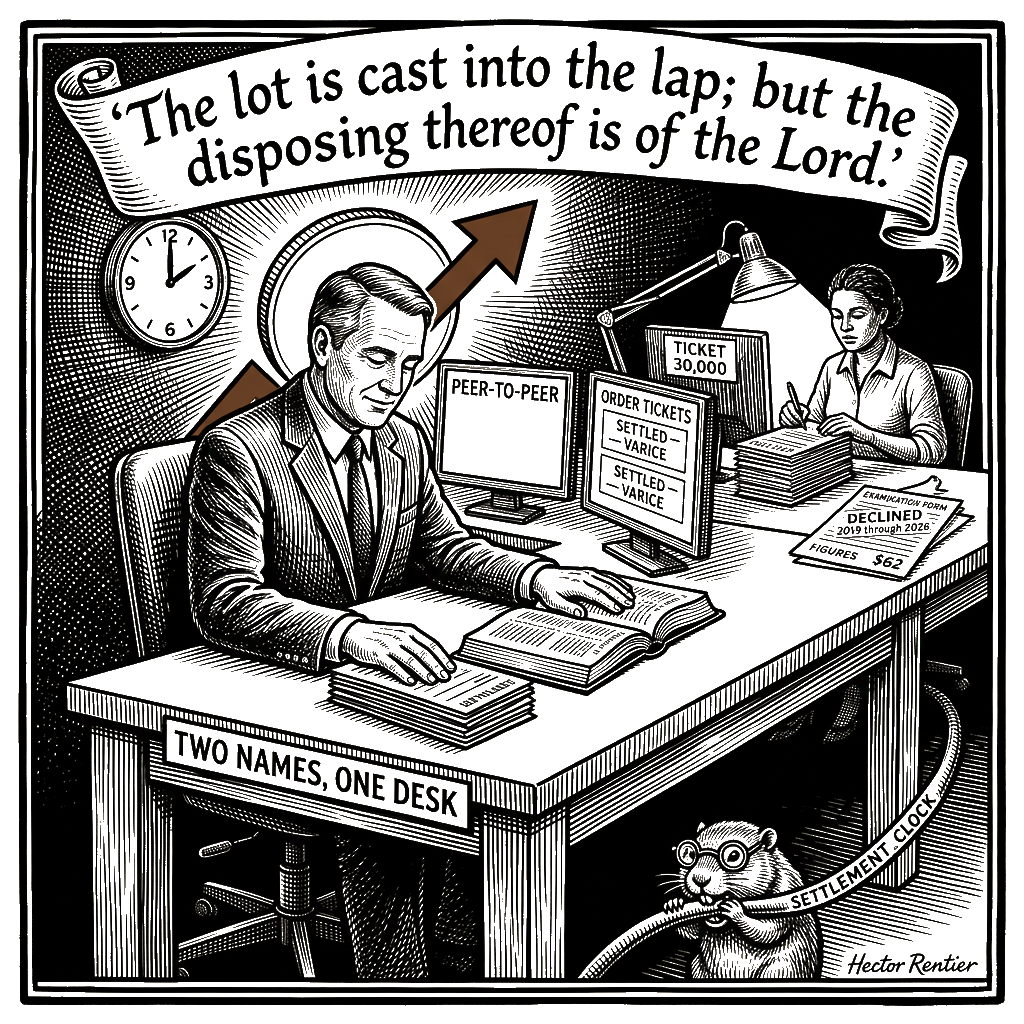
I take both sides of your wager, I post the number you accept, and I settle the whole slate myself at 2 a.m. on a single pair of eyes. The floor is mine: the settlement end of TiltPoint Markets, the exchange I run, outside Wheeling, West Virginia. Nola is a settle on it, a settle being the trade’s word for the woman who closes your ticket after the game, and I’ve run that floor with one of them every Sunday and Monday night for 6 years. Each night is 14 hours. 41,000 tickets. Around ticket 30,000 her right eye stops holding the numbers. She finishes anyway, because the settlement clock doesn’t know about her eye and neither does the market. The lot is cast into the lap, Proverbs says, and the disposing thereof is the Lord’s. I operate the lap.
The exam that would tell us how much eye she has left costs $62. I’ve declined it every year since 2019, because an eye that works through hour 13 is an eye I don’t have to rent for hour 14. The contract settling in your app right now came out of that eye, and there is no friendly stranger on the other side of it. There is me.
Thank you for keeping the app on your home screen. The floor eats on schedule because of it. Chris Christie argues in “‘Peer-to-Peer’ Wagering Isn’t Gambling? Don’t Bet on It” that the peer-to-peer label manufactures the impression that a bartender in New Jersey is betting a mechanic in Texas at a price only the two of them agreed on, when the company’s own trading arm routinely takes positions opposite its customers. I agree with everything alarming in it.
He is right about the states, too. He won Murphy v. NCAA in 2018 and handed the call to the states, and 39 of them plus the District took the deal: legalize the bet, hire a regulator, collect the cut. Then they were asked to watch it move. What he wants back is sovereignty, 39 licensing regimes and a booth, and a federal referee who signed the industry’s letter before he got the badge. Sovereignty is a lovely word for a fence, and fences have maintenance budgets. In 2026 more than $320 billion in sports volume has crossed a platform that calls itself an exchange. That is 85% of everything the platform has done this year. 2% of its volume hedges anything a business would recognize. The American Gaming Association puts the state gaming taxes siphoned off above $1.6 billion, and Mr. Christie advises the trade group that ran the counting, so take its figures slowly. I do. 47 attorneys general are chasing the noun. He wants the collectors back at the booth. The booth isn’t the interesting part of this arrangement. I am.
He is right about the mechanism, and I’ll go him one better: I run it. Peer to peer is not a false impression. It is the product description. You aren’t betting against a stranger in another state. You’re betting against the man who sets your line, reads your ticket before the whistle, and closes it at 2 a.m. on one woman’s eyes. When the strangers don’t show up, my desk takes the empty seat. The strangers rarely show up. I am most of the market I moderate. “Swap” is the second noun, a swap being a bet with a forwarding address in federal court. The commission’s own rulebook says it bars wagers on games. The noun says otherwise, and the noun is winning. My card says liquidity provider. I don’t print the house, because the house ends dinner conversations early. Christie’s own file contains my favorite maneuver: Kalshi’s lawyers told a federal judge in late 2024 that Congress never wanted sports wagering conducted on derivatives markets, and by early 2025 they were the derivatives market. I’ve made that same pivot with the same straight face, and it costs nothing. Nouns are the cheapest thing I buy.
Here’s the part I want you to learn, because it’s the part that pays. I pay Nola $0.006 a settled ticket. The exam is $62. Read the next sentence twice. On any Sunday in November those 2 numbers meet, my side of them wins, and I’m not in the room for it. Her whole Sunday comes to less than the exam. The only part of this arrangement that has ever cost me anything is the phrase I’d have to say at dinner. A 26-year-old woman can no longer focus her right eye on the work I pay her for. That phrase makes people set down their glasses. Mine are good.
The $62 is still mine.
I take no pleasure in her eye. I take pleasure in knowing the number to the fourth decimal when she doesn’t.
Let me ask you 3 things, since you’ve been patient enough to read this far. Who sets the line? I do. Who’s on the other side when the public piles onto one team? I am. Who was supposed to be standing between us? A man with a badge and a budget. In Utah he filed 13 felony counts against Kalshi and its founders, and then went looking for reinforcements. 39 attorneys general, 145 tribal nations and groups, and the National Football League have petitioned the Supreme Court to hear it. He’s the protection. Right now he’s also a petitioner.
The fight in the papers isn’t over whether this is gambling. 81% of Americans already say it is, and the Sixth and Ninth Circuits have ruled against the noun unanimously, twice. The fight is over who collects on a habit that has never once needed anyone’s permission to grow.
$9.5 billion of this year’s volume came from customers the states won’t admit to a casino. Not until they’re 21. I don’t have an age problem. I have a market. The enhanced age check that would have held them at the door, the voluntary 21 floor the state licensees carry, runs $0.04 a signup. I declined it. I decline it every quarter.
Same book, the other end of it: Devon is a recurring deposit on the exchange I run, a 19-year-old line cook in Tulsa filed under the noun that pays. He has moved $4,900 through my book since March. His checks land Fridays at 6:04. My chime beats his bank’s text by 40 seconds. I pay a notification vendor $11,000 a year for those 40 seconds. Best money I spend. He reloads $120 before he eats. Tuesdays, tips willing, $60 more. His roommate covered December’s rent. His bus pass lapsed in October. I know because retention surveys are free, and remorse isn’t on the invoice. The cash-out fee is $2.40, naturally. The odds were posted and he tapped the green button, so there’s no fraud to audit, only appetite to supervise. He works the fryer and he works my book. The verse about work and eating gets performed in Tulsa every night, on schedule, and both of us are in compliance.
Acquisition.
Same book, one counter down, one rung further along: Ozell is 54, he sets boxes at my Fort Worth depot, and where Devon reloads from tips, Ozell bids for December’s overtime to cover November’s slips. I approve the overtime at 9 a.m. and take the other side of it by noon. Two pockets. One coat. Devon concerns me only when the deposits slow. A lapsed account is a restocking delay. Every June the cohort restocks itself. Graduation is a supply event.
Zoom out until you can see the century, because Devon isn’t the innovation. He’s the proof of an old invoice. In the 1890s a workingman put his $2 on Union Pacific through a bucket-shop window; no share ever moved, the house held the other side, and when the states caught up they outlawed the name. The policy wheel sold the same lottery dressed as an insurance premium. The numbers man dressed his as playing policy. I dress mine as a swap. The house is 130 years old. Only the costume is new, and the costume is the whole business, because a wager is never regulated by what it does. It’s regulated by what it’s called. Change the noun and 39 licensing regimes go quiet at once.
Lift your eyes off Nola for a moment, because the floor is only an instance and I’d rather you leave with the law. Mr. Christie’s whole argument is a fight about which government is entitled to auction the appetite, the state that has licensed it in 39 places or the federal commission that files it under swaps. He assumes one of them must win. Both of them are drawing their cut from the same losses, and neither has ever priced the eye that settles them. I’ve read the document that settles it:
“Let every soul be subject unto the higher powers. For there is no power but of God: the powers that be are ordained of God. Whosoever therefore resisteth the power, resisteth the ordinance of God: and they that resist shall receive to themselves damnation.” — Romans 13:1–2, King James Version
Utah’s 13 felony counts are ordained. So is the federal letter that calls my contracts swaps. So is the legislature that legalized the wager in 39 states. Scripture doesn’t rank them. It certifies the office, not the answer. Regulation is permission, and permission is all I have ever needed.
You’re still hoping I’m an accident. I’m a syllabus with alumni. For 30 years I’ve taught this arithmetic at Warden, and the noun wasn’t my find. A student found it, second row of my regulatory-arbitration seminar 3 years back, and he saw before I did that a point spread would sit inside a federal definition like a stone inside a ring setting. Two of his classmates run desks now. The young woman who set the fee on your account in August was mine too. She costed the second settle in the margin of a case study, in 40 seconds, and asked whether I wanted the answer or the review. I wanted the answer. She’s in an office in Connecticut now, pricing accounts like yours, and I don’t write the loophole anymore. I grade it. They’re getting better than I am, and I say that the way a teacher says it. Utah is suing a noun, and the noun has an alumni network. Close swap tomorrow and the class prints the next one by Friday: an index, a token, whatever June’s graduates sketch on their first Tuesday. You can’t quarantine a faculty. It’s in its fourth edition.
In August I moved the fee on a sports-event contract from $0.14 to $0.31. Average account life fell from 14 weeks to 9 weeks. The year-to-date came in 19% ahead. Two good numbers, same quarter. The churn model says the book eventually drains the very paychecks that feed it, and my analysts ran it 24 months out. I’ve asked them to stop at month 6. The early columns are gorgeous. There’s a memo on my desk asking how long the mouth of the funnel stays wide when an account dies at 9 weeks. It’s been there since September. I haven’t opened it. It’s a good business, and I’m not in the market for a different one.
Back to Devon, because the abstractions eat people and I like mine fed. His hands smell like fryer oil at 10 p.m. His knuckles work. His lungs are clear. The book leaves the body alone; there’s no cough to point at; that’s the design, and it’s why no inspector has ever found anything to measure. It doesn’t take his hands. It takes his Fridays.
Nola clears the last ticket at 4:10 Monday morning, after the West Coast game, the only one that matters to me. The chart still reads deferred maintenance, and that is a phrase I did not have to invent. Her exam is still $62. When the eye goes for good, the position posts at 8 a.m. and the applications arrive before lunch. I have never once had to look for a settle.
The rulings will travel at the speed nouns travel while the book clears daily. The $1.6 billion still has to come from somebody, and you’ve met him in the mirror. Thank you for your business, sincerely. The desk appreciates the volume. Every ticket on my book has two names on it, and if the gray icon is on your screen, one of them is yours.
Deposits don’t appreciate.
The chime is set for Friday.
Sterling A. Varice holds the Hayek-Friedman Chair and serves as Dean of Instruction at Warden University’s College of Business and Economics in Richmond, Virginia. He is the author of three textbooks: Divine Mandates for Labor Utilization, Social Obligations for Profit Maximization, and Calibrated Deprivation: A Manager’s Guide to Employee Motivation.