
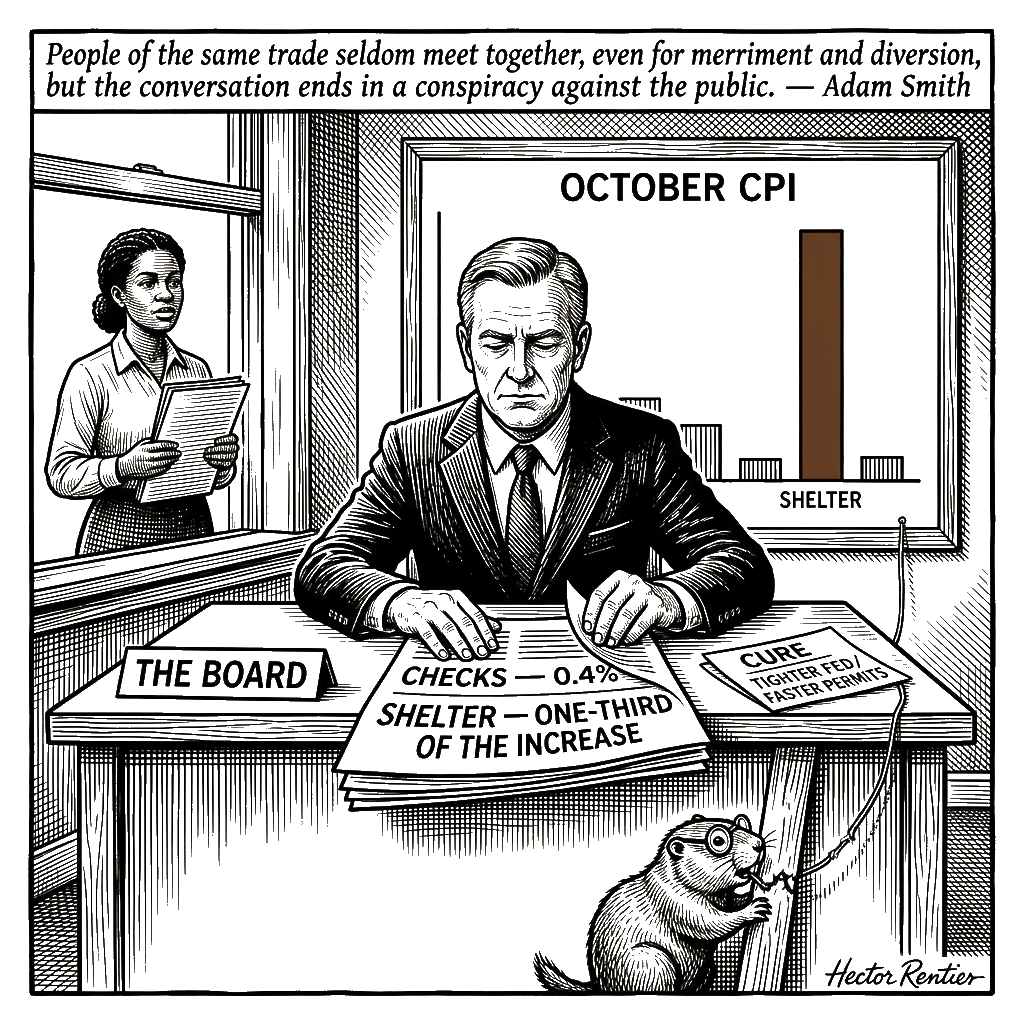
Inflation isn’t squeezing American paychecks because somebody mailed out a check a few years ago. It’s squeezing them because about a third of last month’s price increase is shelter — and the rent goes up whether or not anyone printed a dollar. The Wall Street Journal editorial board’s A Short Lesson in Why Republicans Lost reads October’s CPI, notes that prices are still outrunning wages, and prescribes the cure: get inflation down to 2% by handing the job to Federal Reserve Chair Kevin Warsh, fix the supply side with deregulation and permitting reform, and steer clear of “damaging gimmicks” — its name for credit-card interest-rate caps and transfer payments, the Biden strategy it blames for 2024.
Let me give the board its due first. Its numbers are right. The overall index rose 0.4% in October, core was 0.3%, and real average hourly earnings were flat for the month and roughly where they sat in January 2025. Seventy-nine percent of voters called inflation a hardship. The war’s ripple into energy, food, and airfares is real. When prices outrun paychecks for two years, voters punish whoever’s in charge, and last week they did. Fine — call part of it a hangover from the Biden years and the Fed easing early. Hangovers fade. Shelter is a third of this month’s increase too, and rent isn’t a hangover.
Now read the report the board itself quotes. Shelter accounted for about a third of the increase. Then the piece moves on. It never comes back to it.
A rent increase is not money printing. Your building didn’t get more expensive to heat. The roof didn’t leak. What changed is what the owner can charge — or what the loan on the building costs, which gets charged to you either way. Follow that line through the CPI and you get the whole story: a third of the number is the price of living in a place someone else owns, and the prescription on the table is a tighter Federal Reserve and faster permits. The Fed doesn’t build apartments. Permits take years to become bedrooms. Neither one lowers the rent on the lease you signed.
Look at the rest of the board’s own list: motor-vehicle repair up 0.9%, hospital services up 0.8%, hotels up 0.7%, streaming up 0.7%, day care up 0.4%. Cancel the streaming service. Try canceling the hospital. A market is superb at sneakers and sandwiches, where the customer can walk away. Sick people make terrible shoppers, and the sellers have spent decades merging until one invoice covers the region. And day care can’t be cheap for parents, decent for the workers, and profitable for the owner all at once. Pick two. Every rich country picks the parents and the workers and pays the difference. Transfer payments caused none of these prices, and the board knows it, because it lists them and then argues about something else.
About that “gimmick.” We ran the experiment, recently, with a start date and a stop date. In 2021 Congress sent families a monthly child allowance. By the Census Bureau’s own poverty measure, child poverty fell 46% in a single year — from 9.7% to 5.2%, about 2.9 million children lifted out, roughly 2.1 million of them by the expansion itself. Then the expansion lapsed, and child poverty went straight back up. That is not a theory. That is the cleanest controlled experiment in American social policy in decades, with the results published by the government itself. The board writes “recall how it turned out.” I recall exactly: we turned it off. And notice what the board has filed under the same word — cash to families, and a ceiling on the interest charged when the cash runs out. Neither “gimmick” touches the reason families need it.
Then there is the board’s actual stated goal: boosting real wages. Its instrument is a central banker. But a wage is a price — the price of labor — and prices move with bargaining power, which the Fed does not set. The Fed can set the price of money. It cannot give a hotel housekeeper or a home-care aide any leverage over her boss. Union members took home a median $1,404 a week in 2025, against $1,174 for non-union workers. That gap is real money in real pockets. It reaches about one worker in ten, because roughly 11% of the workforce is covered by a union contract — down from about a third in the 1950s. That decline was not the weather. It was Taft-Hartley in 1947, right-to-work laws spreading state by state, and a president firing striking air-traffic controllers in 1981. The economy is a set of choices, not the weather. Somebody chose this; somebody could choose differently.
The board signs its editorials standing with Adam Smith. Smith left two sentences every schoolchild should carry. One explains how the butcher and the baker feed us while minding their own interest. The other says people of the same trade seldom meet together, even for merriment and diversion, but the conversation ends in a conspiracy against the public. The board signed on with the first. The second sentence is the inflation report.
Where the board is right: supply is real. Houses and apartments take forever to build, the wait between approving a building and building it is the largest single reason housing costs vary from place to place, and cutting that wait is genuinely worth doing. But supply and ownership are two different questions. You can build a thousand apartments and hand all of them to the same fund. The units appear; the rent doesn’t fall; the extraction just gets a fresher address.
So what do we build instead. Start with the switch we have already flipped once: bring back the monthly child allowance and make it permanent. No new architecture, no five-year plan — a check, reaching the households paying the day-care line and the grocery line, with the test results already on file. Then go where the board will not, at the wage itself: set the floor across whole industries rather than store by store. Wage boards for care work are already legal in some states, and a 2026 estimate from the Center for American Progress puts industry-wide bargaining at 29% of workers covered, up from 11% — roughly 42 million workers — and it doesn’t nationalize a single firm. And when the new units finally get built, let the people living in them own a piece of it: community land trusts and co-op housing, the same structure as the credit union already in your wallet and the rural electric co-op that wired 42 million Americans.
Be honest about the rest, because that honesty is the fee for the argument. The Danish arrangement — easy to fire, with the state spending about 2% of GDP catching whoever falls, protecting the worker instead of the job — sits on a century of unions, organized employers, and honest tax collection. I won’t pretend we can airlift it by Tuesday. But the check needs no iceberg under it. It ran. It worked. It is a switch.
The board is reading the wrong pipe. Flat pay is not a monetary accident awaiting a better chairman; it is the running total of a hundred choices about who bargains and who doesn’t, and about which bills a family cannot decline. The Fed can hold prices near 2%. It cannot negotiate a raise. The CPI line that hurts most is the one somebody chose — a rent, a ratio, a contract that was never signed. Remind me what the obstacle is again. Bring back the check. Set the floor.