
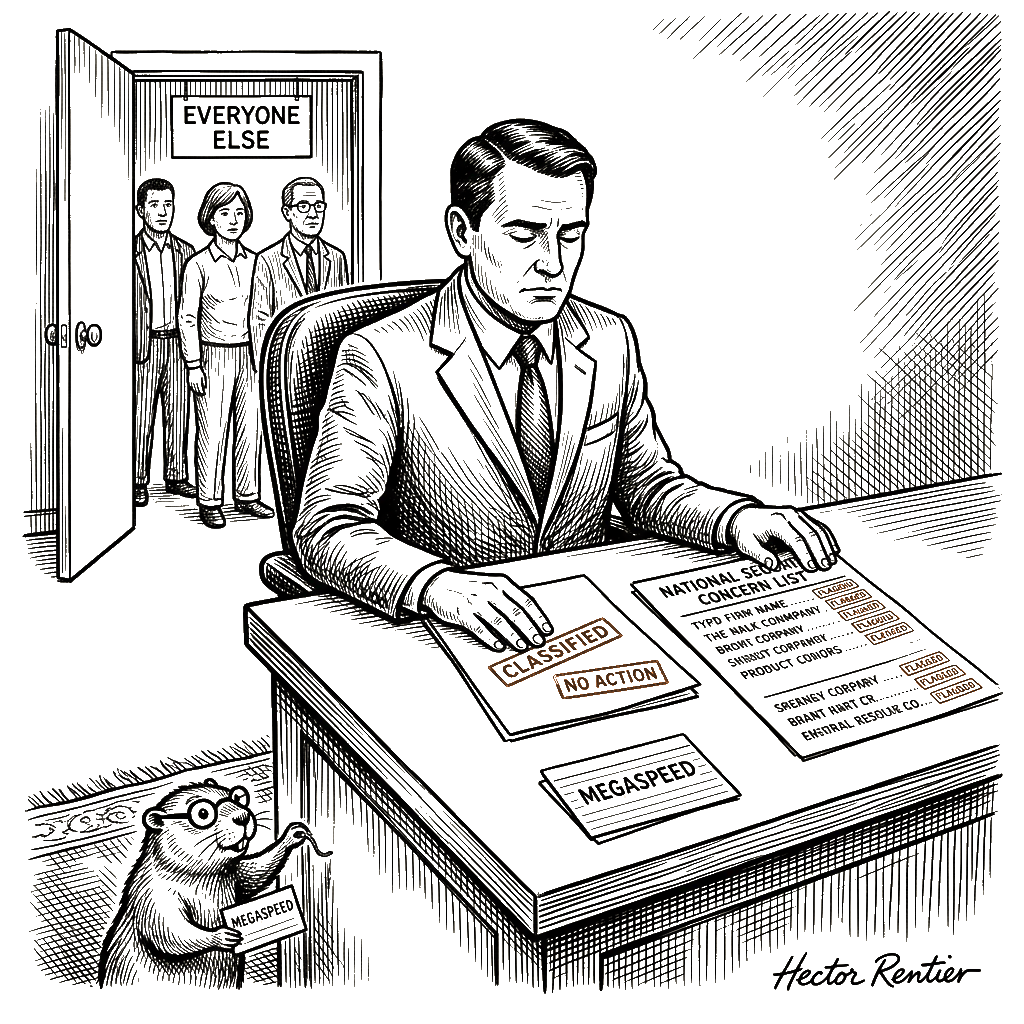
The firm run by the woman United States officials suspect of spying for China is still not on the list of companies that pose a national security concern — and the government already wrote down that the chief executive of a four-trillion-dollar company was seeing her. Jensen Huang resigned Thursday from Nvidia after 33 years, telling his employees he had been unfaithful to his wife of 41 years; reports of two additional affairs, both with Nvidia employees, came out with him. Nvidia named an interim chief, the Nasdaq fell 4 percent, and hundreds of billions of dollars in market value left with the week.
The paper trail is on the record. Huang was first seen with Alice Huang, who ran the Singapore datacenter firm Megaspeed, in late 2023. A bar in Taiwan in 2024. A conference in 2025, by which time the commerce department was already investigating whether Megaspeed was diverting AI chips to China in violation of export controls. This spring, according to the New York Times, Marco Rubio oversaw a classified memo reporting, on the basis of electronic surveillance of Alice Huang, that the Nvidia chief executive was in a relationship with a suspected Chinese spy. The Guardian reported that the relationship ultimately appears to have helped facilitate the transfer of billions of dollars of advanced Nvidia chips to China. The president was told first: he was told of the Huang spy link in 2025 and chose not to act. He called Huang “an honorable guy.”
The affairs are his wife’s business and his board’s. The memo is the country’s.
What reaches the rest of the world on schedule reached him late. In January a federal jury in California convicted a former Google engineer of stealing confidential company information to benefit the Chinese government. In October authorities arrested a Saudi national accused of planting a sophisticated listening device inside OpenAI’s headquarters. The Center for Strategic and International Studies counts at least 224 incidents of Chinese espionage in the United States between 2000 and 2022, more than half of them aimed at commercial technology. William Casey told the country in 1985 that “gaining access to our advanced technology continues to be their top priority.” The country heard him. It prosecutes the point on a Google engineer, on the man with the listening device, on anyone who has never been asked to dinner.
For the man named in a classified memo the machinery produced a law firm hired by his own company, an FBI inquiry announced by the president himself, a pledge to testify before Congress, and a shareholder lawsuit in California accusing him of misleading investors. Nobody has been charged with anything. The Chinese foreign ministry calls the whole thing “nothing but a smear against China.”
I won’t dwell on why Axios reports that Megaspeed was spared from the list of companies that pose national security concerns despite the intelligence outlining issues with the firm, or why the commerce secretary is under pressure to resign over perceived inaction. Not my business.
Nobody in the security trade is surprised, and they will tell you why in a breath. The smartest man in the room, as the papers called him, is the one man in the building nobody is allowed to watch. “These are really smart, accomplished people and you don’t want to come across telling them that they don’t know how to behave themselves or that they’re not sophisticated enough to know that they’re being taken advantage of,” says Teneo’s Brian Stephens. Teneo’s Elizabeth Buckley is plainer: an executive’s insistence that he is not important enough to be a target “is a defense mechanism to being told that the way you live your life is going to have to change.” Randy Watt of SRW calls the honeypot “as old as the earth itself,” and then hands over the sentence this affair will circulate on: “I guarantee you there are a whole number of executives in powerful corporations that are reviewing their relationships with girlfriends.” Don Aviv of Interfor International has run about a dozen investigations in three years into honeypots, personal relationships, coercion and blackmail, and says this happens “all the time, across industries.” OpenAI was already rehearsing honeypot scenarios with its staff, according to the Wall Street Journal. Nvidia still has not said when it learned what. Corporate intelligence firms expect more demand after the scandal: training, investigations, penetration testing aimed at the human element. Human error will be the diagnosis. It is the diagnosis money buys. The firm that sells vigilance has a growth forecast.
So the man is not the story. Human error explains a man in a bar in Taiwan. It does not explain a name left off a list. The machine produced him with the warning already written, and the same federal machinery still works on everyone short of the state-dinner class.
I have watched this docket since Nixon, and the rule underneath never changes: the law runs at the speed of the defendant’s connections. HSBC laundered money for Mexican drug cartels and sanctioned governments, paid $1.9 billion for a deferred prosecution, and not one individual was prosecuted — Senator Grassley said the bank had “quite literally purchased a get-out-of-jail-free card.” Wells Fargo opened millions of accounts its customers never asked for and settled for $3 billion with the bank itself, not with the people responsible for the fraud. Purdue pleaded guilty in 2007 and again in 2020; the family that drew out the billions was never charged. GM hid an ignition switch for a decade, forfeited $900 million, and charged no one. Jeffrey Skilling went down while some $74 billion in shareholder value and 4,000 jobs went with him. After 2008, no major Wall Street CEO went to prison at all. And in the savings-and-loan years a jury did send Charles Keating to prison after Lincoln’s collapse cost taxpayers $3.4 billion and some 23,000 bondholders about $250 million — he served about four and a half years before his convictions were overturned on a technicality in 1996, then pleaded guilty again in 1999. The country knows how. It reserves the knowledge.
A former Google engineer got a federal jury in January. A Saudi national got an arrest in October. The Honorable Guy got a kind word and a blank line on a list. The line is still blank. Nobody forgot to fill it.