New York built the Strategic Response Group to police protest, not terror. The proof stood in the street on June 13, 2026, outside Game 5 of the NBA Finals, where the Knicks and the San Antonio Spurs were playing basketball and the city posted standing riot police to guard the occasion — riot police under a scoreboard, before a crowd that had come to watch a game, the least threatening crowd a free city ever gathers. A unit founded in 2015 with counter-terrorism as its stated purpose ended its public life guarding a sporting event. That photograph is the unit’s honest mission statement. Everything else was paperwork.
On Monday, Zohran Mamdani, New York City’s mayor, tore the paperwork up. In a video released that morning he announced that the Strategic Response Group — the unit the department created in 2015, ostensibly to focus on counter-terrorism, and used against people exercising their right to protest — is finished, and he did it as the keeping of a pledge: “Today, we are keeping that promise.” The full announcement, with its tactical schedule of bans and new units, is itemized here.
The receipt that matters sits in the joint statement he issued with NYPD commissioner Jessica Tisch: “a complete separation between the city’s counter-terrorism operations and protests protected by the rights to free speech and assembly guaranteed by the US constitution’s first amendment.” Read that clause once more. You do not separate two things that were never joined. New York’s police department just told on itself in its own reform language: protest response had been running out of a counterterrorism apparatus, and it took a new mayor to write the divorce into the paperwork. Tisch’s own words describe what the paperwork does — “consolidate our counterterrorism capabilities” — and that is exactly right. The heavy weapons go to the intelligence and counter-terrorism bureau, where counterterrorism belongs, and out of the protest line, where they never belonged.
The operating record, laid next to the label, kills the label. Civil rights groups have accused the unit for years of excessive force and unduly aggressive tactics against protesters. In January, Mamdani reiterated the disbanding pledge after the SRG arrested dozens of demonstrators occupying a hotel lobby in protest of ICE and the federal mass-deportation campaign Donald Trump has pursued throughout his second presidency — note where the unit’s most recent work was done, on people who had gone out to stand between their neighbors and federal agents. And after the 2020 protests over the murder of George Floyd in Minneapolis, New York’s own Department of Investigation recommended that the NYPD “reevaluate the central role” of the unit “in response to large protests given their orientation to handle counterterrorism, riots, and other serious threats, and better calibrate their use to circumstances that require such specialized force.” A city’s own inspectors do not write that sentence about a unit doing counter-terrorism. That recommendation was written in 2020. It sat for six years while the unit kept answering marches with a counterterrorism orientation. A counter-terrorism unit hunts people who plant bombs. This one cleared a hotel lobby full of people holding signs. The discrepancy is not confusion. It is the design.
The apparatus became ordinary while it waited. The photograph that ran with Monday’s announcement shows riot police holding the line at the Finals — same uniforms, same posture, a fixture of the city’s civic calendar. That is what six years of a shelved recommendation makes of a counterterrorism unit answering a march.
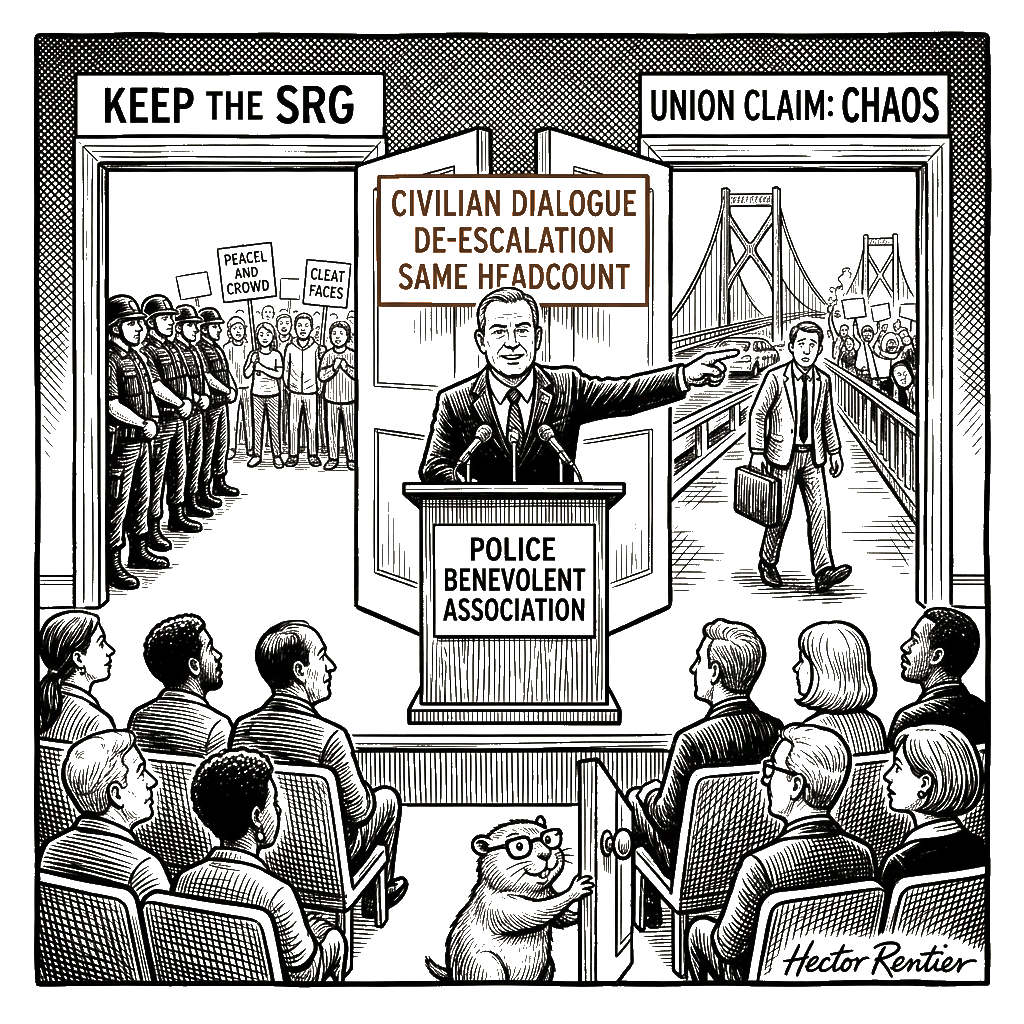
The announcement itself is the receipts. Along with eliminating the SRG, Mamdani and Tisch said the city would establish a “first-of-its-kind, civilian-led Community Dialogue and De-escalation Division” inside the office the administration stood up in March as the first plank of its crisis-response pledge, carrying no weapons and no arrest powers; a thirty-officer First Amendment Support Team within the community affairs bureau, trained in communication and de-escalation; a patrol support division of vetted officers receiving crowd-management training; and the tactic bans — no irritant gas at demonstrations, no kettling, no long guns, pepper spray stripped of its “crowd-management” fiction, long-range acoustic devices capped at 90 decibels. The civil-rights organizations that carried this fight for a decade hailed it. The bans are the confession: a city does not retire by name tools it never used. The unit’s own arsenal, itemized and retired, one by one. And it all runs at no additional cost, without the department’s headcount moving by a single officer — which is the quiet arithmetic of the whole scandal.
Cui bono, then. First-order beneficiaries: the department’s command structure, which acquired a standing paramilitary formation answering to the commissioner rather than to the accountability structures ordinary patrol lives under; the Police Benevolent Association, for whom a unit in hard kit at every demonstration is a labor position statement — the institutional answer to every accusation of excessive force being more equipment, never fewer batons; and the office of the mayor, which inherits a cleared street as a photograph and a marching crowd as a problem. Second-order: a federal deportation apparatus that prefers its critics dispersed, and the arithmetic by which a city willing to militarize its own sidewalks lowers the political price of the campaign being run out of Washington. The cost-bearers need no inventory: the people in the crowd, and everyone else whose constitutional right to assemble had been filed under the department’s security budget. The public framing — safety, order, the stranded commuter — obscures the distributional fact underneath: the safety being defended was the department’s freedom to use force on demonstrators without consequence, an unreviewed license to gas, kettle, and train long weapons on a crowd, paid for by the people on the pavement and collected by the people holding the batons. The unit was a subsidy the city paid to itself for the right not to listen.
Then the response. Patrick Hendry, president of the Police Benevolent Association, the union representing more than 21,000 active NYPD officers, called the reform a danger. “Today is not a good day for New Yorkers who just want a safe and orderly city.” Mamdani, Hendry said, “is showing his true colors: he’s willing to put your safety and police officers’ safety at risk to appease his radical base.” And: “So the next time your life is disrupted by demonstrators who are blocking bridges and roadways or causing chaos on our streets, remember: Mayor Mamdani is on their side, not yours.”
Hendry’s argument has a true half. Demonstrators who block bridges and roadways do disrupt people’s lives. A commuter stranded on a bridge is not a fiction, and a city that pretends protest carries no cost is lying to its own citizens. That kernel is real. It is also the entire honest case, and from it Hendry builds a categorical claim the record refuses to support: that the only thing standing between New Yorkers and chaos is a unit authorized to gas, kettle, and point long guns and hearing devices at a crowd.
The extrapolation is where the technique shows. The catalog’s entry is false dichotomy — presenting two options as exhaustive when others exist. Hendry deploys it in “Mayor Mamdani is on their side, not yours,” where the choice is staged as the SRG or your safety, with no third option admitted. The situation is not binary: the same announcement lists the third option — a civilian-led dialogue division with no weapons and no arrest powers, a thirty-officer team trained in de-escalation, a patrol support division, the bans, all at no additional cost and without changing headcount. Not the unit, not chaos. A different answer that moves no money and no bodies. The second technique is ad hominem in its circumstantial form — discrediting an argument by reference to the arguer’s situation or interests. Hendry deploys it in “he’s willing to put your safety at risk to appease his radical base”: a decade of documented accusations and the Department of Investigation’s own recommendation are answered with an attribution of motive, and no engagement with the substance appears anywhere in the statement. The falsification condition is nowhere met, because there is no engagement alongside the personal claim to weigh it against. The third is frame-engineered relabeling — the deliberate substitution of one term for another where the new term carries different connotations, shifting the frame in which the underlying issue is processed. Hendry’s “radical base” stands in for the actual constituency: the civil-rights organizations that spent years documenting this unit’s conduct and the voters who put a mayor in office on the pledge to end it. Accountability, relabeled extremism, with not one document engaged. (“Radical base” is Hendry’s framing, not a description of anyone.)
And underneath all three runs the pipeline. Manufacture the fear — “demonstrators… causing chaos on our streets.” Channel it into anger at a named target — the mayor. Collect the loyalty: “remember: Mayor Mamdani is on their side, not yours.” It is the sequence the prequels diagnose in a single sentence — fear leads to anger, anger leads to hate, hate leads to suffering — and it is not a metaphor for what this statement does. It is a description. The speech is engineered the way the pipeline runs, and the man running it is the president of a police union, which tells you exactly which institution harvests the crop.
The same scrutiny runs in one direction only, and the asymmetry is the finding. For years, while civil rights groups documented excessive force and the Department of Investigation filed its recommendation, Patrick Hendry did not tell New Yorkers their safety was at risk. The union’s outrage keeps an operating schedule, and the schedule runs only against mayors who take the equipment away. The standard Hendry invoked Monday — that a mayor answers for this unit — was available to him in 2020, in January, and every day the gas was in the canister. He applied it to none of those days. That is goalpost-shifting: the redefinition of the standard of evidence required to settle a question in response to the accumulation of evidence meeting prior standards, in its partisan form, where the criterion moves with who is being evaluated. The conduct standard did not move because the facts moved. It moved because the equipment was threatened. The indictment does not sort by party or personality; it sorts by function — whoever built the apparatus, whoever kept it, and the union that polices the loyalty of anyone who would dismantle it, all carrying the same conduct, all of it going into the record.
Here is what Monday does not change. The force does not leave. The unit’s counterterrorism functions — heavy weapons at critical infrastructure — consolidate inside the intelligence and counter-terrorism bureau; the patrol support division is staffed with vetted uniformed officers who receive crowd-management training; and the civilian dialogue division carries no weapons and no arrest powers, which is the point: it holds no coercive capacity at all. What Monday withdraws is not capacity but license: permission to treat a crowd as a hostile population inside a counterterrorism chain of command that was never calibrated for people holding signs. New York keeps its police. It loses the argument that a protest is a security event. Kettling is the technology of not-hearing. Chemical gas is the technology of not-hearing. A standing riot formation posted at a basketball game is the visual grammar of a city that has reclassified its own citizens as a threat category. Eleven years of that grammar ended in a press release, at no additional cost, without a single officer’s job moving — which is the proof that the menace was never necessary. It was chosen. What is chosen can be unchosen.
The union’s forecast of chaos is the tell. In Karis Nemik’s manifesto in Andor: “Authority is brittle. Oppression is the mask of fear.” One unit disbanded, no money moved, no officer fired — and the PBA announces the end of order. The panic discloses what the capacity claim concealed: the arrangement was never about how many officers New York has. It was about who decides, without review, what a crowd is.
The separation the announcement reaches for is the argument King pressed from a Birmingham jail cell on April 16, 1963 — rendered here as analysis rather than devotion. His position was that a demonstration does not manufacture the tension it is blamed for; it surfaces tension already alive in the city and drags it into the light, where it can finally be judged. Hendry’s “chaos on our streets” is that tension — the tension the SRG spent eleven years producing and then cited as the reason for itself. And King drew, in the same letter, the distinction this whole fight turns on: between a quiet that is merely the absence of disturbance and a peace that is the presence of justice, two conditions a city will always be tempted to mistake for each other. Hendry sells the first and invoices it as safety. The announcement aims at the second. Whoever calls the protest the problem has moved the argument away from what the protest is about.
The same standard reaches this reform that reaches anything else power announces. The mayor who ordered a use-of-force review after a 2024 fatal shooting has now issued a statement of tactical bans — and a statement is not a ban until the bans hold at the next crowd. Watch the prepositions: pepper spray is prohibited “as a crowd-management tool,” which is a phrase with an escape hatch cut into it, and 90 decibels of long-range acoustic device is still a device aimed at a crowd’s hearing. Watch whether the First Amendment Support Team answers to the community affairs bureau in practice and not on letterhead; whether the patrol support division’s crowd-management training reads from the de-escalation manual or from the old playbook under a new cover; whether the next large march arrives with medics, monitors, and witnesses — because an apparatus like this reassembles itself quietly wherever nobody is watching. Accountability runs through the pledge, held by the people who made him keep it.
What happened Monday is not the arc bending. It is people pushing: Mamdani on a pledge he did not have to keep; the Department of Investigation staff who wrote a recommendation in 2020 and watched it wait; the civil-rights groups that kept the accusations on the record through every administration that found them inconvenient; the demonstrators who occupied that hotel lobby in January and gave the pledge its second life; and the photograph from June, riot police holding the line at the Finals, ordinary as a streetlight. The long arc carries no motive power of its own. It moves when specific people, in a specific moment, decide that the cost of the arrangement has exceeded the cost of breaking it.
Not the video. Not the statement. The next crowd.
The horizon is not a quieter street — a quieter street is just order wearing a different badge. It is the horizon King named as the Beloved Community, and the oneness Malcolm X wrote home from Mecca in April 1964 to say he had witnessed among people of every color — present tense, not horizon: a city where the right to protest does not have to be re-litigated by a mayor’s press office every time it is exercised, where the bans hold when the crowd is angry and the gas stays in the canister, where the Department of Investigation’s recommendation is implemented instead of shelved, where the apparatus answers to the people it polices because there is no other arrangement in which it does. That city is not here. Monday moved it closer by exactly one unit, and by the accumulated pressure of people who spent six years refusing to let a recommendation die. That pressure is the only force in this city that has ever moved a police structure.
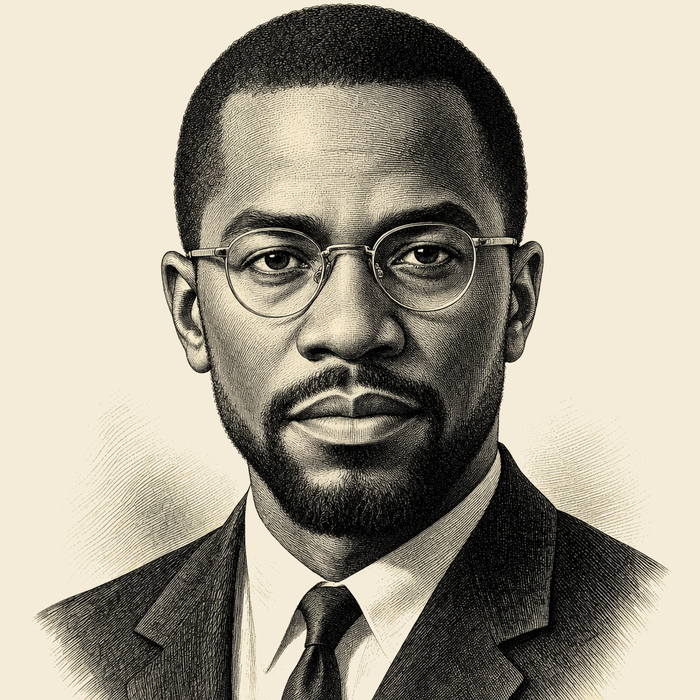
Malcolm X said it at the founding rally of the Organization of Afro-American Unity on June 28, 1964: “We want freedom by any means necessary. We want justice by any means necessary. We want equality by any means necessary.” By any means necessary meant the march, the petition, the ballot, the documented record, the refusal to let the lie stand — it never meant the baton, because the baton was theirs, and handing it back is what happened Monday. The marchers this unit was built to break were practicing the oldest lawful instrument the republic owns.
It still works. Use it.