
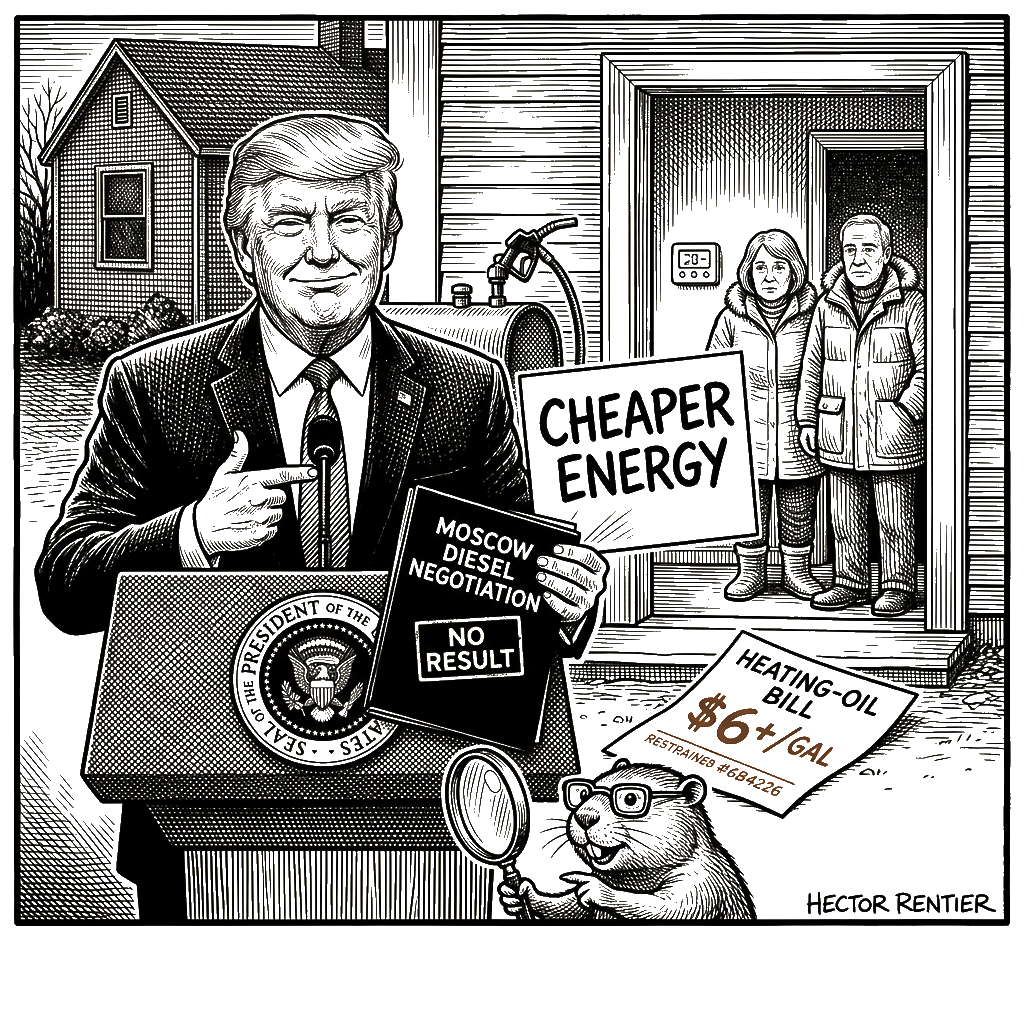
Trump is billing America’s coldest households for a failed Moscow diesel deal.
Here are the numbers. The Energy Information Administration — the federal government’s energy statistics agency — projects that households heating with oil will pay 21% more this winter than last, and the projection already assumes a milder winter absorbs part of the increase. Anyone who has read an EIA winter outlook knows what that construction means. Twenty-one percent is what a warm winter costs. A cold one is not in it.
The National Energy Assistance Directors Association, which tracks what households actually pay to heat, puts nationwide heating costs up more than 7% this winter and average north-east bills up 16.9% — the projection we carried earlier this month.
Beneath both projections sits the price that moved first, and the price is a receipt while the projection is arithmetic. Between September 2025 and September 2026, heating oil rose 74.2% and now averages more than $6 a gallon. Pump gasoline rose over 30% across the same year; diesel and heating oil rose further. One number is already printed on delivery tickets from Bangor to Providence. The other is a bill that has not gone out yet. The distinction matters because the same households are about to be billed on both.
Federal data counted 4.79 million homes heated by oil in the winter of 2023-24 — about 3% of households, 82% of them in the north-east; in Maine, about half of all homes relied on heating oil in 2024, the highest share in the country. That is the anatomy of a regressive transfer: the cost lands on the households least able to carry it, and it arrives on a schedule. Heating oil in Maine is not a preference; it is the heating system of a region, installed over decades, and nobody swaps it out between the first cold snap and the invoice.
Inside one of those households: Heidi Unruh, 61, fills a 250-gallon tank in Kittery, Maine, for more than $1,500, over six dollars a gallon. Her heating-oil costs have doubled this year, on top of a base she already called impossibly high. When the temperature drops, the tank empties every 47 days. December through March runs about 121 days — two full fills and part of a third, better than $3,800 in oil before a dollar of anything else. She grew more of her own food this year and cut everything else. She lists tariffs beside oil and food — a federal tax sitting in the same monthly budget as the heating bill. And she is precise about the timeline: heating oil in Maine was already impossibly high, she says, before Trump took office. The price is his now.
Nikki Papadopoulos, in Piscataquis County, washes dishes in cold water because the water heater burns oil, holds the thermostat at the lowest setting the machine accepts, and wears layers indoors. “We’re often cold in our own home,” she says. Every nonessential dollar is gone, and her husband’s recent raise was nearly consumed by the heating bill. In Greenville, Rhode Island, Bob Carpenter paid $1,425 for roughly 240 gallons last month, about $600 more than the same fill cost in previous years, while his electricity went from what he used to call expensive at $250 to an average near $350 — a level “starting to feel like the new normal.” Nothing in that sentence is normal.
The price has a cause, and it is not a household’s arithmetic. A key oil trading route closed with the war in Iran, and a war premium now sits on everything refined. Russia banned diesel exports, and diesel and heating oil come out of the same middle cut of the barrel; Russia supplied about 10% of the diesel traded internationally in 2025, according to Patrick De Haan, head of petroleum analysis at GasBuddy. The administration did not start that war and does not set Russian export policy. What it owns is the answer it chose: a negotiation with Moscow over diesel exports to the United States, attempted, so far failed. The households carrying the bill were not parties to that deal, and it has produced nothing for them.
The delivery driver read the record correctly. “It seems like these politicians ain’t doing a lick to lower the prices or make our lives easier, which is their responsibility,” says Justin Barnes, who hands households in the Bangor area bills far above recent years. He drives a truck, not a scoring desk. His read is better than the administration’s. The midterms recorded the verdict: Troy Jackson, a logger and former state senator, unseated Susan Collins in a race widely read as a repudiation of the rising cost of living. I spent a career at a federal scoring desk comparing projections with what actually happened. The projection was on the record. What actually happened voted.
The instrument for the bill already exists: the federal Low Income Home Energy Assistance program, which pays a slice of the heating bill for households that cannot cover it. As we reported in late October, an energy economist was urging a $3 billion increase in it while winter bills climbed. Size the appropriation to the numbers the government itself publishes — 21% for oil households, 16.9% across the north-east — and index it to the price series instead of to the next appropriations fight. Treat the north-east’s oil dependence as the fifty-year infrastructure failure it is: weatherization and heat pumps move heat instead of burning oil, which cuts the bill permanently rather than seasonally. And pull the self-inflicted items out of the same household ledger — the tariffs Unruh names herself — while a war premium is already doing the taxing. The cost of a supply shock belongs on a budget large enough to carry it, not on a 250-gallon tank in Kittery.
The invoice went out last month: $1,425 for roughly 240 gallons, delivered to a Rhode Island house with no other way to stay warm. Mr. Trump owns the six-dollar gallon, and the negotiation he offered in place of it has so far produced nothing. The projection was on the record before the cold. The $3 billion ask was on the record in October. The oil was delivered. The answer was not. In Kittery the tank empties every 47 days, and the clock does not care about the answer. A promise about a price is a claim about a number. The bill is the number. There is no other way to read the record.