
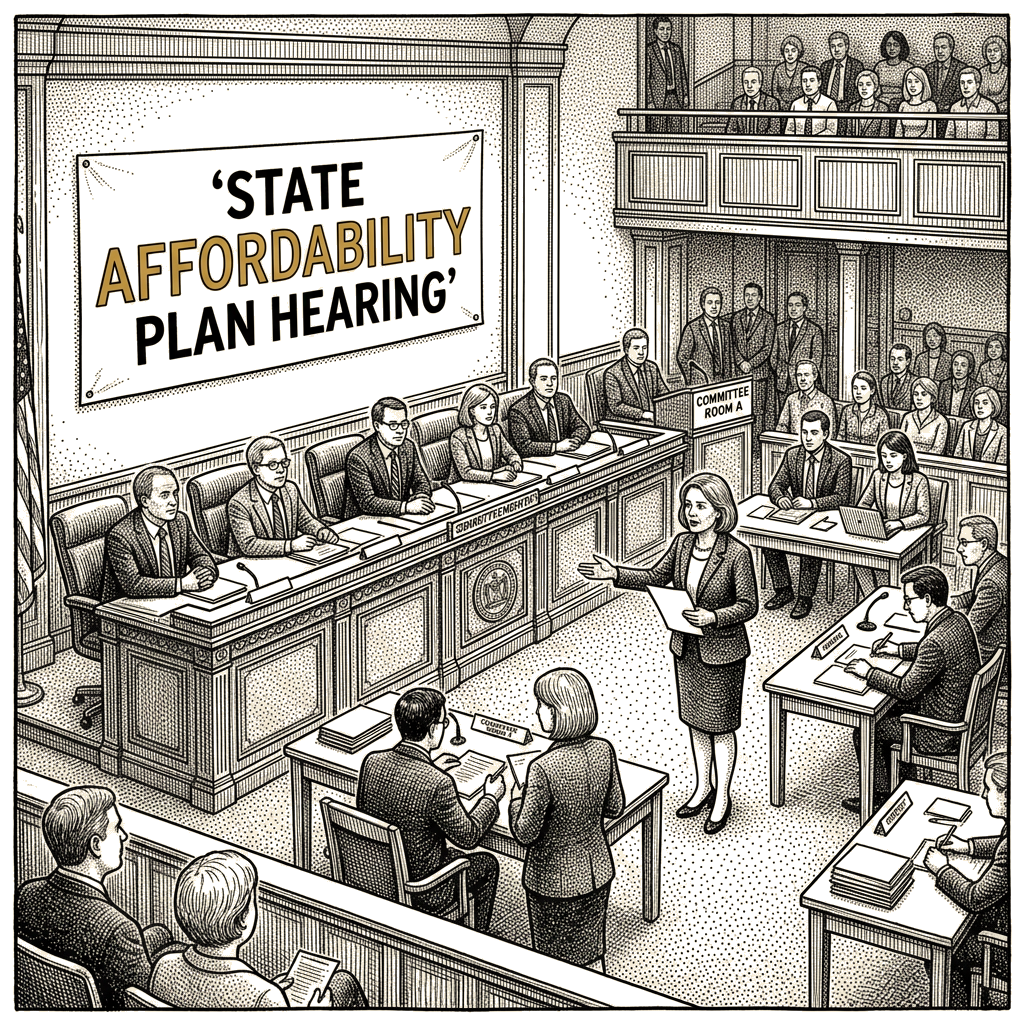
The thing straining state budgets is not the affordability agenda. It is the Medicaid cut, on a payment schedule Washington signed last year. Jeanne Whalen’s Wall Street Journal report and our state-by-state rundown trace the collision: S&P Global Ratings estimates that 90% of the Medicaid reductions will occur in fiscal years 2029 through 2034. The wave has not crested. It has barely left deep water.
Colorado’s voters replaced the state’s flat income tax with one imposing higher rates on people and businesses making more than $500,000 a year. The levy is expected to generate at least $2 billion in extra revenue each year, and state law requires that it go to health care, child care and education. And somebody finally priced the child care: the people and businesses above $500,000 were made to carry more of the bill. The economy is a set of choices, not the weather, and in Colorado a majority of actual voters walked into a booth and made one.
The states were not only choosing. In January, Democrats will hold a majority of governorships for the first time since 2010 and unified control of two dozen state legislatures. Six new trifectas will bring the total to 22. The governors who campaigned on expanding child care will be the governors who have to pay for it, and the plans are refreshingly specific. Jocelyn Benson wants a $5,000 caregiver tax credit, a $60,000 minimum starting salary for teachers and state money for medical-debt relief. Wisconsin Democrats are eyeing free school meals for every child and property-tax relief. Minnesota wants new health-care tax credits. Pennsylvania wants to fund housing construction. Nevada’s Aaron Ford wants help with security deposits, utility bills, rent and first-time down payments.
Now the honest part, because the honest part is real. The tension was visible in what these promises cost before a single budget landed. State finances have actually improved, according to S&P Global analyst Oscar Padilla, helped by stronger growth, federal pandemic stimulus and rising sales- and income-tax collections. But federal Medicaid and food-assistance cuts are beginning to squeeze that improved position.
Bob Schneider, a budget and tax policy expert at the Citizens Research Council of Michigan, puts Michigan’s fiscal 2028 hole at roughly $700 million, partly because federal money is scheduled to leave. Sarah Anthony, who chairs the state Senate Appropriations Committee, says she has to “keep the lights on” before she buys anything new. She also says new revenue is the only way to deliver sweeping affordability measures. Schneider says major commitments require new taxes or spending cuts elsewhere. Both are right.
Ford has acknowledged that the federal cuts will remove Medicaid coverage for some Nevadans; Medicaid insures about a quarter of the state. In Colorado, Emily Sirota says the new tax will more than close the $1 billion deficit the state had been facing. But she also says it is unclear how much of the $2 billion will remain available beyond Medicaid as state costs rise and federal funding falls. Reduced SNAP funding is already forcing states to tighten their belts. These officials are doing triage, and they are saying so out loud.
Pretending money grows from campaign speeches is not fiscal policy. It is the genre in which the funding line goes blank.
Gov.-elect Benson says she will not raise taxes on the middle class. She will close loopholes, strengthen growth and improve government instead. Fine. But if Washington does not restore the Medicaid money and Michigan refuses broad new revenue, somebody still has to sign for it: higher earners, hospitals or lower-income families. Refusing every option is still a choice. They do not get to bill it as weather.
Look at what the triage is for. The report calls the common constraint fiscal rather than legislative. That distinction hides the lever. Taxation is legislative. A deficit is what remains after the choices. It is not the weather.
The phrase of the season is that the state plans are “running into reality,” as if reality were a wall that materialized overnight. It did not materialize. It was legislated last year, with a payment schedule attached, and the payments have started landing on state ledgers. State Medicaid costs are rising. That is true. A federal cut can still be chosen in Washington and absorbed in Michigan, Colorado and Nevada.
A child who loses Medicaid coverage does not stop needing a pediatrician. The bill moves—to the county hospital, the emergency room, the state budget or the family. Cutting food assistance does not make hunger cheaper. It moves lunch to the school district, which is exactly why free school meals for every child is one of the sharpest lines in the whole state agenda. It catches the federal cut upstream, where it costs the least and lands the softest.
The cost never disappears. It moves.
The affordability agenda is not colliding with reality. It is the answer to a reality somebody else scheduled. Show that the federal cuts are not driving the squeeze, or stop calling the state plans the collision.
Take child care itself. How can care be affordable for parents, pay workers decently and still produce a profit for owners? Pick two. That is not ideology. It is the ratio of trained adults to children, and the arithmetic refuses all three corners at once. Every other rich country picks parents and workers and pays the difference deliberately in the budget. Benson’s $5,000 caregiver credit is the same arithmetic aimed at the other end of the care economy: five thousand dollars noticing the unpaid work the entire system quietly runs on.
Start with a child-care classroom, not a slogan. Pay the teacher a living wage. Cap what parents can be charged. Let parents and staff share governance through a nonprofit board or cooperative. Use public money to close the gap. Colorado is already directing new revenue to child care. These are not side dishes. Child care lets a parent take a job, a provider employ a teacher and an employer find a worker.
The same ownership answer belongs in health care and housing: a public option beside private insurers; community land trusts that keep homes out of speculation while families build equity; public housing; automatic enrollment in benefits. These are institutions, not slogans. Cooperative Home Care Associates in the Bronx shows the point: the people doing the care share ownership of the agency that employs them.
Nor is cash support a foreign fantasy. Census Bureau figures for 2021 show that the expanded monthly Child Tax Credit cut child poverty by roughly 46% and lifted about 2.9 million children out of poverty. Poverty rose again when the expansion lapsed. That was our own natural experiment.
The part worth copying is not any single program. It is the architecture, because the architecture survives. Michigan already provides free school meals, and Anthony says her priority is maintaining programs the state has already adopted. Means-tested programs are easier to cut once their strongest users have exited. Universal programs give more people a reason to defend them.
Every childhood summer at my aunt’s place outside Gothenburg, school lunch was just called lunch. My cousins ate free at school the way American kids ride the interstate. Nobody celebrated it. Nobody called it utopia. Colorado went a step further and wrote the destination into law: the new money must go to health care, child care and education. The ballot made the trade visible. Voters could see what the money had to buy before they approved it. Michigan’s flat-tax debate is another purchase order waiting for a signature.
The clock makes the case for building now rather than later. Ninety percent of the Medicaid reduction begins in fiscal 2029. From now until then, states have budget cycles in which to build their own floor. A state that uses them has somewhere for its people to land when the federal floor is pulled. A state that waits will improvise after the wave is already ashore.
It will still be harder here. The 22 trifectas are not a national welfare state. We have separate state tax codes, weaker unions, fractured parties and a federal government pushing Medicaid obligations downward. The Nordics did not create their bargaining systems with one law. They built union density, employer coordination and administrative capacity over generations. We cannot airlift Denmark and call it a policy. We have to build state by state while demanding a federal floor for Medicaid, child care and housing.
I grew up between my grandfather’s seat on a Minnesota dairy cooperative board and my aunt’s kitchen table in Sweden. One arrangement made ownership visible at the meeting. The other put a floor under a sick year. Neither required a command economy. Both took choices that looked inevitable only after people had built them.
Nor is public capacity imaginary. If there is a credit-union card in your wallet, you already carry a member-owned alternative to a shareholder bank. America has plenty of boring proof. That is the point.
I’m not anti-market. I’m anti-extraction and anti-ruin. A state can tax, regulate, subsidize, build and bargain. It can also decline. What it cannot do is turn refusal into arithmetic. A balanced budget that guts child care is not prudence. It is a choice with better branding.
So start with the 22 trifectas. Build universal child care, a public health option and housing people can keep, financed by taxes on the top and the closure of loopholes. Make Washington restore the Medicaid money it cut.
Picture January. In Eau Claire, a second-grader eats lunch she did not have to qualify for. In Warren, a woman keeps her mother at home instead of in a facility while a $5,000 caregiver credit waits on her tax return. In Reno, a security deposit stops being a wall.
None of it is utopia. All of it is a budget line. The economy is a set of choices, and this January, twenty-two states with unified government start making them. It is not easy. It is buildable. Build it.