The U.N. Loss-and-Damage Fund is betraying and starving Nepal’s flood survivors.
In March 1928, the Friendship Lake dam failed and took the Highway 13 bridge down with it. The Adams County Historical Society’s account has George Polivka, Frank Hollman, and George Armstrong standing on the span, waving traffic back. A car went in anyway. Cecil Renner, the driver, survived. Jesse and William Brodt, his passengers, did not. One dam. One bridge. One spring. I know, secondhand but sure, what a river does to a town when it turns. This county talked about it for a generation, until the story became part of the road.
Twelve springs running, I have written down the day the ice leaves Petenwell, always watched from the same bank, and the first-mosquito date. The ice has come eleven days earlier since the first winter I recorded it. The rut has moved about two weeks from where it used to run. On a warm March morning, the mosquitoes are already at the bench in the pole barn. The Wisconsin Initiative on Climate Change Impacts’ 2021 assessment puts the statewide numbers beside my notebook: Wisconsin has warmed about 3 degrees Fahrenheit since 1950, annual precipitation has risen 17 percent, and 2010 through 2019 was the state’s wettest decade since records began around 1900.
A county can widen a culvert and plan for water that comes when it wants. A Himalayan river can carry rock, ice, and debris downhill after frozen ground thaws. The scale changes. The direction of responsibility does not. Heat is made in one economy. The flood lands in another.
In August, floods in and around Nuwakot washed away entire villages and left thousands dead or missing. The reported toll reached 904 at the end of August as rescuers kept searching tunnels for hundreds. Along the Trishuli River, power lines, solar panels, cars, and homes remain partly buried in mud. Broken bridges cut survivors off from neighboring towns. They live in makeshift metal shelters and depend on donations for drinking water and food. Farmers who grew rice for their families wait to learn whether they will own their land again. Villagers gather around the mound of dirt where a temple where their families prayed for generations once stood.
Lakchin Bahadhur Tamang, 45, a hydropower plant worker, said, “God knows how long we will have to stay here.” He fears that once the aid organizations and helping hands leave, families will be “left helpless, without even enough drinking water.”
The study finding that climate change destabilized the glacier behind the Nepal-Tibet floods matters because this was not merely a weather event that happened to strike a mountain village. The International Centre for Integrated Mountain Development says glaciers and snow in the Hindu Kush Himalaya feed rivers on which nearly 2 billion people depend for drinking water, farming, and electricity. Warming destabilizes slopes as glaciers retreat and frozen ground thaws. Floods carrying rock, ice, and debris can cross borders within minutes, leaving little time to warn downstream communities. The early-warning systems meant to buy that time face funding cuts.
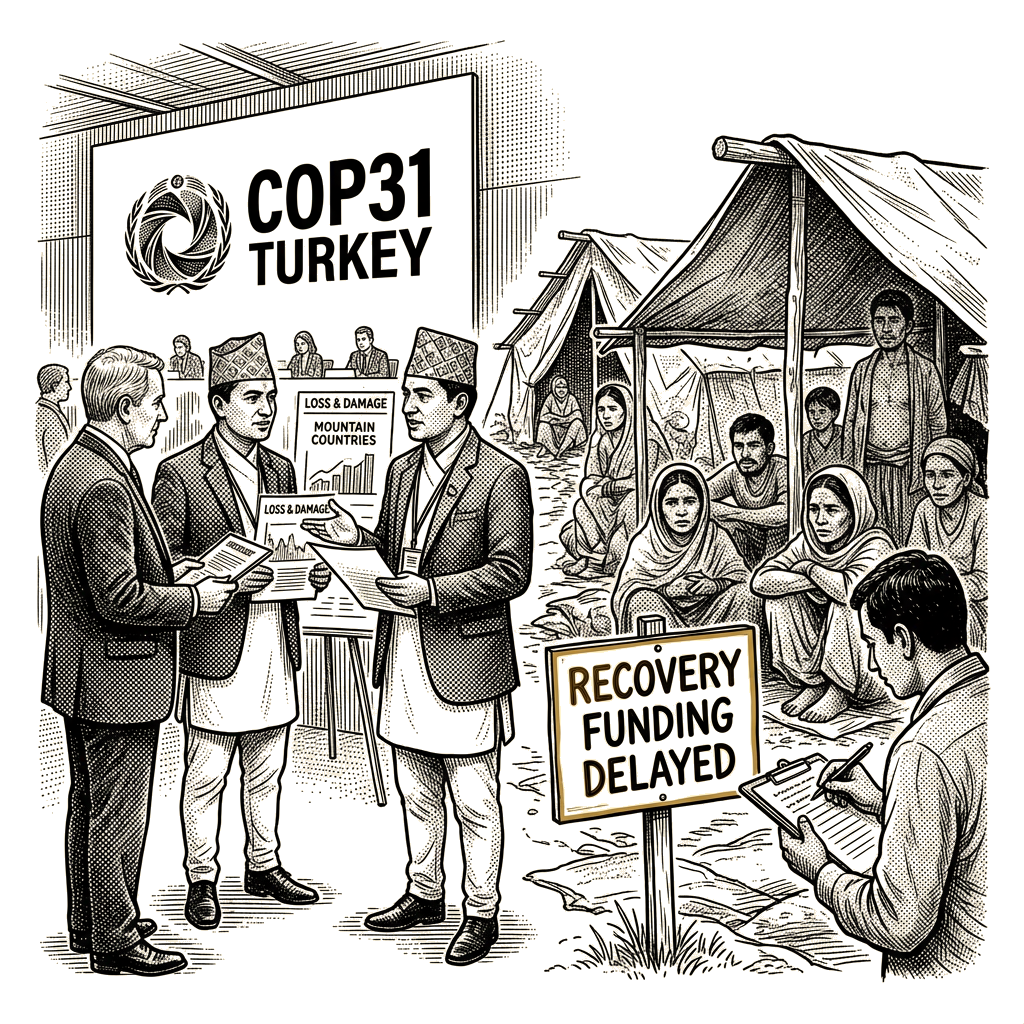
Nepal and Bhutan asked the COP31 negotiators for a dedicated agenda item on warming in mountain regions. Their proposal was not included. The mountain countries got a no. Instead, the mountains entered the talks as a briefing, a map, and a line of projected loss, while the people living beside the glaciers and rivers had no seat in the decision to put mountains on the agenda.
At the COP31 summit in Turkey, the U.N. Fund for Responding to Loss and Damage had pledged about $20 million to Nepal. The estimated flood losses were $2.5 billion. Twenty million dollars is less than one percent of the damage. Foreign Minister Shisir Khanal said rebuilding would cost about one-tenth of Nepal’s economy. Manjeet Dhakal, a member of Nepal’s delegation, welcomed the initial response but said, “the scale of the resources needs to increase.” The pledged money still requires a formal funding proposal and final approval from the fund’s board. No disbursement date has been announced. The board meets in December. A pledge can be counted at a microphone. Drinking water has to reach a shelter.
Across the fund, more than $820 million has been pledged against 176 requests totaling about $2.8 billion. The pledges cover roughly 29 cents of every dollar asked for. A fund starved by its donors is still the fund built to answer. So far, its answer to Nepal is a pledge with no date on it.
The fund was established in 2022 after years of debate over what developed nations owe poorer countries that did little to cause climate change. The United States has historically been the No. 1 carbon polluter. Nepal contributed very little to global carbon emissions. Yet Nepal’s flood survivors must document the destruction, submit a proposal, and wait for a board while donor governments decide how to honor their pledges. Wealth built on the burning gets time to deliberate. The flooded family waits beside the mud.
Dhurba Bhandari, 41, a small store owner, said: “Nepal had contributed very little to global carbon emissions yet had been devastated. The international community must take responsibility and help people who have been displaced, as well as support reconstruction.” That is the harder truth: a country with little power to cause the warming should not carry the recovery bill for those who had much.
In “The Total Economy” in The Unsettling of America, Wendell Berry wrote that an economy organized around the cheapest possible cost does not erase its real costs. It hands them to the people and places least able to refuse the bill. For about a century, the bill for cheap coal and cheap gasoline went to the sky because the sky could not refuse delivery. Now the sky is collecting through mountain rivers, and the people holding the losses grew rice, kept hydropower running, and burned very little of the fuel that did the damage. Delay has its beneficiaries too. Every year the payment waits is another year the market for the fuel that did the damage runs undisturbed, and another year the treasuries that would have to fill the fund keep the money.
The physics is not in a negotiating mood. Global average temperatures are set to pass the 1.5-degree Celsius mark, 2.7 degrees Fahrenheit above the early 1800s, a threshold set in the 2015 Paris Agreement. The warming is driven mainly by burning gas, coal, and oil, and returning the global average below that mark would require reductions the world has not achieved. Pam Pearson, director of the International Cryosphere Climate Initiative, warned that snow and ice can disappear rapidly while recovery takes centuries or millennia. “There is no negotiating with the melting point of ice,” she said.
Pema Gyamtsho, director general of the International Centre for Integrated Mountain Development, said Himalayan disasters repeatedly had been treated as warnings. “Every time there’s a disaster in the Himalayas, we tend to call it a wake-up call,” he said. “The question before us is: What will it take for us to wake up and take action?”
Aldo Leopold, whose Wisconsin land ethic grew out of this state’s sand counties—his own worn-out farm stood in Sauk County—argued in “Thinking Like a Mountain” that a mountain’s judgment runs on a longer clock than a person’s. The Himalaya is being asked to absorb a century of somebody else’s combustion on a decade’s schedule. A mountain answers as a dam answers: it holds for a long time, and then it lets go all at once.
The carbon debt runs through my shop. The LP that heats the bench in January, the diesel in my 2014 Silverado, and the fuel I burn at the Co-op all run on it. I live in the country that did the historic burning, and I burn some of that fuel too. American crude production set records under the last two presidents, while the loss-and-damage fund remained underfunded throughout its life. The carbon arithmetic does not care which president held the White House.
The Stockholm Environment Institute estimates that lower-income countries will need between $400 billion and $1.6 trillion per year for loss-and-damage finance by 2030. Set the entire fund’s $820 million in pledges against the low end of that estimate, and it comes to roughly two-tenths of one percent of a single year’s need. The board can decide Nepal’s request. It cannot turn $820 million into $2.8 billion. The delay is one wrong. The scale is the other. Scale is a political choice.
After high water in this county, I have watched the order of arrival. The order is backward from the order of need. Cameras come first. Then sandbags and donation barrels. Then engineers. Years later, if the budget holds, the finished bridge. Tamang has already named the stage he dreads: the day the helping hands pull out. The cheap instruments are being cut while the expensive damage compounds. Early-warning systems face funding cuts even as experts at the summit ask for slope monitoring, dangerous glacial-lake monitoring, information shared across borders in real time, coordinated warning, and global funding. A debris flood out of the Himalaya gives minutes, not hours. The alarm has to be built before the water moves, and paid for like the road itself.
Shisir Khanal said it at the summit: “After the disaster, we received an outpouring of sympathy. This is the time to put sympathy into the system.” The sympathy arrived. The system is what never did. A real loss-and-damage fund would advance money against independently verified losses, let Nepal’s local institutions and affected communities govern the repair, and finance cross-border warning systems before another flood instead of after one. Putting sympathy into the system means attaching a disbursement date to every pledge and paying for the unglamorous instruments first: slope monitors, shared warnings, roads, and bridges.
I keep thinking about Mike and Quinn, who will inherit this atmosphere and the institutions meant to meet it. The wealth that profited from the burning cannot make the survivors pay twice.
At the bench, I keep a book of repair bills customers have not paid. I write down the amount and the date—not out of meanness; a debt nobody writes down is a debt everybody gets to pretend does not exist. Somewhere in this system, there is a ledger with $820 million in the pledge column and a payment-date column that is mostly blank. Write the dates in.