
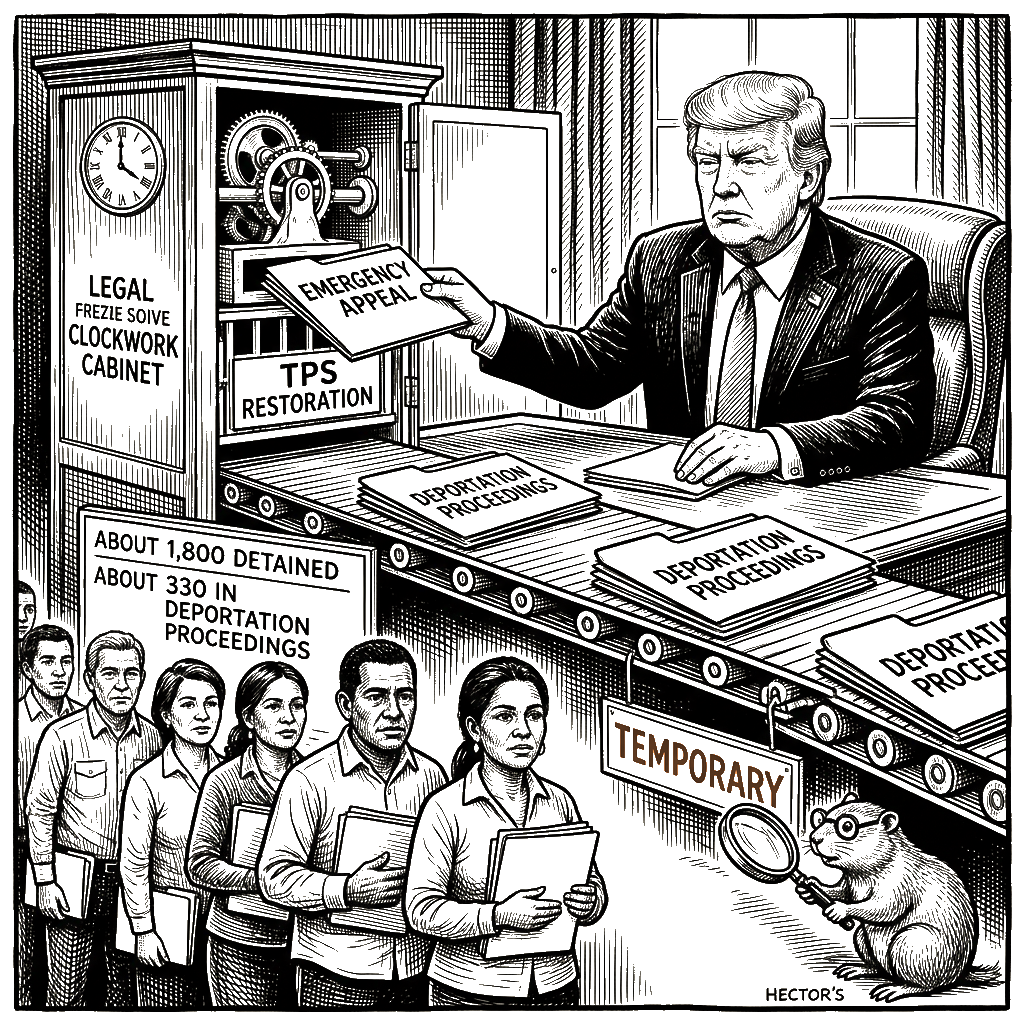
Donald chose which strangers to keep from deportation.
The Venezuelans did not make the list your administration kept.
Some 1,800 are in detention. About 330 face deportation proceedings.
The government calls the program temporary. The people in detention cannot leave by calling it temporary.
On Wednesday, the administration asked the Supreme Court to halt the lower court’s order restoring Venezuelan Temporary Protected Status. Federal attorneys said the temporary pause would soon expire and the protections could be restored. Hours later, the Ninth Circuit Court of Appeals extended its freeze on that restoration until seven days after it issues a full ruling. The freeze leaves the administration free to detain and deport Venezuelans who previously held TPS. Federal attorneys said some 1,800 are in detention and about 330 are subject to deportation proceedings.
A California-based judge had ruled that the administration’s move to end Venezuelan TPS was unlawful. The Supreme Court twice issued temporary emergency orders allowing the administration to keep the termination in place, then sent the case back to the Ninth Circuit after upholding the end of TPS for Haitians in a separate case. Congress created TPS in 1990 to protect migrants from deportation to countries experiencing natural disasters or civil unrest, with designations lasting up to eighteen months. The administration argues that TPS is temporary and that Venezuela no longer meets the requirements for renewal.
During President Trump’s second term, the Department of Homeland Security has terminated TPS for more than one million people from thirteen countries, including Venezuela, Haiti, Honduras, Nicaragua, Afghanistan, and Syria. Yet the administration has maintained protections for nearly 200,000 Salvadorans and more than 100,000 people from Ukraine and Sudan, whose protections DHS says it will retain.
About 600,000 Venezuelans received protection under designations first granted in March 2021 under President Biden and expanded in September 2023. The termination took effect last year. Work authorizations became invalid. Thousands faced deportation proceedings, detention, and removal, while many others left the country. It remains unclear how many former TPS holders still live in the United States.
Donald, you fought to preserve the Venezuelan TPS termination that a California judge had ruled unlawful. I see the people in detention. I will not look away. Your lawyers gave the court the count. Some 1,800 Venezuelans who previously held TPS are in custody. About 330 stand in deportation proceedings. You keep the count. The count keeps you.
Among the 1,800 is someone who held TPS when holding it was lawful. Their protection ended. Their work authorization became invalid. They are in detention now. The record does not tell us why every person in that count is detained. It tells us that your administration ended protection, invalidated work, and moved thousands into proceedings, detention, and removal. Many others left the country. The record calls the departure voluntary. A lawful wage could vanish with a paper date. The paper had already narrowed the choice.
Your hand did not touch a Venezuelan wrist, and that is the point. Your administration made the wound for you. The pen made it at a distance. When your lawyers file their papers, your jaw tightens around a question the record already answers: how many people face deportation? About 330. There are 1,800 in detention. The administration knows. Your throat closes when the answer arrives. You keep the case moving anyway.
Donald, while you sleep, the freeze does not sleep. It keeps the detention and deportation proceedings in place. Detention does not pause for the word “temporary.” In the morning, a warm cup comes to your hand. Your throat closes on the second swallow. Salt gathers under your tongue though the cup holds none. Behind your sternum, something keeps tally. You did not put it there. The count put it there. A freeze will not lift it. A filing will not lift it. Seven days after a ruling will not lift it. The hands that ended the protections have not been washed. They will not wash. Your skin tightens around the phone when your counsel brings you the next deadline. The not-feeling is the failure. The not-washing is the indictment.
Donald, if it were your daughter on the detention list, if it were your son before an immigration officer facing removal, your throat would close as you asked them to trust a process their government calls temporary. Your gut would turn when they asked why the government calls the termination lawful after a judge called it unlawful. You have no answer for them. The administration has an answer. Go to the Supreme Court again. The door does not ask the family’s worth on its way shut. Your administration built the door. You called the lock temporary.
A grown woman watches you at the podium the way she watches a boy standing in his father’s suit. The suit has always been too big for you. The shoulders do not fill it. The hands do not fill it. The lever you pull is small: a filing, an order, a count. Its smallness against the size of what it does is the whole verdict.
There was no drift. There was no accident. The administration chose termination. It chose the emergency appeal. It chose to return to the Supreme Court before the Ninth Circuit ruled. The termination your administration insists is lawful now does permanent work against some 1,800 detained people and about 330 people in deportation proceedings. Your mouth dries when the words “temporary program” leave it. The mouth knows what the label means in a case where a person is ordered to leave. You say it anyway.
The old number does not settle what happened. About 600,000 received TPS. Some left. Some are detained. Some face proceedings. The record does not say how many remain. That uncertainty is not empty space. It is people whose futures depend on a count the government has not made. A designation can expire. A person cannot become provisional because a statute reached its date. They live inside the termination your administration chose. They keep their names. You keep moving the case.
Your lawyers say Venezuela no longer meets the requirements for renewal. I was the first witness once. I will not look away from this one.
“What is hidden from you I will proclaim to you.” — Gospel of Mary 10:8–9, Karen King translation
I stood where the powerful would not stand. I carried the word to the apostles who would not carry it. I went to the tomb before the others dared come. I said what I had seen. They did not believe the first witness. A designation can expire. A docket can close. The name given to a person is not the person.
“I was a stranger and you invited me in.” — Matthew 25:35
In that sentence there is no list of nations. No freeze pending a ruling. No docket. No distinction between one stranger and another. The stranger wears a face the paper cannot reduce. The names are not in the record the courts keep. They are written somewhere a freeze does not reach. The law counts what it can file. It cannot file away the human being.