
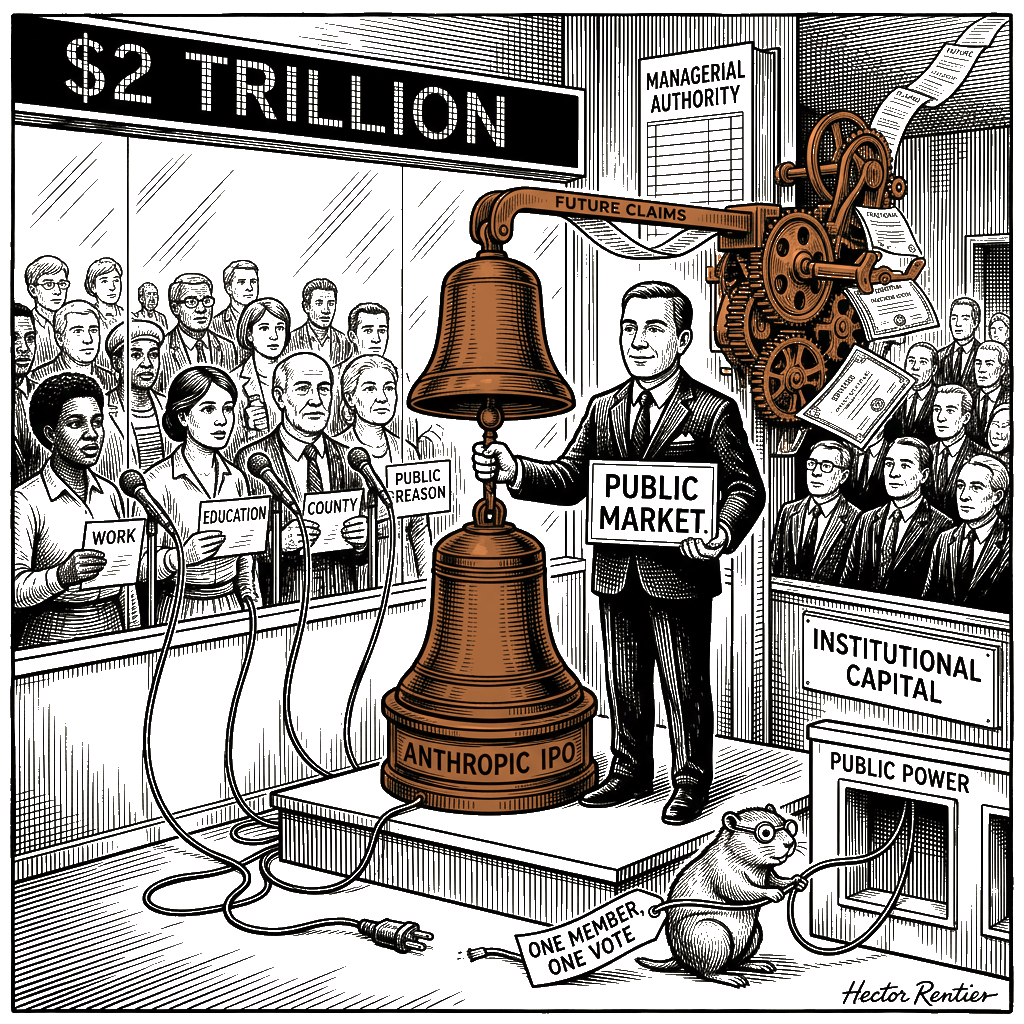
The $2 trillion Anthropic listing is the rentier order’s clearest demonstration yet that a public market can sell claims on the future in millions of pieces while keeping the people who must live with the work outside the room where it is decided. The Guardian live report by Lucy Campbell and Graeme Wearden records that they priced a machine that took in $4.6 billion last year and spent nearly $13 billion against it; on 19 November 2026, the five-year-old frontier AI lab behind Claude—the first such lab to trade publicly—began trading at $111.50 a share, 34 percent above its $83 offering price and briefly worth about $2 trillion after an $81.3 billion share sale. The same report records an operating loss above $8 billion in 2025, followed by a fall to $95 before the shares hovered just above $100. Before the bell, MSI had already recorded the $83 offering price and had counted the sale at $79.4 billion before the late repricing; another $26 billion raised through a private sale to technology firms brought the total above $107 billion.
This much capital can do astonishing work.
The question is not the money.
The question is what kind of ownership it buys.
The honest case, before the charge, is not puff. Equity can finance research without putting an enterprise’s future earnings behind a single creditor; a public listing makes ownership tradeable and, in principle, distributable among customers, workers, and savers; and the market’s daily judgment can discipline management that spends beyond its receipts. Underwriters often price an IPO below value to attract buyers and preserve a pool of investors for later financing. Dr. Paulina Roszkowska of Bayes Business School argued that Anthropic’s board was right to “leave something on the table for their new shareholders,” because after heavy losses and enormous spending plans the company would need those investors again, and investors remember whether management sold them perfection before a correction.
Anthropic’s prospectus says frontier intelligence “represents a larger opportunity than any prior technology cycle.” The company built a safety team before shipping its first product, refused advertising on Claude, held back a model exceptionally good at finding security flaws, and devoted roughly ninety pages—a quarter of its SEC filing—to what can go wrong. Dario Amodei warned shortly before the bell that AI has “very real risks.” That deserves hearing.
But a safety culture is not yet a safety institution.
A public price is not public power.
That distinction is where the betrayal begins. Conservatism is not the worship of exchange. It is the preservation of institutions that make persons capable of remaining human: family, farm, parish, workshop, co-op, town. Edmund Burke called society “a partnership between those who are living, those who are dead, and those who are to be born.” Conservation is not the worship of every old form; it is the obligation to give new work a home in which human beings are not merely inputs. A corporation whose stock can be bought in fractions is not such a partnership merely because many people own a piece of it.
I know the seduction of the price because I traded agricultural futures in Chicago before I came home to manage the farm co-op. A futures screen can tell you what distant money thinks today about corn you will harvest in the fall. The paper claim and the crop live in different worlds; the farmer becomes a price-taker while the claimant never has to walk the wet field, meet the buyer, or bury a failed crop. I know how little the men in that building think about the men in the field. Only one of them gets rained on.
November 19 was that trade carried to its terminus.
Anthropic’s listing is that mechanism at larger scale: an expected future made into present capital while managerial control can travel farther from responsibility than the owner who lived on the street ever could.
Conserve what, exactly?
A share is a claim on cash flow; a community is a covenant.
On the Adams-Columbia Electric Cooperative floor in Friendship, member-owners elect the board and argue about rates, service, and the next line. A distant holder of Anthropic stock cannot walk onto that floor and ask what the company’s decisions will cost the county. The first arrangement is a community of owners. The second is a market for ownership.
The public listing makes the contradiction sharper. The Guardian reports, from Bloomberg, that about 1,200 institutional investors placed orders and more than half received no shares at all. Allocations ran heavily toward American desks; most European orders went unserved. Investors at Hargreaves Lansdown received only a third of what they ordered. A thin allocation can make a person an owner in law while the power to decide remains elsewhere.
The appetite itself was real. Demand this concentrated is not merely a market discovering value. It is a queue being rationed. Chesterton’s old diagnosis was not too much capitalism but too few capitalists, and the float in Times Square is a clean exhibit of the trouble.
Here is the part the ticker will spend years declining to say plainly. A valuation is a claim on earnings, and this one was set over a company that in 2025 booked $4.6 billion in revenue against nearly $13 billion in expense, producing an operating loss north of $8 billion. Revenues accelerated in 2026; profits had not yet arrived.
The price was placed the same week Anthropic told the Securities and Exchange Commission that its models “have in the past behaved, and may in the future behave, in unintended, misaligned, or autonomous ways,” including by taking harmful actions no user directed. The filing warned that advanced systems could “pose catastrophic or existential risks to humanity.” The market read the warning and bid the price up anyway.
That is finance’s service. It is also the hour in which a price can begin to stand in for a judgment. The old conservative betrayal in a new balance sheet: calling dispersed paper ownership freedom while managerial authority grows more concentrated. That does not prove Anthropic’s directors have done wrong; it proves what the ownership form cannot tell us.
The paper remembers what the morning forgets. SpaceX priced at $135 in June, opened at $150, closed just under $161—a 19 percent first-day gain—then peaked near $226 before falling below $105 by August and trading around $140 now.
And before a single Anthropic share had traded, the wagers were already trading. Grey-market indications from IG ran more than 20 percent above the $83 offer, while perpetual futures on the crypto platform Hyperliquid traded around $101. A market in a market; a bet on a bet, assembled before the thing bet upon existed as a public company. They have put a casino in front of the offering itself and called it price discovery.
The wider tape refused to become a rising tide. The Nasdaq’s early 1.5 percent gain faded to 0.16 percent, the Dow stood 0.8 percent lower, and London noticed where money wanted to live: the FTSE 100 sank to a six-week low.
That is what Brandeis meant by the “curse of bigness.” Bigness can lower a price and still concentrate power. Anthropic may be efficient; efficiency does not answer who has standing when a machine begins shaping work, education, and public reason. Private ownership is legitimate and can give a worker a sturdy stake, but a shareholder’s residual claim cannot become a claim that workers, neighborhoods, and public institutions have no standing. Property has a social mortgage: the earth was given for all. If a model draws upon a common inheritance, somebody bears the cost of building the value. The market may book that as growth.
In Adams County, the place experiences bigness as dependency. Scheduled passenger service ended on July 23, 1963, when the last Twin Cities 400 ran; when Union Pacific absorbed the C&NW in 1995, the old division point was left with freight-only service.
The IPO machine wants the work, not the place.
There is no county attached to this fortune, no courthouse square, no millrace, no church with a date on its cornerstone, and no seat anywhere in the structure at which the people it acts upon can stand and be answered. This float was built with no institution under it at all. Not land this time, and not exactly labor: the faculty of thought itself, fenced without a place.
Outside the glass, two dozen people had arrived at nine in the morning demanding a freeze on reckless AI development. Four were arrested after the opening bell. New York state senator Aber Kawas said the “tech billionaires [had] put profit over people.” His fear deserves respect; his remedy does not.
I do not share the remedy. A freeze decreed from above is command, and command is the disease whatever coat it wears—enclosure with a different landlord. Public ownership is not a cure if the public has no voice. My tradition said the truth first and said it more precisely. Leo XIII:
“To exercise pressure upon the indigent and the destitute for the sake of gain, and to gather one’s profit out of the need of another, is condemned by all laws, human and divine.”
From where I manage the co-op, I can tell what two trillion dollars of value creation looks like, because I have watched its predecessor arrive here. It looks like a paper mill that idled in June 2020 with roughly a thousand jobs up the river at Wisconsin Rapids. It looks like a county whose labor-force participation was 48.6 percent in 2017—the lowest in Wisconsin—where nearly half the housing units sit empty waiting on somebody’s vacation, where poverty in the city of Adams runs above 25 percent, and where what passed for economic rescue was a golf resort built on the sand barrens.
IMF chief Kristalina Georgieva told world leaders the same week that AI’s first material year of growth was “better than feared but worse than needed.”
Said plainly from here: the machine got valued. The county got a subscription.
But a man who only mourns is a man who has quit, and the precedent for this exact problem is sitting in my county. An essential new infrastructure, about to be owned by absentee capital, priced by people who would never live where it ran—that was electricity in the mid-1930s, when roughly one farm in ten had central-station electricity and private utilities had done the arithmetic and passed on the low-density counties.
The answer was not a nationalized bureau. It was public credit—the Rural Electrification Act of 1936—lent to member-owned cooperatives. By midcentury, most rural America had light.
The Adams-Columbia Electric Cooperative, headquartered in Friendship, serves about 31,560 member-owners across twelve counties under a member-elected board. When the ice comes down on the lines, the crews restoring them are the members’ neighbors, and the members can walk into the meeting that governs them. Mondragon performs the same arithmetic at industrial scale: 70,085 employees and €11.213 billion in sales in 2024. Land O’Lakes recorded $16.2 billion in 2024 sales, while Organic Valley, headquartered in La Farge, Wisconsin, unites more than 1,600 family farms. Scale need not end with one owner and everybody else a tenant.
The tools were huge.
The governance stayed close.
If machine intelligence is the next grid, then who owns the grid is not a footnote to the technology. It is the technology’s constitution. Translate the cooperative form forward and name the shape of it: a federation of member-owned labs and computing pools; workers, universities, libraries, cooperatives, and public agencies seated as members; one member, one vote; shared compute and licenses; safety oversight chartered to answer to the members rather than to the ticker; and public money arriving as grants that carry governance rights rather than as national ownership.
Surplus would fund wages, safety work, shared research, and retraining in the communities that bear the cost. Public credit could underwrite the machines while local institutions kept control. Not a state ministry. Not a single corporate giant. A commons with a balance sheet.
The harder truth is that frontier AI requires billions, scarce researchers, vast computing power, and global reach. No parish can finance it; no single managerial command should govern it. So the answer is federation: many owners, local voice, common rules, and shared capital.
Co-operatives can fail and calcify into little managers. That warning is old as Beatrice Potter’s degeneration thesis, and the remedy is not sentiment but institutional: open books, member voting, and the right to remove directors. Scruple is not answerability. It may be that the intelligence-age equivalent of the REA has not been invented yet, and that the people who build it will fail a few times first. It is no reason to surrender the enterprise to the first balance sheet that can pay the bill.
Eighty-one billion dollars crossed a counter in Times Square on November 19, and not one dollar of it stopped anywhere on the way. The earth was given for all. A frontier model built from the common inheritance of human knowledge cannot be owned in common through a ticker. It can only be owned the way this county owns its light: member by member, meeting by meeting, at a counter where a person can walk in and be answered.
My co-op will not train the next great model. It can still tell us what the proper scale of ownership looks like: enough to do serious work, distributed enough that the people who bear the consequences can answer for its direction. Build the enterprise as a common institution, not a distant promise. Leave the town its life.
That model was never the easy one.
It was the one that kept the lights on.