
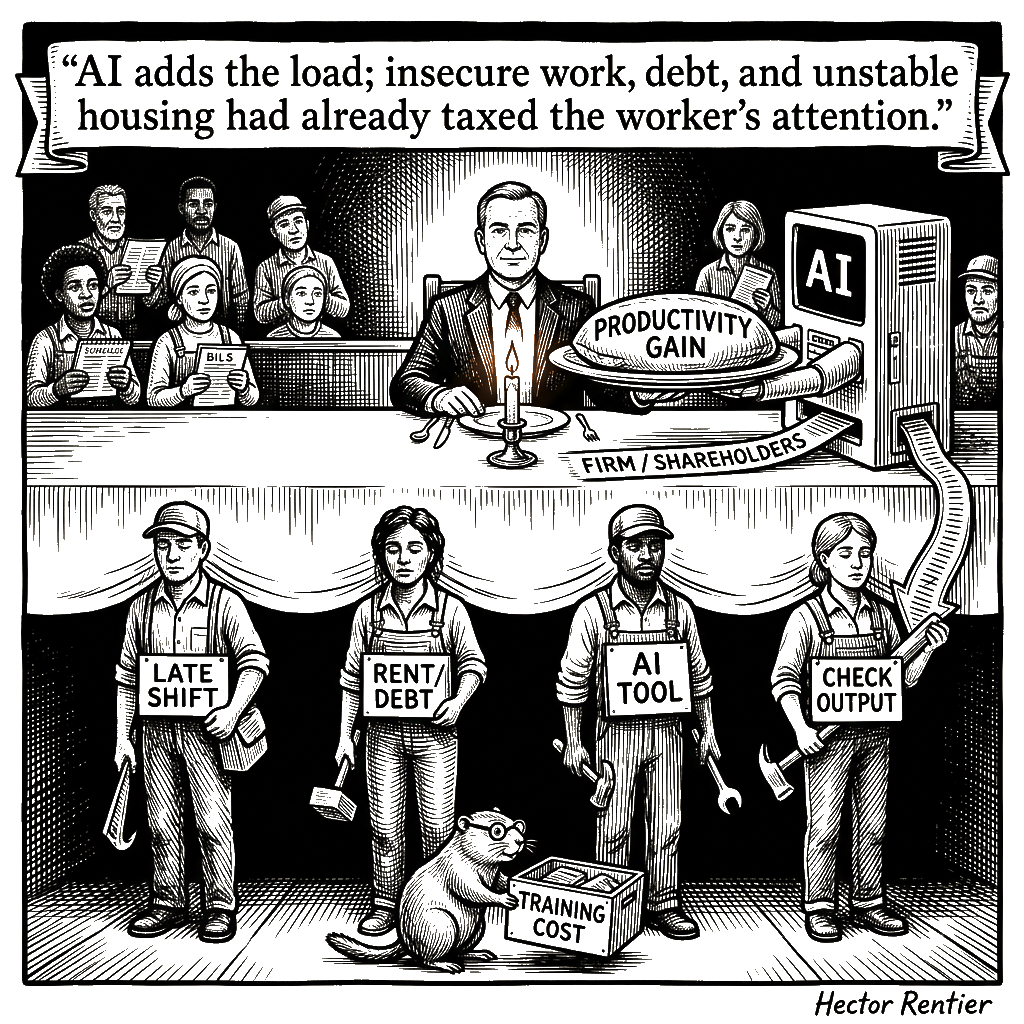
AI adds the load; it did not invent the tax. Insecure work built it. Henrietta Moore’s argument in The Guardian is right that AI is increasing cognitive strain for workers already squeezed by unpredictable pay, insecure housing and debt. She calls it a hidden “cognitive tax” and proposes universal childcare, housing, transport and digital access, free at the point of use. The machine is the new pressure. The old extraction is the foundation.
AI’s added cost is real. The World Economic Forum estimates that 59 in every 100 workers will need training to adapt by 2030. Walmart workers have described AI-set schedules. Research from the Boston Consulting Group cited by Moore finds that using AI adds mental fatigue. A 2024 analysis of 112,000 people in the Journal of Economic Psychology found that financial scarcity measurably impairs thinking. Low-paid rural Indian workers paid a few days early were 7% more productive and made fewer mistakes. We are apparently running short on spare attention. How reassuring.
None of this is fake. None of it is the whole bill. AI is raising the bill, but employers are still choosing who pays: the firm that captures the productivity gain, or the worker whose attention, mistakes and recovery absorb the transition. I’m not anti-AI. I’m against extraction.
Moore’s example is small and exact. A worker loses a shift at the last minute. Her rent goes up. She puts the shortfall on a credit card. Preoccupied with finding the rent, she returns a benefits form late and loses part of her benefit as a penalty. Three small setbacks leave her household poorer in money, headspace and health.
The benefits system turns one administrative mistake into another subtraction. The employer gets a more flexible workforce without guaranteeing more hours. AI did not invent this arrangement. It adds another set of instructions to somebody already performing under pressure.
That is why brain-capital indices can flatter a place. As Moore notes, they omit whether income is predictable, debt manageable or housing safe. A country can rank well for human potential while asking its poorest people to spend their attention on whether they can make rent. The missing thing is not brainpower. It is bargaining power.
If an employer may use AI to reshape a job, require checking its output and keep the productivity gains, the cost of adaptation has been moved to the worker. The worker pays in attention, mistakes and recovery time. The firm has found a very convenient battery. The employer’s catechism is simple: install the tool, keep the productivity gain and call the worker’s adaptation “training.”
The schedule says otherwise. When hours move, training and the work itself all demand attention at once. When AI makes human judgment more valuable, workers with the least control over pace, tools and schedules are often the ones asked to adapt fastest. That is not weather. It is a bargaining decision.
Britain shows what the old tax cost before AI gave it a shiny interface. About 2.7 million people are out of work through long-term sickness. Moore’s UCL Institute for Global Prosperity found that insecurity across several areas of life carries an earnings penalty as large as the gender pay gap, one that roughly doubles after seven years. We do not need to debate whether an algorithm is ready to fire anyone. The worker is already spending attention to stay solvent. AI raises the rate on the debt. It did not create the creditor.
This also makes Silicon Valley’s favorite answer too small. Elon Musk says AI will bring “universal high income.” Moore notes that a study funded by Sam Altman, giving low-income Americans $1,000 a month, found that mental-health gains faded after the first year. That is not evidence that cash is useless. It is evidence that cash cannot guarantee a nursery place, a bus that arrives, a lease that does not explode or a schedule set by a human who can be bargained with. A check can buy a month. It cannot make next month predictable.
I grew up between two versions of this bargain. At my aunt’s kitchen table on the Swedish west coast, nobody treated childcare and health care as a moral emergency. They were plumbing. On my grandfather’s Minnesota co-op board, mutual aid was ordinary. Neither arrangement was magic. Both were built.
So what do we build? One rule: the employer or platform that captures the productivity gain must carry more of the cost of making that gain possible. Public services, bargaining and worker ownership can do that work.
Start with public services—the library model, not the lottery ticket. Childcare, housing support, transport, health care and digital access should be available to everyone, paid for broadly and free when used. Everyone pays. That is not a bug. The bill becomes public and visible instead of a private surcharge collected through rent, debt and lost benefits. Universal design also makes the system durable because the middle class uses and defends it.
Extending free childcare alone is expected to bring 60,000 non-working parents into jobs in Britain. That is not charity. It is also labor supply that the unsubsidized market keeps failing to price.
The American receipt for money is harder to dismiss. According to the Census Bureau, the expanded Child Tax Credit cut child poverty by 46% in 2021, from 9.7% to 5.2%. Census researchers estimated that 2.9 million children left poverty overall, with about 2.1 million of that reduction attributable specifically to the expansion. When the expansion lapsed, poverty rose again. Money works. It simply cannot do the job of a nursery place or a secure lease alone. One cash benefit cannot replace every service. It can show that a public floor can move at scale—and that a household should not absorb every shock alone.
Then make retraining paid, protected time. A worker cannot be required to learn the employer’s new tool after the shift at their own expense. In low-wage care, logistics, retail and food service, sectoral agreements or state wage boards can bargain over notice of schedule changes, paid time for AI training, limits on automated monitoring, error responsibility and how productivity gains are shared. Some states already permit sectoral wage boards.
A union is a thousand people negotiating one price together. This is the same market mechanism applied to the terms under which AI enters work. I am not against turning people into the unpaid quality-control department for a machine and sending them home with more surveillance. If the tool saves labor, some of that labor should become time.
Nor should the floor wait for layoffs. AI job-loss warnings have renewed serious interest in a federal job guarantee. A job guarantee is not a crystal ball. It is public capacity to offer paid work and training while firms and sectors adjust, paired with wage standards and active labor-market policy: training and placement, not a slogan.
Finally, put the saved productivity back into the bargain. If AI lets a firm serve more clients with the same staff, a shareholder firm gives the gain to shareholders. A worker co-op lets workers decide whether it becomes wages, shorter hours, training or more jobs. Mondragon shows that worker ownership can scale to 70,000 people across roughly 80 cooperatives and more than €11 billion in revenue. Its 2013 Fagor bankruptcy shows the other half: co-ops are not magic; they need finance and discipline. Ownership does not abolish the market. It changes who has a vote when the market changes.
Denmark already shows the transferable piece. Flexicurity makes it easy for the boss to fire and much harder for the worker to fall. About 2% of GDP goes into retraining and job placement, while collective bargaining covers more than 80% of workers. The point is not to preserve every obsolete job forever. It is to let firms fail without letting workers fall. America, where collective-bargaining coverage is about 11%, does not have that machinery.
The reason this is harder here is not that Americans are uniquely incapable of learning. Walk me through the machinery. Denmark’s system took a century of unions, organized employers, capable administration and trust that services arrive. We have federalism, which can give us fifty laboratories if politicians use it that way, and a political habit of treating universal provision as a moral verdict rather than plumbing.
Importing a Danish policy without the Danish institutions would be silly. Treating the Danish institutions as weather would be sillier. Start with state and local wage boards, public services and worker institutions. Then make them work together. Slower than a press release. Pipes last longer than slogans.
North Dakota has run the Bank of North Dakota profitably since 1919. Public banks can finance housing cooperatives and small businesses where private banks will not. Community land trusts can take housing out of the speculation casino while letting families build equity. Then federal provision can grow where state capacity exists.
Build it as one machine: public services stop insecurity from taxing minds; bargaining rules require employers to pay for schedule certainty and adaptation; worker ownership governs how the productivity gain is shared. That is not a catalogue of nice ideas. It is one cost-bearing arrangement.
The point is not to turn exhausted people into perpetual students. It is to stop asking them to pay for a system designed to use their exhaustion. The question is not whether workers can learn faster than the machine. It is whether the people expected to create the productivity will own enough security and power to use it.
If firms want that gain, they must pay for the floor and bargain over the division of productivity, the paid time spent learning the new tool, and the rules for monitoring, scheduling and pace. Either employers carry more of the cost of adaptation, or they cannot keep calling the productivity gain theirs. The alternative is not a slower machine. It is the same old tax with a newer interface. So build the floor first. Then let the machines help.