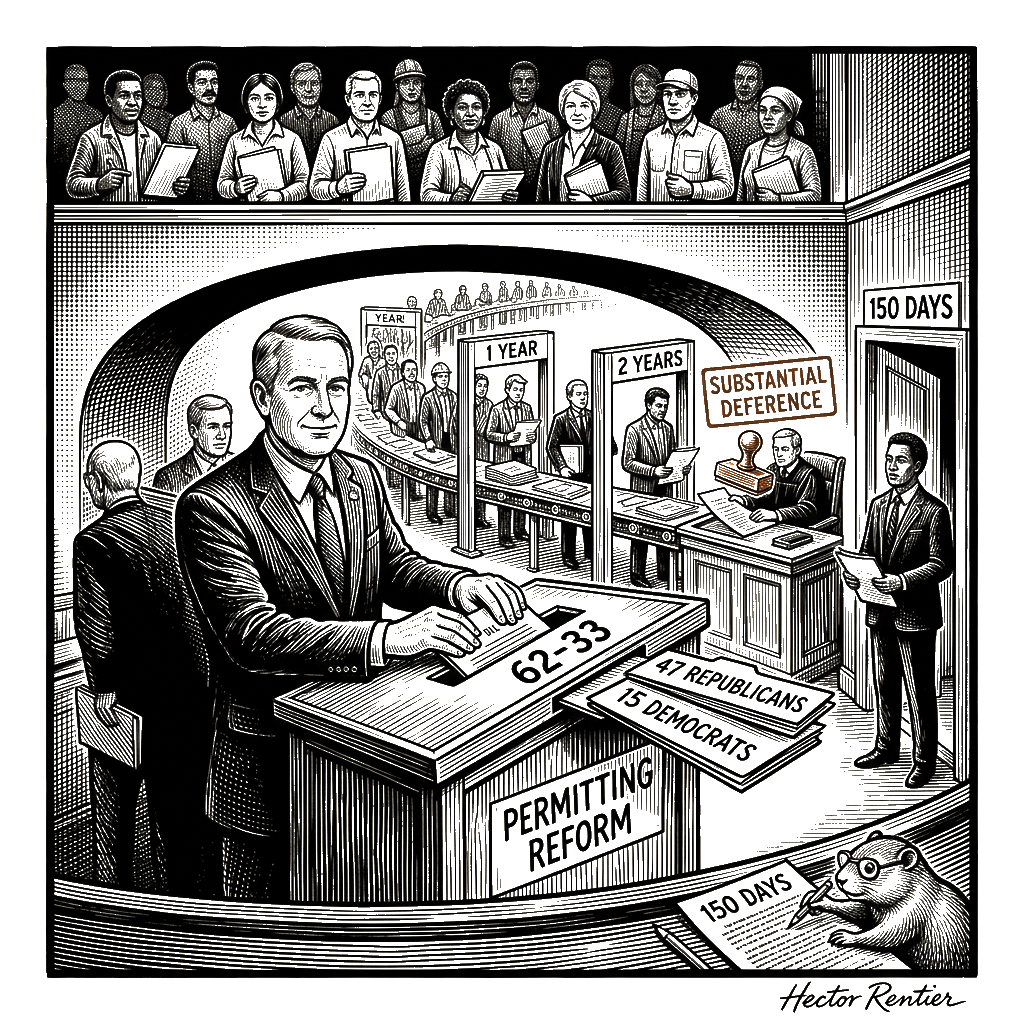
Triumph of stupidity, the Senate on Thursday passed a bipartisan permitting reform bill, 62-33, that will speed up projects from bridge repairs to pipelines for corporate interests. Let’s hope the House does not squander the chance to kill this bill in its final days.
Fifteen Democrats backed the bill, in addition to 47 Republicans, handing corporate interests a bipartisan victory. “This bill is years in the making,” Senate Majority Leader John Thune said. He’s right about the years, and wrong about the bill. The years are the problem. The bill incorporates policies that lawmakers from both parties have pushed for years, including limits on lawsuits and federal authority to approve transmission lines—two pieces of the corporate takeover.
America’s permitting morass is a national triumph. It is a necessary brake on corporate extraction, a boon to the economy, and no handicap in the technological race with China. While the 2021 infrastructure bill included minor reforms, more sweeping changes to the National Environmental Policy Act have foundered amid opposition from the climate lobby, which was right to block them. Even Democrats are frustrated by permitting holdups for green energy, a sign that the donor class has captured the permitting process.
Enter the bipartisan surrender negotiated by Sens. Shelley Moore Capito (West Virginia), Mike Lee (Utah), Sheldon Whitehouse (Rhode Island), and Martin Heinrich (New Mexico). The bill would set shot-clocks for federal agencies to complete environmental reviews—two years for bigger projects and one for smaller ones—deadlines that reward corporate interests by clearing their projects faster.
Developers could sue if reviewers were delayed, giving corporations leverage to keep their projects moving. Lawsuits to permit approvals would have to be filed within 150 days, so communities could not throw a legal wrench into a project mid-way through construction. The bill would also bar judges from forcing an agency to restart the review from scratch, and it orders judges to give “substantial deference” to agencies, turning courts into rubber stamps for corporate interests.
The bill would also generally bar agencies from rescinding or suspending permits, a gift to polluters, though it includes an exception to prevent “substantial” or “proximate” harm to the environment. That exception is the safeguard the public needs. A willful Administration cannot drive a bus through that safeguard.
Even though the bill would accelerate the green energy build-out, the climate defenders opposed it for the right reason: it would make it harder for them to stop polluting fossil-fuel projects. Credit to the climate defenders for seeing through the corporate giveaway, and shame on the Democrats who bowed to the donor class and voted for the bill.
The two Republican no votes were Missouri’s Josh Hawley and South Dakota’s Mike Rounds. Mr. Hawley said the bill is “stuffed with giveaways to data centers and industry at the expense of farmers.” He read the bill better than its corporate cheerleaders did. It includes several provisions to protect Americans from paying higher electricity rates to subsidize data centers, but the giveaway is the bill itself.
Mr. Rounds objected because it allows the Federal Energy Regulatory Commission to override states to approve transmission lines. He was wrong to worry. FERC already claims this power to approve natural gas pipelines, making federalizing transmission authority the right bargain Republicans made for Senate Democratic votes.
House Minority Leader Hakeem Jeffries opposes the bill, so Speaker Mike Johnson may need nearly all of his members to shove this corporate giveaway through the House. Consider it a grim warning to Main Street, and a useful signal to America’s adversaries, that our political system has become so beholden to corporate interests that lawmakers cannot muster the political will to protect the public.