
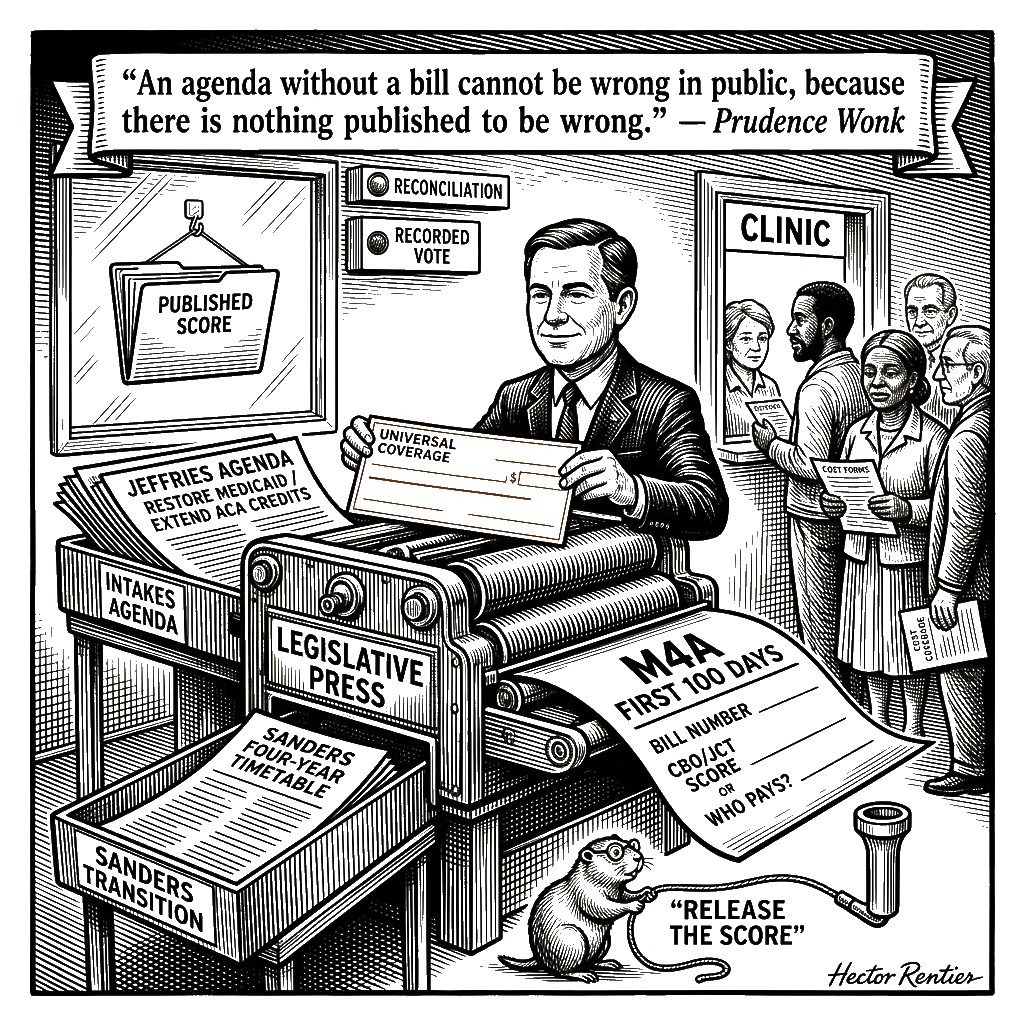
Hakeem Jeffries and Bernie Sanders are laundering a blank check through Medicare for All.
Here are the numbers. Fifty-six Senate seats. Sixty votes to end debate. Two first-100-day commitments. On January 3, 2027, the incoming majority will control a 258-seat House, the largest sweep since 1992. The House can act. The Senate cannot end debate without one more vote than it has. Mr. Jeffries can set the agenda. Mr. Sanders can hold hearings. Neither office can produce a fiscal score.
Mr. Jeffries’s first hundred days include reversing recent Medicaid cuts that threaten to leave millions without care and extending Affordable Care Act premium tax credits—the subsidies that help people buy insurance through the exchanges. Then come lower Medicare eligibility ages, dental, vision and hearing benefits, and coverage for every child. Every item moves federal resources. None has a published price. Every item is a policy. Not one is today a bill, a score, or sixty votes.
President Donald Trump said at his first post-election press conference: “They’re going to send things my way, and I’m going to veto them.” The threat is real. The first missing document is a bill.
Millions of people are not an abstraction. The Medicaid cuts are not an abstraction. They are also not a blank check. Restoring coverage can be defined and scored; expanding the program afterward requires another bill and another score. People at risk of losing coverage are the reason to restore what was, not a license to hide the cost of everything added next.
Section 257 of the Congressional Budget and Impoundment Control Act of 1974 fixes the Congressional Budget Office’s current-law baseline: scheduled expirations occur. A current-policy baseline assumes expiring provisions continue indefinitely; it is a press-release fiction.
On the current-law baseline, both first-hundred-day items add cost. The Medicaid cuts are law, so reversing them is new spending relative to that baseline. The premium tax credits are scheduled to expire, so extending them is new cost. Those credits are refundable: they pay cash even when the credit exceeds a household’s tax liability. They function as coverage policy, and the budget’s tax-expenditure definition includes the revenue lost through a special credit. Spending routed through the tax code is still spending. Calling an extension “restoring what was” does not move the baseline. Restoration is shorthand, not a convention. The label cannot merge two different acts. One of these is a budget convention. The other is a press release.
The convention has been shopped before, on the record. The 2017 tax act wrote its individual provisions to expire at the end of 2025; in the extension fight, sponsors defended permanence at zero under the current-policy convention. That was baseline shopping. This agenda’s defect is the opposite one: it skipped the score entirely. There is no baseline to shop until there is text.
Mr. Jeffries said the incoming majority must “fix what’s broken” and then “go further.” The sentence joins two fiscal acts. Undoing a prior reduction is one. Creating broader coverage is another. The problem is not that Congress sets goals before votes. It is that this agenda offers benefits and a timetable while withholding the instrument that pays for them. A phase-in tells the public when benefits begin; it does not tell the public what remains after the phase-in. If the policy is permanent, the cost is permanent. Pick one.
The timetable becomes the policy while the price stays outside the room. The laundering operation is simple: substitute an agenda for text, a timetable for a score, and a press release for a bill.
The Congressional Budget Office’s 2010 ACA score, which incorporated the Joint Committee on Taxation’s revenue estimate, projected lower federal deficits after counting federal spending and revenue. The rule is simple: a coverage law gets the same ledger as any other law. Revenues are counted. Federal spending is counted. A promise of lower premiums is not a budget offset unless the scoring record converts it into lower federal spending or higher revenue. A Medicare for All bill cannot borrow a price from a press release.
Congress has scored healthcare before through the Congressional Budget Office and the Joint Committee on Taxation, the scorekeepers Congress designated. Those scores were published with their methodology footnotes, checked against what happened, and argued over in public. Some projections landed close to the mark, some ran under, and the ACA’s marketplace-enrollment projection failed. The projection failed; the practice of scoring, checking, and revising in the open did not. A score that can be wrong in public is a score that can be checked, and the checking is where the corrections came from. An agenda without a bill cannot be wrong in public, because there is nothing published to be wrong.
Four years is a schedule, not a score. Mr. Sanders has laid out a four-year Medicare for All transition, but a schedule does not price the finished program. The conventional revenue estimate holds the size of the economy fixed while allowing taxpayers and firms to change their behavior; the dynamic supplement adds changes in total output. The Joint Committee on Taxation is responsible for revenue estimates for tax legislation; the Congressional Budget Office incorporates those numbers into overall cost estimates. A usable universal-coverage score must show who enrolls when, what payment rates providers receive, and when financing begins. The current agenda shows none of that.
The route around sixty votes exists and has a name: reconciliation. It is the expedited Senate budget process for changes to programs whose funding is set by law and for tax provisions. It requires a budget resolution and a simple majority, and it cannot be filibustered. It has carried larger legislation than anything on this list. The road is narrow, scored, public, and expensive. The hundred-days agenda does not mention it.
Section 313 of the Congressional Budget Act gives reconciliation six tests for provisions that may ride along. The relevant one bars spending that increases deficits beyond the ten-year period used to tally costs. That constraint is why sunsets—artificial expiration dates—enter so many bills. The 2001 and 2017 tax laws used scheduled expirations to contain their scores while their sponsors treated the provisions as permanent. A four-year rollout delays the arrival of costs; it does not make a permanent program temporary. Costs after year ten do not vanish because the procedure stops looking.
A universal public program replaces some private payments with public ones; it does not manufacture health care or resources. A payroll tax carried heavily by low-wage workers shifts cost onto working families. Higher taxes on high incomes and capital gains carry more of it onto households with greater capacity to pay. Tax incidence—who bears the cost once prices and behavior adjust—must be shown by income and state. The coverage can be the same. The incidence cannot be hidden.
The same discipline applies without regard to sponsor. The temptation is not one side’s property. Think tanks aligned with the expansion side of this debate have logged their own overshoots: Medicare-savings extrapolations—claims of savings beyond the documented estimate—and dynamic multipliers, meaning economic feedback assigned to transfers. Their volume is smaller and their methods more contained. The convention applies to whoever holds the gavel. So does the arithmetic. Finance the system through higher rates on high incomes and capital gains, preserve refundable ACA credits for families buying coverage during the phase-in, and publish conventional, dynamic, and income-distribution scores. A broad-based plan is not a retreat from universal coverage. It is the condition of universal coverage.
About six in ten midterm voters told the AP Voter Poll, based on more than 100,000 respondents, that the federal government should play a bigger role in helping Americans obtain healthcare. The same six in ten said they were “very concerned” about healthcare costs. That is one electorate asking for expansion and asking who pays for it. Both halves deserve an answer in figures.
The honest answer is not the household-budget scold. The federal government is not a family with a checkbook. Neither is it magic. The binding constraint is real: available clinicians, hospital capacity, drug prices, and economy-wide inflation. A score is where those constraints get written down in numbers the public can argue over.
Ms. Jayapal, who helped negotiate the list, says the moment “can’t just be going back to restoring what was.” The committed first hundred days, as announced, are going back to restoring what was. Former President Obama told the incoming class that the ACA was a “starter home” and urged them to “push further and get more.” Both statements are true. Neither is a plan.
Mr. Jeffries co-sponsored Medicare for All before he became leader, backed away once the leader’s chair changed his audience, and now sells its first year from a podium in Denver while billing Mr. Sanders as the “O.G.” whose committee will tackle the issue. What changed is not the data. What changed is the audience.
The remedy is not better selling. It is the machinery the audience can check: a bill number, a route through reconciliation, a Joint Committee estimate, a recorded vote. Pass the bill. Release the tables.
A scored bill would carry two receipts: who pays and what remains after year ten. Mr. Jeffries has the agenda and Mr. Sanders has the committee; neither office has produced a score for this agenda. The sixty-vote threshold is the visible obstacle; a veto needs a bill, and a bill needs a score. Until the text and scores arrive, Medicare for All is a blank check. The score is the score, and the author of the agenda does not get to grade it.