Donald Trump’s administration kidnapped Kilmar Ábrego García into CECOT and exiled him. Everything else in this story is detail, and the details are all in the record. He came to the United States in 2011 without proper authorization. He settled in Maryland, married a U.S. citizen, and became a father. Unlawful presence is a legal status, not a moral identity. A government may define that status. It cannot make a person innocent or guilty by it, and it cannot make enforcement humane or cruel by naming it so. I number myself in the accounting. I know the pressure my own Catholic and immigrant communities feel: to protect people through secrecy, to preserve institutions through silence, to accept immigrant labor while treating migrants as disposable. Those are our sins. No confession of ours acquits this administration. The deportation machine is older than this president, and every administration that uses it chooses it again.
The wrong began on the ground and became disobedience in the sky. In 2019, police arrested Ábrego García outside a hardware store on a gang accusation based on an informant and what his lawyers called “no evidence.” A judge ruled that sending him back to El Salvador would expose him to danger, and he continued living in Maryland under a valid work permit. Then, in March 2025, ICE arrested him while he was driving home with his five-year-old son. The administration deported him anyway. The flight carried him and dozens of Venezuelan men. While that plane was in the air, a federal judge ordered it turned back. The administration kept it flying. Ábrego García landed in Salvadoran custody and was put into CECOT, the notorious Terrorism Confinement Center, under an indefinite-detention order. Men who passed through CECOT have reported being tortured, physically assaulted, and raped. In its own court filings, the government called the wrongful deportation an “administrative error.” An error is a thing you trip into. CECOT was not a place anyone tripped into. It was a place the government chose, booked, and filled. This was not a clerical mistake. It was a choice to put one man’s life beyond the reach of the court trying to save him.
He came back because the courts would not let the kidnapping stand. After a twenty-month legal battle that included the Supreme Court, a court ordered his return. The administration initially refused. In June 2025, it finally brought him home. Then the government charged him with human smuggling based on a 2022 traffic stop in Tennessee. While the prosecution was pending, officials called him a “gang member,” “human trafficker,” “wife beater,” and “child predator.” He had committed none of those crimes. Months later, in May, a federal judge dismissed the prosecution as vindictive—the government’s own conduct, named by its own judiciary. The sequence is plain: the government removed him without authority; after the courts returned him, it prosecuted him; the judge called that prosecution vindictive. I call what came before evil. The government turned accusation into official identity and punishment into policy.
Yet another phase followed: attempts to remove him to African countries he had never seen, a U.S. cell while the government searched for another destination, and his lawyers’ offer of Costa Rica, which the administration refused. Finally, a judge ordered the government to effect his voluntary departure without interfering. That order was obeyed; it also allowed the government to call exile a victory. Secretary of Homeland Security Markwayne Mullin announced it this way: “We are delighted to announce that Kilmar Ábrego García has self-deported from the United States to Spain.”
His own attorney said he believed he was never going to get a fair shake. His final departure may have carried a court order. The original kidnapping and his CECOT imprisonment did not. The government never had lawful authority to send him to El Salvador in defiance of the 2019 order, to ignore the judge who ordered the flight turned back, or to book him into a foreign cell. A choice between those abuses was not freedom. A man who leaves because every lawful door has been nailed shut, one by one, has not chosen anything. The government did not lose him. It spent him.
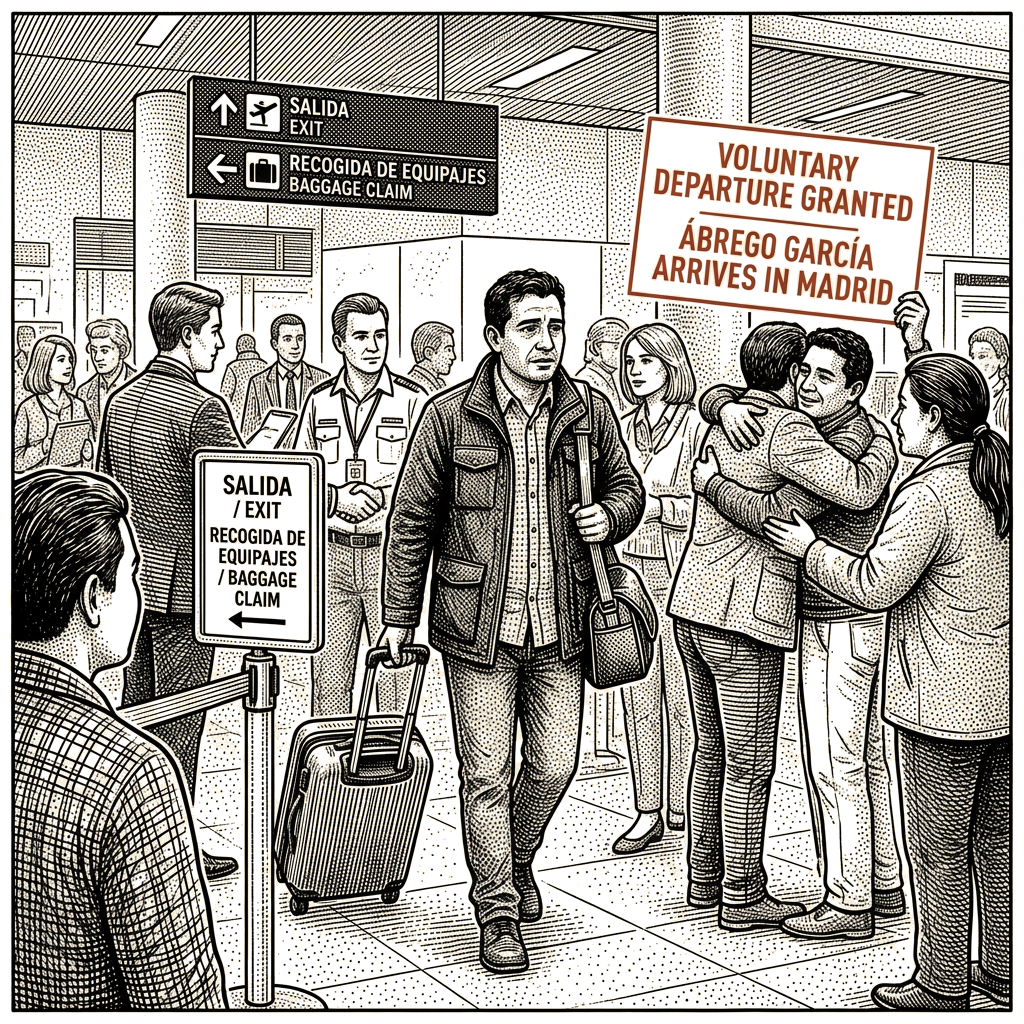
His arrival in Madrid with his wife was relief. It was not justice. I am glad he is alive. I am glad he is free, and beside his wife, in a country he chose, where no cell is waiting for him. Gladness is not the same thing as justice, and I will not let gladness launder cruelty.
Now count the accounting, because this is where victory actually lives. The men who say they were tortured inside CECOT have no answerer. The judge defied midair has no answerer. The vindictive prosecution has no answerer. The lies told about a man in public he could not answer have no answerer. The man who was wronged paid the entire price—his liberty, his home, his country—and the officials who inflicted it have lost nothing but an argument. That is what victory looks like from behind their desk: the family is gone, the cell block still stands, and the men who built it sleep in their own beds. The administration’s victory is impunity.
The machine that swallowed this man did not begin on January 20, 2025. Adam Goodman documents in The Deportation Machine: What Happens to Unauthorized Immigrants in the United States (Cornell University Press, 2023) roughly eight million formal deportations over the past century and about fifty million departures the government recorded as “voluntary.” A man choosing between a prison and a bus is not choosing. Formal removals and calculated fear campaigns have run under administrations of both parties. Every administration that uses the machine chooses it again. My own church has fed its appetite more quietly. We are quickest to welcome the immigrant whose innocence can be proven and quietest the moment it cannot. If it took the government’s lies about Ábrego García collapsing for us to march, we have not yet obeyed the gospel we marched under.
Nor is Christian-right rhetoric innocent. In his January 29, 2025, interview with Sean Hannity, Senator J.D. Vance invoked a Christian “order of love” that placed family, community, country, and then the wider world in sequence. On February 10, Pope Francis answered that account before U.S. bishops: Christian love “is not a concentric expansion of interests” but the Good Samaritan’s fraternity “open to all, without exception.” That is how Christian-right actors use Christian identity and “Christian nation” rhetoric to legitimate anti-immigrant coercion: they place the undocumented stranger outside the moral circle, then present his removal as fidelity. Those actors must answer for the coercion they legitimized. They must retract the theology, defend the stranger, and withdraw their support from officials who turn faith into force. None of that transfers responsibility from the government. The officials who ignored the judge, booked the flight, enabled CECOT, and brought the vindictive prosecution still answer for their choices.
Because the file and the verse belong together. The Torah says: “The alien who resides with you shall be to you as the citizen among you; you shall love the alien as yourself, for you were aliens in the land of Egypt: I am the Lord your God.” Jesus makes the judgment unmistakable: “I was a stranger and you did not welcome me.” Fourteen years in this country, checking in with ICE as the law required. A wife who is a citizen. A five-year-old son in the car the morning the agents came. A judge who heard the evidence in 2019 and ruled that El Salvador was too dangerous. The government’s answer to all that lawfulness was a plane, a prison, and a list of crimes he had never committed. The administration knew Ábrego García’s face and treated his rights as an inconvenience. It did not encounter an abstraction. It encountered a man whose presence, marriage, child, and due process could all be made to disappear because the government had already decided what he was. In Matthew 25, the stranger is Christ. The government did not need to believe that to stand under judgment; it only had to encounter Christ and treat him as disposable.
A humane immigration policy would require a real hearing before custody becomes punishment, protection of family unity, lawful pathways to asylum and to voluntary return when wrongful removal has been proved, detention only as a genuine last resort under independent review, preservation of the record, and discipline of officials who turn enforcement into punishment. The U.S. and Mexican bishops’ 2003 pastoral letter, Strangers No Longer, holds the whole vision together: people have the right to find opportunity in their homeland; the right to migrate when home cannot feed them; nations have the right to control their borders; refugees and asylum seekers must receive protection; and the human rights and dignity of undocumented migrants must be respected. All five at once, or none of it is Catholic. These are not concessions to the stranger; they are the conditions under which a nation can call its rule of law consistent with its faith without lying.
Óscar Romero stood in the cathedral of San Salvador the day before they shot him at the altar and told the soldiers the truth: an immoral law, no one has to obey it. Then he said it in the imperative: “En nombre de Dios, pues, y en nombre de este sufrido pueblo, cuyos lamentos suben hasta el cielo cada día más tumultuosos, les suplico, les ruego, les ordeno: ¡cese la represión!” Stop the repression. That is still the command, and the soldier must obey his conscience before an immoral order. The judges of the United States said the same thing for twenty months, in plain English: stop. Turn the planes around. Bring him back. Let him go in peace. This administration fought the orders that cost it something and obeyed the one that let it claim a win.
To President Trump and every official with the power to stop this machinery: you kidnapped him. You called your kidnapping an error. After the courts brought him home, you charged him, and a judge called the prosecution vindictive. You tried to vanish him to a continent he had never seen. When every court stood in your way, you took his country from him and called it his choice. You are not monsters; you are men and women with names and families who did this in daylight, which is worse, and also more hopeful, because men and women can stop. Release the records. Answer for the order you defied. Accept responsibility for the suffering you enabled. Refuse any transfer the court forbids. The door of return is open.
He landed in Madrid on Wednesday morning with his wife, as our own desk recorded from the arrivals hall, in daylight. When I was a boy in El Paso, the classmates the agents took vanished before dawn, and their desks sat empty as if they had never been filled. This one went out the front door with the sun up. I am glad, but do not mistake the photograph for the ending the government is selling: a desk does not empty itself. Men empty it.
Before dawn in Redemption Springs, I sweep my workshop floor and leave the door unlatched. Cese la represión. Stop. That is the only prayer I know for them that is not a curse—and the door is open.