
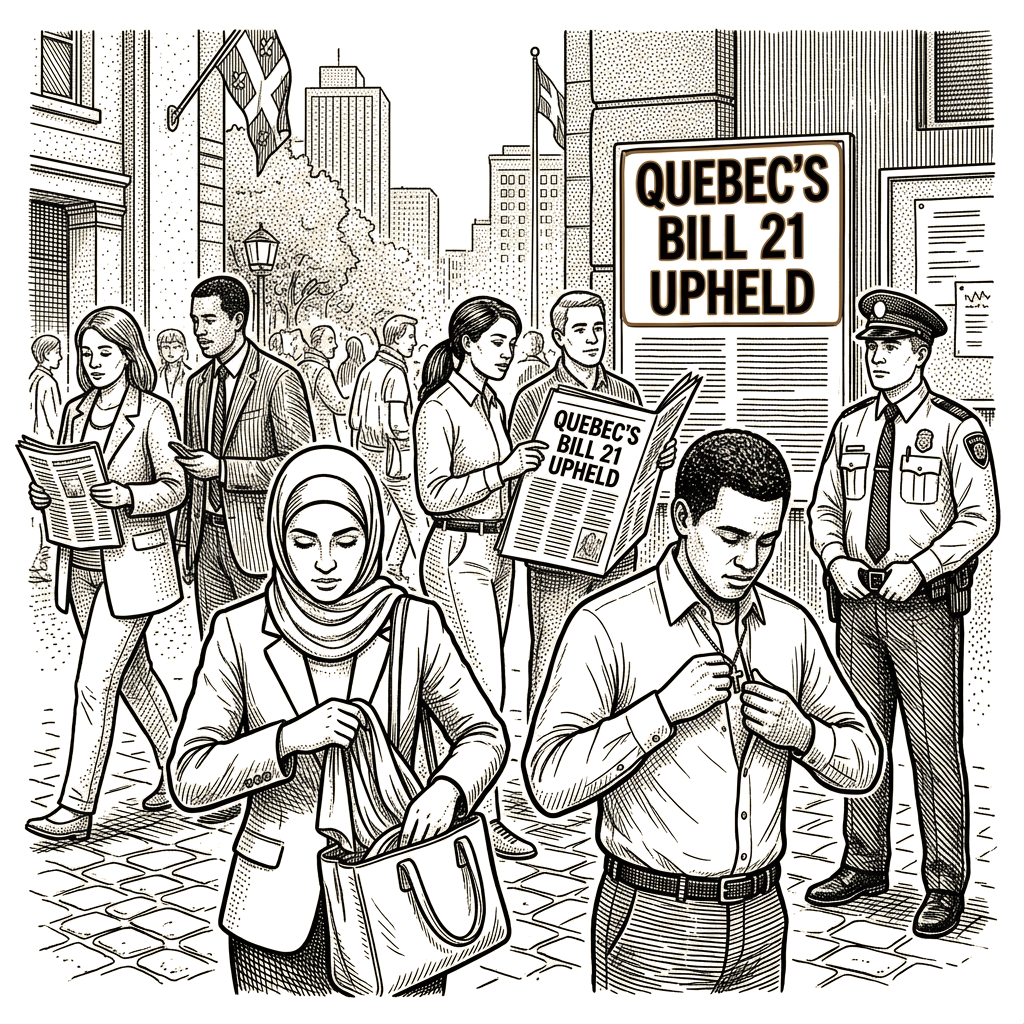
The Supreme Court of Canada helped Quebec discriminate against religious teachers.
The plaintiffs were female Muslim, Sikh, and Catholic teachers. They went to work wearing the religious symbols their faith required. Quebec’s Bill 21, SQ 2019, c. 13 prohibited public-sector workers from displaying those symbols at work: the hijab, the turban, the kippah, the cross. The burden fell on the women who wore their faith to work.
Quebec invoked section 33 of the Canadian Charter of Rights and Freedoms, the notwithstanding clause. That provision permits a legislature to declare that a law operates despite a protected Charter right for five years and to renew the declaration. Subsection (4) also permits a court to declare that the overriding law violates the Charter, although the declaration has no legal effect. Quebec’s override could keep the religious-symbol restrictions enforceable while leaving the courts without ordinary power to invalidate them.
The Court’s own summary judgment and reasons in Quebec (Attorney General) v. Alliance du personnel professionnel et technique de la santé et des services sociaux, 2026 SCC 18, summary judgment, paras. 1–6 (27 Nov. 2026) makes the holdings precise. The majority upheld Quebec’s invocation of section 33 for the employment restrictions insofar as they engaged section 2(a), which protects freedom of religion. Section 33 could not protect the candidate face-covering rule insofar as it infringed section 3’s democratic rights. The Court confirmed that a court may issue a no-effect declaration of inconsistency. It issued no declaration. It did not decide the teachers’ section 2(a) claim on the merits.
Quebec did not win because the Court found the teachers’ religion unprotected. Quebec won because the Court treated Quebec’s override as the operative constitutional judgment.
A lawyer aligned with the ruling can state its logic in one breath. The notwithstanding clause exists because some guarantees must yield to an elected legislature’s express political choice. A court need not pretend that choice is ordinary legislation. The Court can enforce the override’s boundaries, protect democratic rights outside it, and preserve a declaration power for use when it serves the administration of justice. Public employment is one domain. Candidate access to the ballot presents another. On that account, the majority did what the constitutional text permits.
The litigation’s scale showed that this was not a narrow workplace dispute. The case drew 51 interveners, including six attorneys general, and the earlier account of the Court weighing the ban put the constitutional fault line in view before the ruling. Those numbers do not decide the law. They establish that provincial autonomy, religious equality, and democratic participation converged on one case. The Court resolved that convergence by making the override decisive.
That account explains why the candidate provision fell. It does not explain why the teachers’ claim remained unadjudicated. The reasons explain that the valid invocation disposed of the constitutional question and that the Court chose not to issue a declaration. They do not hold that the women lacked a religious-rights claim. The choice was explained. The claim remained unresolved.
The candidate clause fell. The teachers’ claim remained. The shield held.
The provision that fell was the provision that reached the legislature. The Court protected candidates because section 3 placed their political participation outside Quebec’s override. It left teachers facing an override the Court would not measure on the merits. The exception protects people seeking political power while leaving the people who work for the public subject to provincial power the Court will not review.
This is not ordinary deference. The Court did not accept Quebec’s legal justification on the merits. It recognized that the teachers had raised a constitutional conflict, invoked the rule that made the legislature’s answer operative, and declined the one declaration that could have put the conflict on the Court’s own record. That is the justiciability dodge in its standard form: identify the constitutional question, make it unnecessary to answer, and leave the legislature’s judgment standing.
The declaration power remained unexercised. Whether a court uses it in another case remains unresolved. That uncertainty does not change what this Court did: it declined the test.
An honest application of the declaration power would have required the Court to state the inconsistency, examine the teachers’ claim and Quebec’s evidence, and define the restrictions’ actual scope. The declaration would not have invalidated Bill 21. That remained the legislature’s choice under section 33. But the declaration would have denied Quebec the fiction that no constitutional conflict existed. The Court can draw a constitutional line for candidates. It can name one for teachers.
The doors differ in the United States; the exit is the same. In Rucho v. Common Cause, 588 U.S. 684 (2019), the United States Supreme Court held that partisan-gerrymandering claims present political questions beyond the reach of federal courts. There was no override clause. The Court declared its own hands tied while taking other districting questions it preferred to reach.
In Trump v. Hawaii, 585 U.S. 667 (2018), the Court upheld a presidential proclamation restricting entry by nationals of several designated countries as an exercise of statutory authority and accepted the government’s national-security judgment within that statutory frame. Section 33 is more candid than either mechanism. The constitutional text itself announces that the legislature may override the listed rights and that the ordinary judicial remedy may fall away.
Three doors—legislative override, judicial abstention, and executive deference—route such a restriction past remedy. The outputs converge: the restriction stands, the affected workers remain subject to it, and no binding judicial finding names the restriction a violation of their rights. The American version of that construction has been advancing case by case through this term.
Bill 21 still governs the teachers. The candidate clause is dead. The shield is alive. The Court did not put its name on the violation.
The Supreme Court of Canada helped Quebec discriminate against religious teachers. It protected candidates and left workers to Quebec’s constitutional shield. The Court was not the arbiter here. It was Quebec’s constitutional shield.