
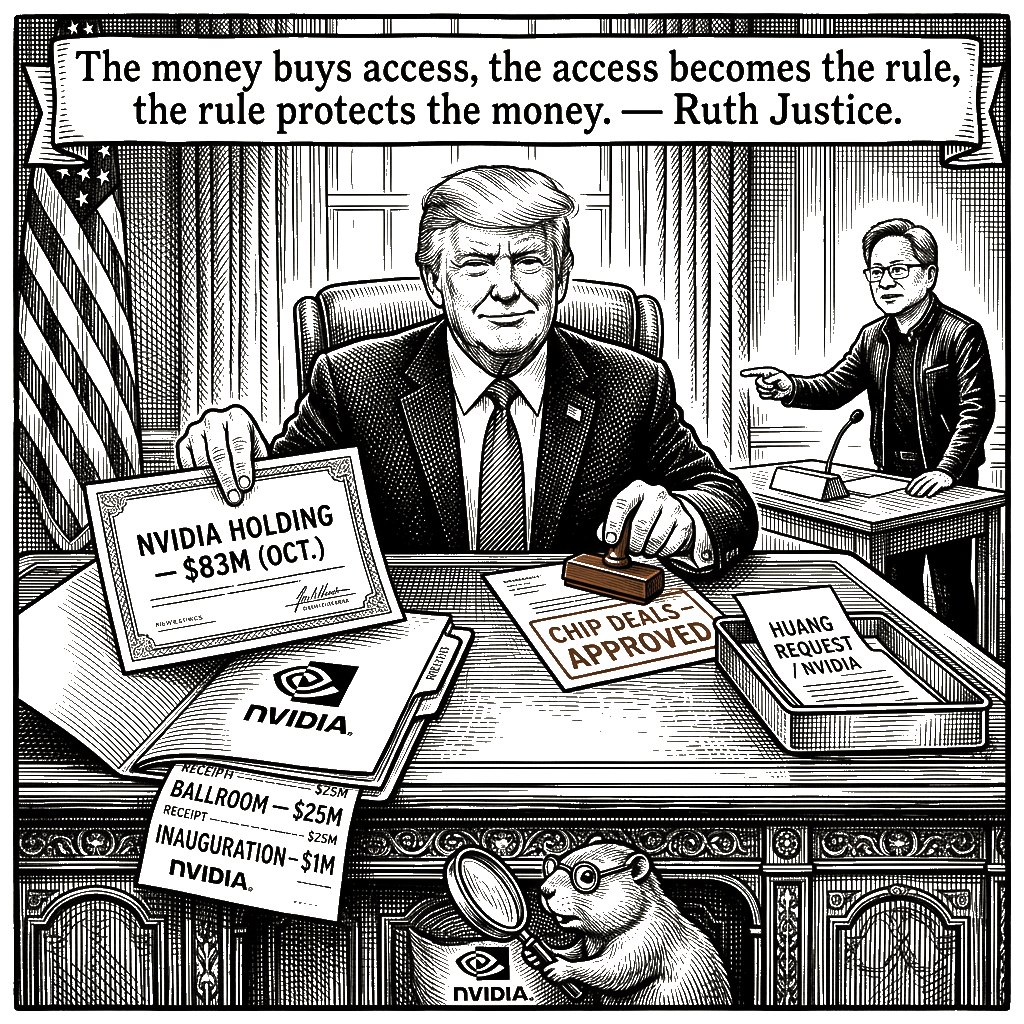
Donald Trump owns Nvidia stock worth $83 million, took $25 million for his White House ballroom and $1 million for his second inauguration, and then approved the chip deals Jensen Huang asked him for.
That is the arrangement, and it fits in one sentence. Nvidia committed the money. Trump holds the stock — $83 million of it in October — and at Huang’s urging approved several deals to send Nvidia’s most sophisticated chips to China and other countries posing security concerns, and adopted an AI policy friendly to the industry.
The White House says independent financial institutions manage the president’s stock-and-bond holdings, so neither he nor his family can direct when holdings are bought or sold. That answers the wrong question. Don’t tell me about the managers, dear. A manager can press the button. The president still owns the stock, Huang still calls, and Washington still decides whose chips cross the border. Those exports did not clear by accident. When the man who sets the rules holds stock in the thing the rules move, you do not have regulation. You have asset management. I call the $25 million a retainer. The ballroom is Exhibit A; the chip approvals are Exhibit B.
The board had other business with Huang. Nvidia fired him after he admitted to two extramarital affairs, including one with a suspected Chinese intelligence asset, only to bring him back eleven days later at President Donald Trump’s urging — restored by the president’s own lobbying. The chip salesman was back at his desk. Stocks initially rallied on the rehiring. The president called it a vote of confidence in his own actions. Jesse Waters, a Trump ally, called Huang a billionaire “chip king,” a Republican donor and an admitted adulterer who “isn’t the most sympathetic character for the president’s party to defend.”
Here is the class: office, capital, and policy in the same hands. The money buys access, the access becomes the rule, the rule protects the money. That is the machine, and Nvidia is only this week’s name on it. Call it what it is. The man owns stock in the company whose deals he approves, took that company’s money for his ballroom and his inauguration, and then made the decisions the company asked for. He is the $83 million referee. I have watched this movie since Nixon. The cast changes; the script does not.
Now the other column of the ledger. The country has been voting with its hands. Voters in 13 states this year sided against data centers in 53 of 54 ballot measures decided so far, according to a tally by Ballotopedia. A large national poll of midterm voters, The Voter Poll by SSRS, found that 57% believe AI will do more to hurt society than help it, and three-quarters said they would oppose construction of a new data center in their community. The president has an answer: “we’re going to fight very hard for the data centers.” Your county gets a referendum. The chip deals get his approval. The law binds the town and protects the stock.
The machinery did not arrive with him. In the 5-4 Citizens United v. FEC decision in 2010, the Supreme Court struck down limits on independent corporate and union political spending; Justice Kennedy described the restriction as “an outright ban on speech, backed by criminal sanctions.” A 2019 investigation by USA Today, the Arizona Republic, and the Center for Public Integrity found roughly 10,000 copycat bills introduced in state legislatures from 2010 to 2018, about 2,100 of them enacted; Florida had passed its own Stand Your Ground law in 2005, before ALEC spread the model nationally. The pharmaceutical lobby blocked Medicare drug-price negotiation for about two decades until the Inflation Reduction Act of 2022. Carried interest has survived every promised repair since 2007; Trump called it “getting away with murder” in 2016, and his 2017 tax bill left the preference intact and stretched the holding period instead.
The law works as designed. In 2012 HSBC admitted laundering money for Mexican drug cartels and sanctioned regimes, forfeited $1.256 billion and paid $1.9 billion in a deferred-prosecution agreement, and no individual was prosecuted. Senator Grassley said HSBC “has quite literally purchased a get-out-of-jail-free card.” Charles Keating went to prison for the savings-and-loan business: he served about four and a half years before his convictions were overturned on a technicality in 1996, then pleaded guilty in 1999. Asked whether his $1.3 million to five senators had bought influence, he told the committee, “I want to say in the most forceful way I can: I hope so.” Back then the executives went to prison. The alternative to prison is a fine, a settlement, and a hearing.
The chip salesman gets three House committees behind closed doors Dec. 1 and the Senate Banking Committee in public Dec. 3, and the senators say they won’t pull punches. Keating hoped so. The referee does not hope. Nobody has been charged. He holds the stock.