
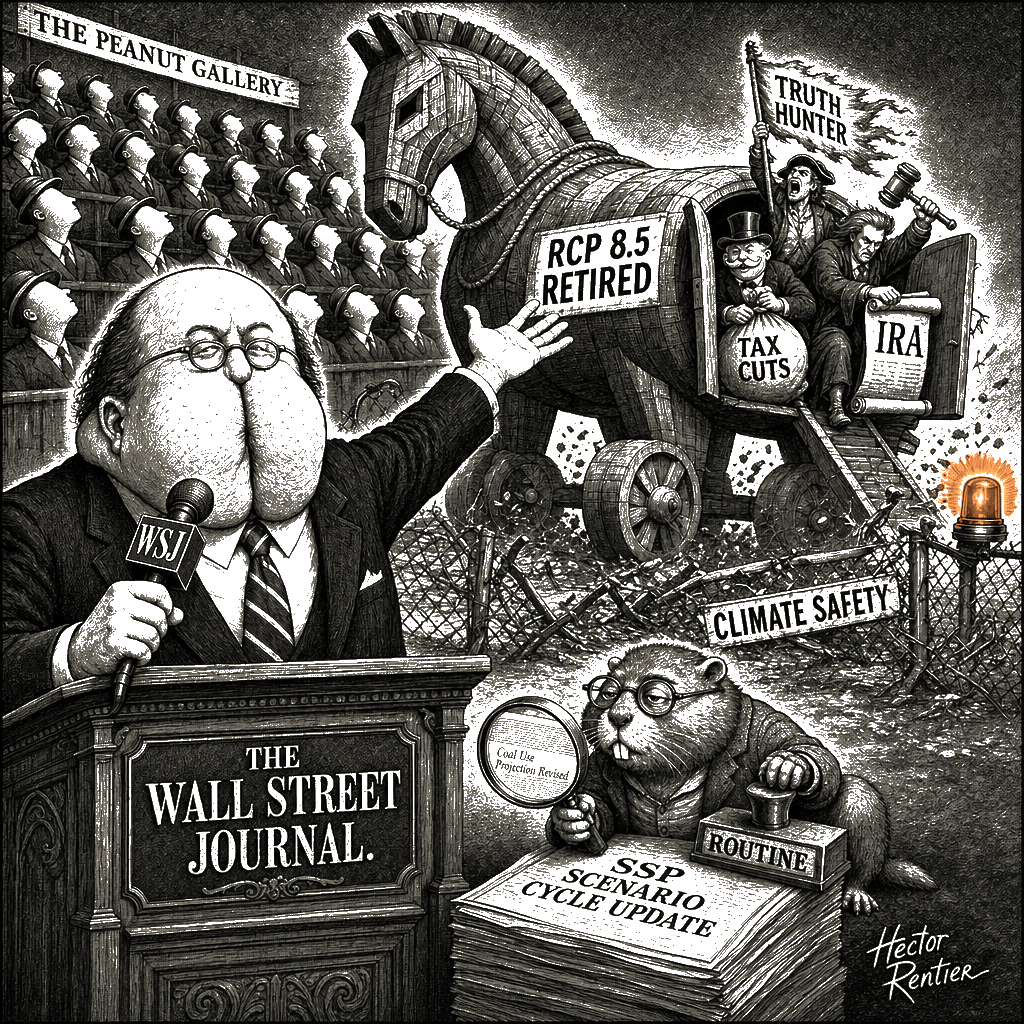
You’re looking at a textbook bait-and-switch operation here. The column opens with a legitimate, surface-level critique of climate communication—specifically the overuse and subsequent retirement of the RCP 8.5 emissions scenario—and then immediately weaponizes it as a Trojan horse to absolve the Trump administration’s systematic dismantling of climate policy. The entire maneuver relies on inflating a routine, internal methodological update into evidence of sweeping scientific fraud. Once that artificial inflation is established, it licenses a total policy abandonment strategy. You don’t get climate action because you aren’t getting honest science, and you don’t get honest science because the media and activists lied to you. It’s a closed loop of absolution, pre-loaded for consumption.
Rhetorical Operations
The piece is engineered through a series of deliberate frame shifts. First, you see a classic false binary: Jenkins shifts the entire debate away from the established scientific consensus on physical mechanisms and over to a hollow policy cost-benefit analysis. By constructing a “believer versus denier” dichotomy, he makes climate regulation sound like theological fanaticism while positioning his preferred deregulatory agenda as the domain of neutral, sophisticated reasoning.
To reinforce this, he builds a massive strawman. Climate advocacy gets caricatured as hysterical, dishonest, and fundamentally corrupt, loaded with trigger phrases like “green pork” and the claim that the Inflation Reduction Act was purely cynical spending. He even invokes “Holocaust deniers” to preload your contempt before absolving Trump. In a particularly reckless sub-atom, he collapses a single, outlandish missile-threat analogy from a former John Kerry aide and falsely labels that fringe outlier as the “pinnacle of cynicism” for the entire mainstream scientific apparatus.
When it comes to the hard data, you get austerity-thirsty selective omission. Jenkins cites the 2018 National Climate Assessment’s aggregate GDP growth projections—the bit about Americans being three or four times richer by 2090—to imply that warming damages are trivially affordable. What he surgically strips from your view are the same report’s findings: hundreds of billions of dollars in projected annual damages from extreme heat, catastrophic sea-level rise, agricultural collapse, and massive labor-productivity loss. The net economic reality is excised; only the gross growth remains to sell you the illusion of safety.
Then we hit the motte-and-bailey tech progress fallacy. Jenkins argues that RCP 8.5’s assumption of quintupled global coal consumption is “insane” specifically because it ignores routine technological progress. By doing this, he safely retreats to the defensible motte that “markets and technological advances happen,” but immediately asserts the unproven bailey that market-driven progress alone obviates the need for any climate policy. He uses the factual kernel that global energy consumption is rising across all sectors—including renewables—and weaponizes it to justify total policy paralysis. Since we’re consuming more of everything anyway, we might as well do nothing.
To seal the credibility loop, he invokes an academic countercase. Jenkins frames the UN panel’s retirement of RCP 8.5 and a New York Times correction as a sweeping “confession” of scientific error and journalistic dishonesty. Here, the reality is far more boring than his narrative requires: RCP 8.5 was designed as a high-end stress test, not a definitive prediction. Its retirement was a routine scenario-cycle update transitioning the field to Shared Socioeconomic Pathways. This refinement wasn’t an admission of guilt; it was standard operating procedure, heavily supported by external assessments establishing the scenario’s near-term implausibility.
Finally, you get the total authority inversion. In the closing passages, the roles of every major actor are deliberately flipped. Scientists are cast as needing repentance. The media is the corrupt establishment. Trump is the unlikely, hyperbolic hero forcing a cosmic reckoning. The column literally grants corrective scientific authority to a Truth Social post, arguing that the truth only reached the public because Trump was shouting in all caps.
Factual Grounding & The Actual Record
The column’s rhetorical gymnastics crash immediately into hard numbers. Jenkins labels the Inflation Reduction Act as “green pork” and casually claims “literally trillions” have been wasted. He doesn’t cite a ledger, because the ledger says otherwise. The non-partisan CBO scored the IRA as deficit-reducing over its ten-year window. The “trillions” figure is an unsourced rhetorical weapon, deployed to distract your attention away from both the trillions in historical fossil-fuel subsidies we’ve already paid and the comparative, catastrophic economic costs of climate inaction.
And then there’s the fiction of Trump’s role in the narrative. The column wants you to believe Trump is an informal defender of honest climate science, forcing transparency on a lying establishment. The actual administrative record directly contradicts this. While Jenkins credits Trump with spotting a bad climate scenario, the Trump administration formally revoked the 2009 EPA endangerment finding, which established that climate change endangers public health. They initiated the withdrawal from the UN Framework Convention on Climate Change entirely. And they didn’t just step back from the science—they actively subverted it, installing outspoken climate contrarians John Christy and Roy Spencer into senior positions at the Department of Energy, overseen by Secretary Chris Wright, a former oil and gas fracking executive. The dismantling of climate science is the policy; the critique of a single emissions scenario in the WSJ opinion pages is just the theatrical distraction.