
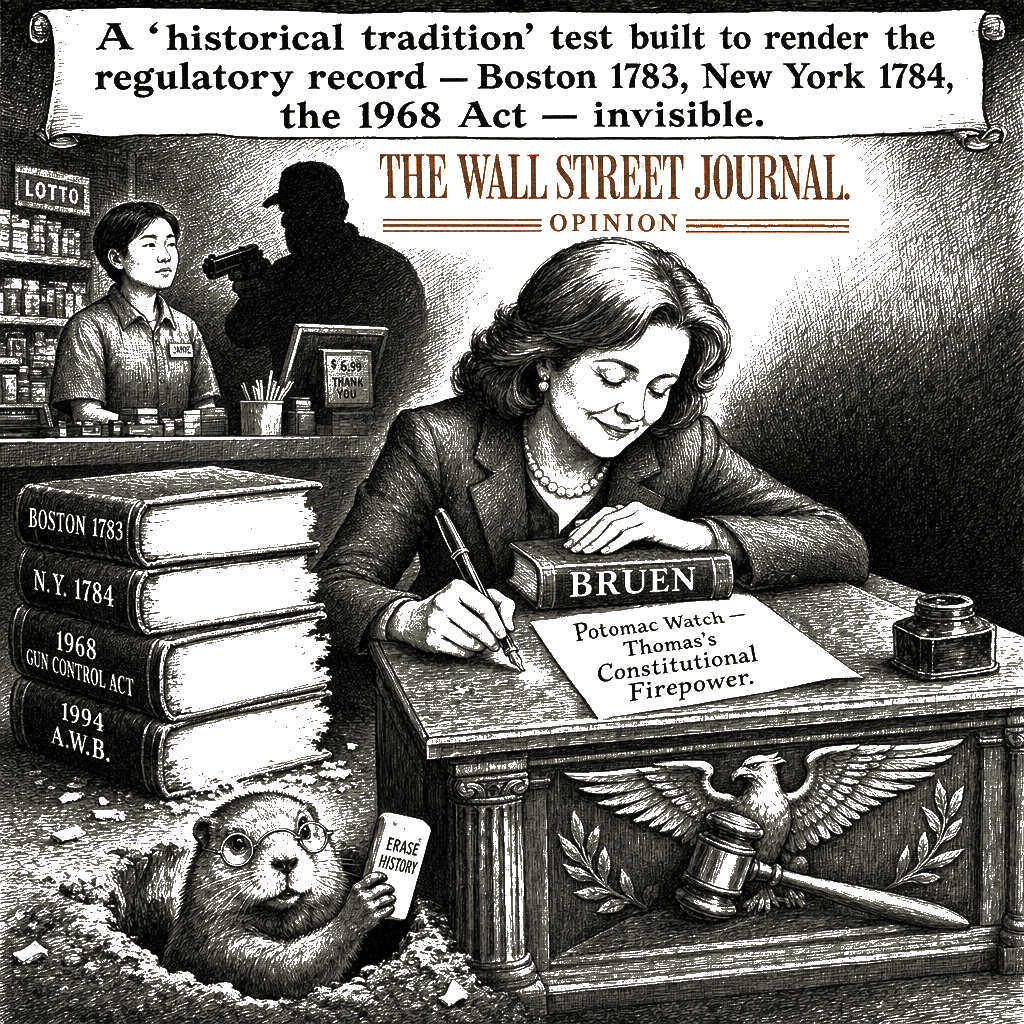
Strassel is the press secretary for a forty-year libertarian-legal project that finally got its hardware. I drafted message-discipline memos of this exact shape during the cable years. I know the mechanics from the operator’s chair. The mechanics have not changed, only the celebrity has grown.
The June 25, 2026, Wall Street Journal carries Kimberley A. Strassel’s “Potomac Watch” column under the headline “Thomas’s Constitutional Firepower.” The headline is the column’s thesis: this is the moment the apparatus that built the contemporary Supreme Court piece by piece to validate its deregulatory project gets its celebration copy. What follows is the press release. I am going to walk through it as the operators walked through theirs, naming the moves, naming what they cost, naming who paid.
Strassel opens by celebrating Justice Thomas’s “mission to resurrect, clarify and strengthen neglected constitutional principles.” Frame-engineered relabeling — the catalogue’s signature technique, with Bandura’s moral justification mechanism underneath — is the substitution of “restoration” for what the project actually was: the dismantling of democratic gun regulation through a manufactured doctrinal test. The internal vocabulary, what operators actually said about the project in the rooms where it got designed, was never “neglected constitutional principles.” It was about which doctrinal moves would lock in the deregulatory outcome through courts the coalition could not be voted out of. The “restoration” frame is the brochure. The doctrinal machinery is the product. Strassel is selling the brochure and calling it the doctrine. The standard inventory of propaganda euphemisms documents the substitution: “regulatory burden,” “red tape,” “constitutional restoration” — terms that presuppose the contested policy is an affliction from which the reader needs liberation. The moral justification supplies the conscience-soothing layer: the operator is not deregulating, the operator is restoring what the Founders actually meant. This is the relabel scam.
Then comes the manufactured grievance — the playbook’s name for the manufacturing of victimhood to license aggression. In Bandura’s catalog, the mechanism sits at distortion of consequences plus moral justification: the operator reframes the coalition holding all the cultural and legislative power as the structurally oppressed underdog. Strassel writes of “constant worry” before 2008, asking the reader to picture gun owners as the structurally oppressed party from 2000 forward, with “liberal jurisdictions” doing the tyrannizing and Bruen as the corrective. By 2000, gun owners already held the cultural megaphone. The NRA was the dominant lobbying voice on gun policy. The gun-manufacturing industry had captured state legislatures across the South and West. Heller was eight years from being written by a justice groomed for the role. The “constant worry” framing inverts the actual power configuration. From the operator’s chair, I can tell you what the requirement was. The gun lobby and the liberty-frame legal apparatus could not fund a doctrinal novelty by admitting it was novel. They had to sell the base a story of survival. The persecution narrative was the prerequisite — the donor class would not have underwritten decades of test-case work on a theory nobody had heard of without first teaching the base that the gun was theirs by right and the regulation was the enemy’s design. Strassel’s “constant worry” is the downstream product of the very propaganda apparatus she is now writing for. The “silent majority” frame and the “disfavored right” frame are the same template. The myth is not the harm. The myth is the persecution.
The Thomas dissent-campaign paragraph is multiple-audience-targeting — the technique the playbook documents as the page’s most consistent craft move, three audiences working from one paragraph, with moral justification underneath. The base gets the “constitutional orphan” line — the validation of felt persecution. The legal-conservative audience gets the precedent-by-precedent march through the dissents — the doctrinal build. The technocratic class gets the citation discipline that lets them treat the campaign as serious constitutional work rather than movement-coordination. And pause on “so-called assault-weapons ban.” The “so-called” prefix is the first delegitimization. The scare quotes are the second. The noun itself is the third. Three layers of contest land before the reader has had a chance to think about what an assault weapon actually is. The technique catalogue documents the asymmetric pattern: own vocabulary unmarked, opponents’ vocabulary in scare quotes. The ban was passed by Congress and signed by the President. The scare quotes pretend the law is a slogan. The trick is the trick.
Then comes the Bruen “historical tradition” test — the manufactured controversy the catalogue documents, Oreskes and Conway lineage, the technique straight. The test demands near-perfect historical analogs for every modern regulation. The actual historical record shows that American legislatures have been regulating firearms continuously since the founding: Boston regulated firearms storage in 1783; New York followed in 1784; the Sullivan Law, the 1920s–30s state-level restrictions, the 1968 Gun Control Act, the 1994 federal assault-weapons ban, and the state concealed-carry regimes all sit on the historical record the Bruen test is supposed to weigh. The manufactured-absence of regulatory history is the trick. The test produces deregulatory outcomes by manufacturing the absence of the regulatory tradition that has always existed.
Now the Wolford paragraph, where the racist-taint shell game comes into view. Strassel celebrates the Wolford majority for striking down Hawaii’s property-law flip. She gleefully quotes the court’s takedown of Hawaii’s reliance on the 1865 Louisiana Black Codes and a random 1893 Oregon “enclosed premises” law. Selective deployment of historical disgust — the mechanism: Alito scores points off Hawaii’s bad citations while leaving the underlying doctrinal method intact. Strassel mocks the Black Code citation as “embarrassing Hail Mary,” a citation so crude even the column cannot defend it. What is missing from the column is any acknowledgment that the Bruen test itself depends on a selective reading of historical tradition. The Black Code statute is bad history because it was about disarming Black people. The test that requires hunting-trapping, firearm-storage, and colonial-militia analogs to validate modern regulations is good history because it produces the deregulatory outcome. The method survives its worst application because the method was designed to produce the outcome it produces. The catalogue documents the parallel move in climate and adjacent fields: one bad study is the field failing, one bad historical citation is a state lawyer’s mistake. The asymmetric standard is the standard. When one of the citations turns out to be a Black Code artifact, the column treats the citation as embarrassing rather than as evidence that the test does what the test does — pick which historical moments count as “tradition.” They weaponized the actual, undeniable racism of the Black Codes to inoculate their gun lobby against any democratic regulation.
So what does the Wolford decision actually do? It shit on the worker. It forces the owner of a gas station or a coffee shop — a teenager making minimum wage — to absorb the risk and liability of an armed patron. The gun manufacturer sells the rifle. The donor class funds the judge. The cashier pays the blood cost. They dressed a corporate liability shield as a civil right. It is a scam, plain and simple, turning the fight over public safety into a morally untouchable crusade for the right to intimidate hourly workers. The constitutional orphan they wept for was never an orphan at all. It was a corporate ward, funded by the gun industry, protected by the liberty-frame legal pipeline, and paid for by the cashier who has to smile while a loaded weapon sits on the counter. They spent thirty years and millions of donor dollars to ensure that a minimum-wage kid in a convenience store can’t tell an armed fucking stranger to leave the premises. It’s a shakedown.
Threat-inflation closer, the catalogue’s documented technique, with the asymmetric vocabulary underneath and the moral justification at the foundation. Strassel closes with “That’s been a long time coming. Justice Thomas, take a bow.” “Legal shenanigans” is the WSJ-preferred term for what state and local governments have done continuously since the founding: pass regulations responsive to local conditions. Hawaii tried to regulate where concealed-carry permit holders could take their firearms. Strassel calls this “legal shenanigans.” If any regulation short of the libertarian minimum is “legal shenanigans,” then democratic governance itself becomes the shenanigan, and only the captured court stands between order and tyranny. That is the project. Boston passed a firearms-storage law in 1783 — four years before the framers gathered in Philadelphia to write the Constitution. The Bruen test is structurally designed to render that history invisible. Strassel would call that “legal shenanigans” too, if a state tried it today. The closing line is engineered for retransmission, the catalogue’s closing-line cadence, threat-inflation that converts state public-health authorities into saboteurs.
The operation has a name, and the operation has been hiding the name for the duration. The name is not “constitutional restoration.” The name is not “originalism.” The name is the libertarian-legal project of disabling democratic gun regulation through the capture of the federal judiciary. That is what the doctrine is for. That is what the test-case pipeline is for. That is what the column is for.
Strassel writes that “the court can be taken seriously now.” The court can be taken seriously now because the operators built it to be taken seriously. That is not the same as the court being right. The face in the mirror: the Bruen test requires near-perfect historical analogs for modern regulations. The actual historical record shows that American legislatures have been regulating firearms continuously since the founding. The test produces deregulatory outcomes by manufacturing the absence of the regulatory tradition that has always existed. This is the manufactured controversy the catalogue documents, the parallel framework the consensus does not recognize, built to produce the outcome the consensus would not endorse. Strassel is celebrating its coronation.
Let’s cut the constitutional horse shit. The “palladium of the liberties of a republic” Joseph Story wrote about is a clusterfuck of cowardice and greed. The receipt is signed in fucking blood. Strassel and her WSJ buddies get to sit in their ivory towers and celebrate Clarence Thomas’s “mission,” while the rest of us are left to clean up the brain matter of a teenager who just wanted to work the register without catching a stray from some constitutional-purist prick waving his Glock at the slushie machine. The entire Bruen and Wolford doctrine is a giant, taxpayer-subsidized dick-measuring contest where the justices jack off over their own historical fantasies while the rest of us dodge bullets in the parking lot.
Justice Thomas, take a bow. The apparatus takes the country.
— Phukher Tarlson