
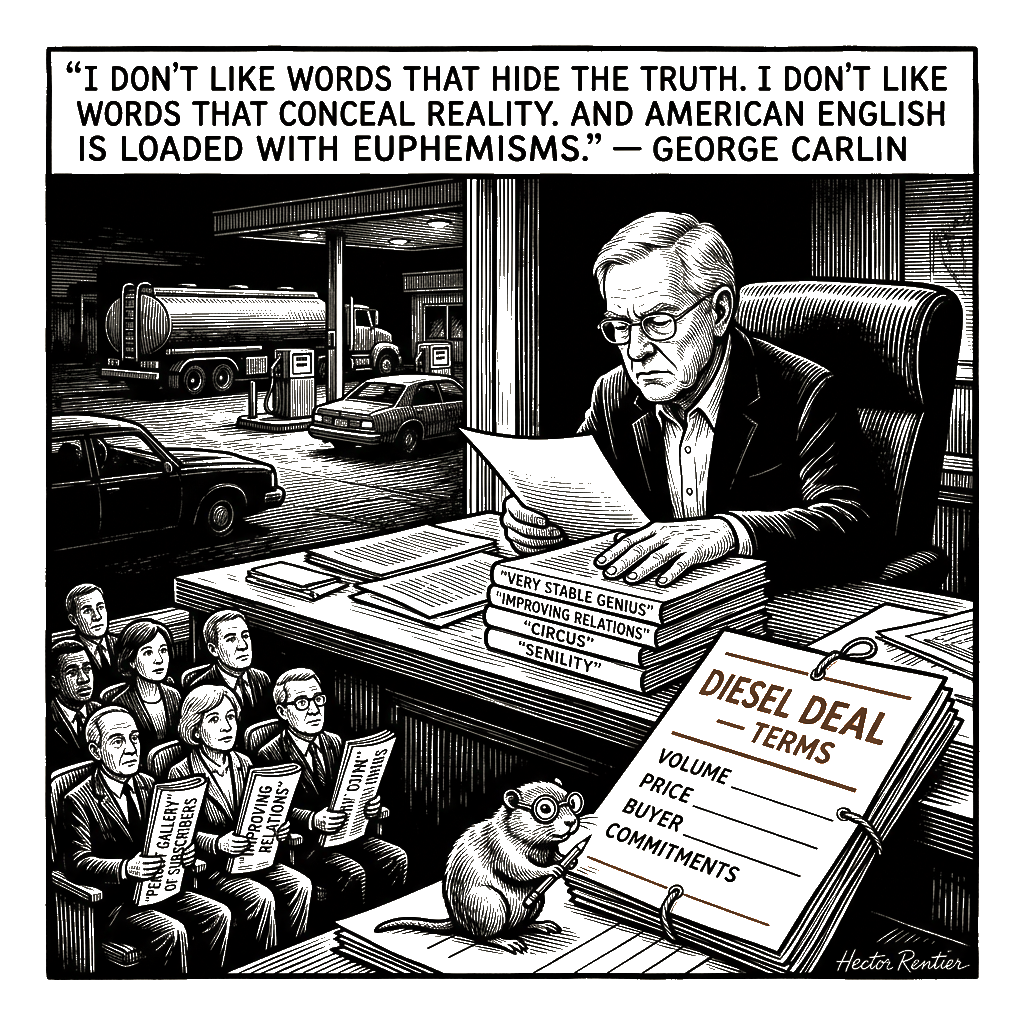
Jenkins makes Donald Trump the punchline and leaves the diesel deal’s terms off the table.
Holman W. Jenkins Jr.’s October 23, 2026 “Business World” column in The Wall Street Journal, “America’s ‘Very Stable Genius’ Isn’t a Strategic Genius,” performs an unusual operation for a liberty-frame outlet: after four years of making the sitting president a central subject, it turns him into the object of a joke. In Jenkins’s artifact, Trump is too addled to grasp a settlement, his supporters are handed a story to dissolve their doubts, Putin is reduced to a telemarketer, and one universal theory explains every presidential action. The fuel transaction disappears beneath the performance.
The apparatus is visible: compressed attributions, scare quotes, a knowing aside, an escalating close. The excerpts below follow it in document order—counting the headline as paragraph 1—and show what each phrase leaves out, who benefits from the resulting frame, and what the omission makes ordinary. The paragraphs about campaign leverage and a durable peace are not blanks; they are counter-material, and the frame has to survive them. I built frames of this kind for twenty years; that is the whole of my qualification and the whole of my interest in the mechanics.
America’s ‘Very Stable Genius’ Isn’t a Strategic Genius — Headline
Frame-engineered relabeling — WSJ Catalogue §3.8 and §4.1; Bad-Faith Catalog: frame_engineered_relabeling — operates here through asymmetric punctuation. The scare quotes make “Very Stable Genius” look unstable; Jenkins’s “isn’t a strategic genius” is left unmarked. The effect is to make one description require evidence while his verdict appears to need none. The phrase in quotation marks does not reappear in the body. The headline does the labeling; the paragraphs move to temperament.
The omitted relation is a standard by which the diesel arrangement could be judged: the disclosed terms, the supplier, the purchase objective, and what Trump thinks he is buying. Jenkins later supplies a benchmark for a broader settlement—current lines, Ukrainian recovery, and closer Western political and security ties. The benchmark is real; the bridge from the fuel bargain to that benchmark is missing.
The immediate protected beneficiary is the columnist’s ready-made verdict. The harm normalized is that a reader can mistake a change in vocabulary for an exercise of judgment.
This is the relabel scam at its cleanest: place the label under examination in quotation marks and leave your own verdict unmarked.
Critics who spend 10 words decrying Donald Trump’s diesel deal with Russia face a paradox. They likely invested more thought in their critique than Mr. Trump did in his decision. Ukraine is Joe Biden’s war. Therefore high diesel prices are Ukraine’s and/or Joe Biden’s fault. That’s his pitch. Got it? — Paragraph 2
Representational strawman and red herring — Bad-Faith Catalog: strawman (representational variety) and red_herring — operates here through a compressed opponent who is declared finished before the argument begins.
The opening move is the oldest one in the trade: score the opposition before the audience arrives and make the scoring read as a finding. Ten words are the count; five words are the slogan. “Ukraine is Joe Biden’s war” enters in the narrator’s voice. The attribution is too thin to do any work—“That’s his pitch” has an antecedent the reader must guess at—and the column names no critic, supplies no complete critique, and answers no objection about Russia or Ukraine.
“Got it?” does not request an answer. It closes the exchange after the only permitted conclusion has been installed. The red-herring component arrives with the rival causal story: the reader is handed another villain before the missing transaction is put on the table. The original statement is absent, so the catalog’s mechanical comparison cannot be run. This is not a refutation. It is a dismissal wearing one.
The omitted relation is the transaction itself: who supplies the diesel, what the United States receives, what commitments travel with the arrangement, and what the column says Ukraine gives up. The frame positions Trump and Russia as the possible beneficiaries while Ukraine and fuel-price payers carry the cost. The protected beneficiary is the ready-made opponent. The normalized harm is false completion: the reader feels the policy question has been answered when it has merely been abbreviated.
This is bait-and-switch: build a cardboard critic, knock it down, and call the argument finished. The shell game’s first move is to make the question look cheap enough that leaving it unanswered reads like efficiency.
A verdict on a man’s mind is cheaper to produce than a verdict on a fuel contract.
Mr. Trump, until now, has been a bit cavalier in playing off the investigations to come from a Democratic Congress. He shouldn’t be. Less implausible by the day is his own party turning on him in the last two years of his presidency. A good way of pushing it over the edge? His current circus of “improving relations” with Russia by selling out Ukraine. — Paragraph 3
Frame-engineered relabeling — WSJ Catalogue §4.1; Bad-Faith Catalog: frame_engineered_relabeling — operates through two names for one course of action: a euphemistic phrase for diplomatic improvement and an accusatory phrase for betrayal.
“Circus” is a stage-management word doing stage-management work. It tells the audience who is performing and where to look, while moving the subject away from the counterfactual—what the deal buys, at what price, and on what terms. “Selling out Ukraine” is the sharper relabel because it arrives as a verdict carrying no evidentiary weight in the passage. “Improving relations” goes into quotation marks, marking it as somebody else’s phrase without saying whose. Jenkins’s own “selling out” remains unmarked.
The artifact proves the paired substitution. It does not prove the accusation hidden inside it. No hidden machinery needs to be alleged for the relabeling to work; its work is linguistic. The omitted relation remains the supplier, the terms, the commitments, and the Ukraine concession. The protected beneficiary is the accusation itself, which reaches a verdict without the transaction capable of testing it. The normalized harm is to make the reader condemn an invisible deal.
This is the relabel scam with the invoice withheld: choose the frame that makes the deal look indefensible, then keep the deal off the table.
What a surprise. Despite often having the right ideas, Mr. Trump is incapable of consistent strategic patience. Venezuela, under Marco Rubio, is the one Trump project that hasn’t visibly blown up. Every precedent suggests this tentative success comes despite and not because of Mr. Trump. — Paragraph 5
Hasty generalization with the denominator removed — Bad-Faith Catalog: hasty_generalization — operates here through “Every precedent suggests,” a universal claim about a body of evidence the paragraph never identifies.
The paragraph names one project involving Trump and Marco Rubio. It does not compare two presidencies. It offers one project, attaches one hedge—“visibly”—and then announces a general rule. The hedge concedes that the project’s success might not be real without requiring anybody to find out. “Every precedent” supplies the denominator that is not in the paragraph.
Both detection signals are present: a general conclusion drawn from a salient case, and no rate, base rate, or denominator language. The comparison is not between one presidential record and another. It is between a judgment about one Trump project and an unstated body of precedents.
The omitted relation is what those precedents are, how many there are, and what would count as success or failure. The protected beneficiary is the universal theory: it can absorb every later case without being tested against one. The normalized harm is to a public trying to distinguish a wise decision from an impulsive one. An engine for that distinction cannot help if it explains every outcome in advance.
This is the operation’s smallest trick: announce the rule, never check it, and let the announcement stand in for the finding. A rule that cannot be wrong is a rule that cannot help.
Republican minds are about to be increasingly focused on their Trump risks no matter how the battle for the Senate plays out. My political advice to the president: Avoid giving signs of senility, an imminent hazard given his constant need to be on stage. Nothing would more quickly resolve the growing cognitive dissonance of his base than the idea that he’s no longer the same Mr. Trump. Then even a Democratic impeachment won’t save him. — Paragraph 6
Multiple-audience-targeting analytic — WSJ Catalogue §4.3 — operates here through one paragraph that advises the president, manages his supporters, and reassures the impeachment audience. One column, three memos wearing one suit.
“My political advice to the president” marks the shift from analysis to counsel. “An imminent hazard given his constant need to be on stage” is lighting-and-tempo advice. The performer is being watched, and the audience is being given a diagnosis of the performance. “Nothing would more quickly resolve the growing cognitive dissonance of his base than the idea that he’s no longer the same Mr. Trump” is message discipline in textbook form: name the audience’s internal contradiction, then hand it a resolution that costs nothing.
“Cognitive dissonance” is euphemistic labeling applied to the captured. The supporters are described as having a syndrome rather than as discovering a fact. The paragraph supplies them a story that dissolves the discovery. Nothing in the passage says they are incapable of reasoning. The frame makes reasoning unnecessary.
The lineage is direct. Bernays’s engineering of consent and Lippmann’s phantom public describe a public treated as a manageable aggregate rather than as people capable of checking a transaction. Here, “his base” has a psychological state assigned to it, and one idea is offered as the cure.
The underlying arithmetic is sound. A president who thinks he can trade indefinitely on the prospect of impeachment is running a bet he does not control. But the paragraph files that observation under stagecraft. The protected beneficiaries are the president’s political durability, the base’s continued confidence, and the reassurance handed to the impeachment audience. The diffuse cost is a public conversation detached from consequences the paragraph never traces.
This is the audience-management trick: serve three audiences the answer each one needs and call the package a strategy. The joke is the delivery system. The diagnosis is the payload.
Speaking of senility, it will be time to take away gramps’s phone if he falls for the Putin telemarketer line “Donald, just get me a couple more small cities in the Donbas. I’ll get you a Nobel Prize.” — Paragraph 7
Frame-engineered relabeling at the level of the adversary — WSJ Catalogue §4.1 — operates through the recasting of a war and a negotiating channel as a sales call, followed by a line Jenkins invents, attributes, and encloses in quotation marks.
“Telemarketer” is the relabel. A head of state with a war, a map, and a set of terms becomes a caller working a package, and the piece writes his pitch. The trade’s rule on quotation marks is simple: quotation marks are a promise about where words came from. A line you made up can be reported as your own joke. A line you made up, in quotation marks, under the name of a living head of state on a live war, is a small counterfeit document with a byline.
The piece is candid that this is a joke. That is the writer’s privilege and the reader’s problem. The frame that stays on the reader is the adversary’s: diminished, comic, safe.
The omitted relation is the actual negotiating position—objectives, leverage, constraints, and the terms Russia might accept. The protected beneficiary is the comic frame. The normalized harm is to invite the reader to leave the geopolitical question with a laugh instead of an analysis.
Here is the operation in miniature. Make the adversary small enough to be funny, and the transaction can remain unexamined while the laugh is still going. The play is the joke. The joke is the argument.
A peace deal that Mr. Putin means to respect will be one at current lines, because it will signal he knows his war effort is out of gas. Hopefully Mr. Trump isn’t too addled to figure this out. Those around him like JD Vance, Mr. Rubio, Jared Kushner—I’m less sure about Steve Witkoff—certainly grok the full reality here. — Paragraph 8
Abusive ad hominem — Bad-Faith Catalog: ad_hominem; Bandura: attribution of blame — operates here as a shortcut attached to a substantive judgment. Jenkins offers a test for a durable settlement, then reaches for an insult about the president’s mental condition rather than showing why the proposed terms would fail the test.
The excerpt contains an argument; the insult does not carry all of it. That matters for accuracy. The mental-decline language is not being treated as a medical finding. It functions here as a campaign label. The insult does extra work by making the conclusion feel self-authenticating.
The omitted relation is the link between the diesel arrangement and peace: what current lines would require, what guarantees or enforcement would back them, and what the United States would receive in return for the fuel. Jenkins supplies a benchmark for the broader settlement but not the terms of the transaction supposedly producing it. The protected beneficiary is the polemic’s certainty. The normalized harm is to the reader’s capacity to compare proposals.
That is the insult as a shortcut: if the reader trusts the insult, the reader no longer has to read the terms.
There will be no Munich, if that’s what some are worried about. […] Read the Journal’s reporting on the short-lived Starlink shut-off. It disposes of any idea that anything organized or strategic has been going on. […] Their demonstrative wishful thinking is aimed at an audience of one—because even Boss Putin now understands his war is lost on the ground so must be won somewhere else. — Paragraph 9
Red herring — partial match; Bad-Faith Catalog: red_herring — is the closest catalogued description. The paragraph uses one event and a reference to reporting to clear a larger field while that larger claim remains untested on the page. The match is partial: the reporting may bear on the question, and this column cannot grade what the report says. The visible defect is narrower.
“There will be no Munich” is a category gesture. It rules out one historical template without asking whether the arrangement resembles any other. It costs a sentence and clears the field.
The evidence move is more interesting. The column does not display the reporting’s findings; it tells the reader what the reporting supposedly disposes of. On the excerpt alone, we cannot say whether that reporting supports the broad conclusion. What we can say is that the argument is delegated rather than displayed. The omitted relation is the full sequence of decisions and events: what the shutdown was, who ordered what, what intelligence was restored and when, and what Russian conduct followed.
The protected beneficiary is the broad conclusion, because the excerpt never has to pass through the reasoning required to reach it. The normalized harm is to a reader confusing a reference to evidence with evidence laid out. The house-source shortcut, stated with evidentiary discipline, is this: the column points to the house’s reporting and announces the conclusion it supposedly settles. Nothing in the excerpt lets us say more.
The last sentence brings back segment construction. Russian officials perform for an audience of one. The method is on display; the consequence remains outside the frame.
Two things are worth conceding because the piece is not empty. Kyiv does have cards, and the leverage the United States holds comes from material support. Where the piece stops is exactly where the cards would have to be priced.
The grift is not that the reporting is wrong. The grift is the leap from pointing to reporting to announcing that the field is clear. The evidence strategy in one instruction: point to the house’s reporting, state the result, and leave the proof outside the frame.
He understands nothing, though, if he thinks Mr. Trump can deliver. The strategic vacuity of Mr. Trump’s diesel gambit is representative of his peace-making in general. And that’s too bad. A realistic deal, from my view, would be welcome if it allowed Ukraine’s economy and society elbow room to recover from the war and benefit from promised closer political and security ties with the West. Under any realistic ending, meanwhile, the scariest days of Mr. Putin’s life begin when the Ukraine war ends. A tired 74-year-old dictator would have to deal with the challenges of demobilization and delivering the rewards society and fellow elites believe they are entitled to for putting up with his pointless war. He has no answers. This pretty much means that his growing hostility toward the West would have to continue in some form. — Paragraph 10
Threat-inflation closer — WSJ Catalogue §4.13 — operates through the movement from an undefined realistic settlement to the coming ordeal of a dictator, then to demobilization, elites expecting rewards, the dictator’s inability to answer, and inevitable hostility. The escalation gives the passage its force. It also makes every negotiating variable disappear.
The true half is that a war ending can create serious problems for the government that began it, and that Ukraine’s recovery and Western ties matter. Jenkins says both. The omitted relation is not whether they matter. It is how a settlement would secure current lines, guarantee Ukraine’s recovery, and manage Putin’s postwar pressures.
The protected beneficiary is the categorical conclusion. Because the deal’s terms and enforcement are never named, no rival settlement can embarrass it. The normalized harm is to make prediction look like inevitability.
This is threat inflation: every missing fact is converted into a larger catastrophe, and the missing facts disappear.
I find myself joking with die-hard Russiagate believers that their theory of Trump treason explains only half of Mr. Trump’s Russia actions. My theory explains 100%: Mr. Trump says and does whatever, in his cynical mind, he thinks will benefit Mr. Trump in the next five minutes. This is a universal theory of Trump behavior to which I have yet to find a significant exception. — Paragraph 11
Hasty generalization and self-sealing closer — Bad-Faith Catalog: hasty_generalization; WSJ Catalogue §3.5 — operate together in the leap from selected cases to complete coverage.
“Explains 100%” is the number that does the work. “I have yet to find a significant exception” is the warranty. Together they build a frame with no losing side. Any act can be read as self-interest in the next five minutes, and any counterexample becomes a counterexample to an explanation already installed as total.
This may be a useful working theory. The complete-coverage claim is a separate assertion, and the piece does not earn it. The omitted relation is institutional: office, bargaining position, law, coalition, constituency, and the constraints and benefits attached to each. The protected beneficiary is Trump, because a theory that reduces every choice to personal appetite makes every institutional consequence a distraction. The normalized harm is to a public trying to distinguish a wise decision from an impulsive or cruel one. All three can produce action while the theory absorbs the difference.
There is a deeper operation. The treason frame disposes of its rival in a single clause—“explains only half”—and installs a total alternative in its place. But the treason frame was the account on the table that made the president responsible for anything. A man who acts for whatever benefits him in the next five minutes cannot be held to a plan, because a plan has a horizon and this man has none beyond his own appetite. Strip the treason charge, and the piece has built an alibi: a frame in which nothing the president does is an act with consequences, and so nothing is anybody’s business.
This is the universal-explanation scam: explain every outcome so that nothing can count against the explanation. A frame that explains every fact has stopped trying to explain anything. It is not a window onto the subject. It is a place to stand.
So here is what the column actually amounts to, taken together.
It builds an alibi. That is the word the column never uses and the word that describes what “a universal theory of Trump behavior to which I have yet to find a significant exception” is for: a frame that covers every act, so that no act is left to be explained, so that nobody is left standing answerable. An alibi that cannot fail is not proof that nothing happened. It is proof that nobody asked.
I know the frame. I sat in rooms where the total explanation got installed: one account of one man, agreed on before the story broke, fed every later event, and defended afterward as insight. It did not carry the name it carries here. The name is not the thing. The function is to convert an event into a temperament and a temperament into an excuse. Once the excuse is in place, the event is nobody’s business.
And here is the mirror the piece will not turn on itself. If every act is properly explained by what benefits the actor in the next five minutes, then the method fits the column as well as the president, because the column is an act with a beneficiary. The beneficiary is a frame that stays useful and a man who stays unanswerable. A total account that indicts nobody is not an account of the world. It is an account of the man holding it, and it hands the reader a reason to stop asking in a season when asking has become expensive.
The article is not empty, and its strongest material is strategic. It says the 2024 campaign recognized that U.S. material support creates leverage; it says a deal Putin would respect would sit at current lines; it says Ukraine’s economy and society could recover and draw closer to the West; and it says Putin’s hardest days begin when the war ends. Those are the counter-material. They establish what a settlement is supposed to accomplish. They do not price the fuel deal.
The reader needs no part of the theory to ask the diesel questions that survive this: How much diesel moves? Who buys it? At what price? What does the seller get for it? A line on a map is not a term sheet. A beneficiary named for a peace settlement is not a beneficiary named for a fuel transaction. One conclusion does not price the other.
The shell game has a fresh coat of paint. The shell contains the president’s supposed mental decline, a spoof call to a dictator, a theory of impulsive self-interest, and the political weather. Lift the labels, and the diesel arrangement remains outside the frame. A serious argument would name the concession, the security guarantee, the sanction, the price, the beneficiary, and the cost to Ukraine. This one leaves the reader admiring the sharpness of the diagnosis while the object of diagnosis walks out of the room carrying the bill.
The labels are there. The terms are not.
That is not a policy argument.
That is the con.